

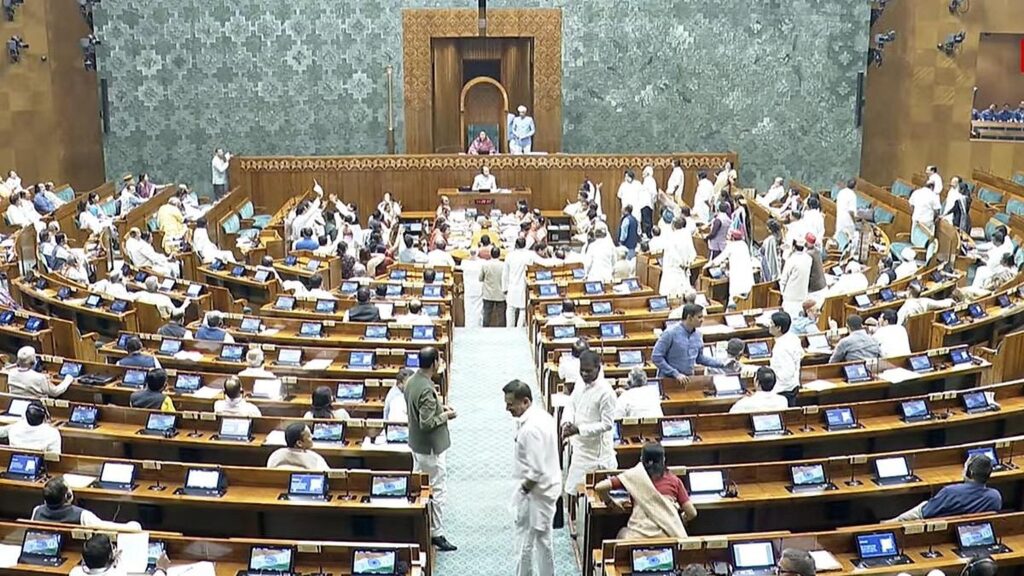
India’s Parliament witnessed tense scenes on March 10 as the Lok Sabha became the centre of a sharp political confrontation after opposition parties moved a resolution seeking the removal of Speaker Om Birla. The development unfolded during the ongoing Budget Session and triggered heated exchanges between members of the ruling coalition and opposition benches.
Opposition MPs accused the Speaker of bias in conducting proceedings, while government leaders rejected the allegations and defended his role. The House witnessed repeated disruptions as lawmakers raised slogans and demanded discussions on several issues, including developments in West Asia and electoral roll revisions in several states.
The day’s proceedings reflected growing tensions in Parliament as members from both sides exchanged sharp remarks during debates and protests continued inside the chamber.
Rare Motion
Congress MP Mohammed Jawed formally moved the resolution in the Lok Sabha seeking the removal of Speaker Om Birla. The motion alleged that the Speaker had failed to maintain the impartiality expected of the Chair during parliamentary proceedings.
According to parliamentary rules, the House agreed to allocate around 10 hours for debate on the resolution before any vote is taken. The motion was supported by around 118 opposition MPs, reflecting broad backing from several opposition parties.
Under Article 94 of the Constitution, the Speaker of the Lok Sabha can be removed by a resolution passed by a majority of members of the House. Such motions are uncommon in India’s parliamentary practice and require a formal discussion before voting.
No Lok Sabha Speaker has been removed through such a resolution since India became independent, making the procedure a rare development during the Budget Session.
Speaker Steps Aside
Om Birla did not preside over the Lok Sabha proceedings while the motion concerning his removal remained under consideration. Parliamentary convention requires that the Speaker step aside from the chair when a resolution seeking their removal is being discussed.
During the proceedings, other presiding members conducted the session. At different points during the day, BJP MP Jagdambika Pal chaired the House.
The arrangement allows discussions on such motions to take place without the Speaker occupying the chair.
Opposition Allegations
Opposition leaders said the motion was prompted by a series of disputes over parliamentary proceedings in recent sessions. Several opposition parties accused the Speaker of restricting the ability of their members to raise issues in the House.
Opposition MPs said the move was triggered by limitations on speaking time for opposition leaders, refusal to allow discussion on certain issues raised by opposition benches, and suspension of several opposition MPs during earlier sittings of Parliament.
Members also referred to incidents in which they said Rahul Gandhi had not been given sufficient opportunity to address the House during debates.
Government leaders rejected the allegations and said parliamentary rules had been followed in conducting proceedings.
Debate in Lok Sabha
During the debate on the motion, several opposition leaders addressed the House. Congress MP Gaurav Gogoi spoke in support of the resolution and questioned the neutrality expected from the Speaker’s office.
Members from both the treasury benches and opposition benches continued to exchange remarks during the discussion as the debate progressed.
Union Minister Kiren Rijiju criticised opposition leaders during his speech in the House. Referring to Rahul Gandhi, Rijiju said: “Have you seen any Leader of Opposition who runs to hug the Prime Minister?”
The comment referred to a previous parliamentary moment when Rahul Gandhi crossed the aisle and hugged Prime Minister Narendra Modi during a debate.
The remark triggered protests from opposition members and further exchanges across the aisle.
Mahua Moitra’s Remark
Another sharp exchange occurred during remarks by Mahua Moitra of the Trinamool Congress.
During her speech in the Lok Sabha, Moitra criticised the Speaker’s conduct and referred to earlier disputes involving her expulsion from Parliament.
“You can’t run away from karma,” she said during the debate.
Her remarks drew reactions from members across the aisle and added to the tense atmosphere in the House.
Slogans and Disruptions
The Lok Sabha witnessed repeated disruptions during the day as opposition MPs raised slogans during Question Hour. Members were heard shouting “vote chori” slogans while demanding discussions on several political issues.
The protests led to temporary adjournments of the House at different points during the proceedings. Parliamentary business slowed as members continued to raise their concerns when the House resumed after each adjournment.
Despite the disruptions, discussions on the motion and other matters continued during the session.
West Asia Issue Raised
Apart from the motion concerning the Speaker, several opposition parties demanded a discussion on developments in West Asia involving Iran and Israel.
Lawmakers said the conflict could have implications for global oil prices and the safety of Indian nationals working in the region.
India’s External Affairs Minister Subrahmanyam Jaishankar addressed Parliament and said the government was closely monitoring developments.
He said India’s priority remained the safety of Indian citizens abroad and maintaining stability in the region.
Rajya Sabha Debate
In the Rajya Sabha, Leader of Opposition Mallikarjun Kharge raised concerns over the Special Intensive Revision of electoral rolls in several states.
Kharge criticised the process and described it as “fraud” during his remarks in the Upper House.
The issue was raised as part of wider discussions during the ongoing Budget Session of Parliament.
Budget Session Continues
The developments occurred during the second phase of Parliament’s Budget Session, which resumed on March 9 after a recess. The Union Budget for the 2026–27 financial year had been presented earlier in the session.
During the current phase, the Lok Sabha also approved amendments to the Insolvency and Bankruptcy Code and the Companies Act, 2013, relating to corporate procedures and insolvency resolution timelines.
Further discussions on the motion concerning Om Birla and other parliamentary matters are expected to continue as the Budget Session proceeds in the coming weeks.


