

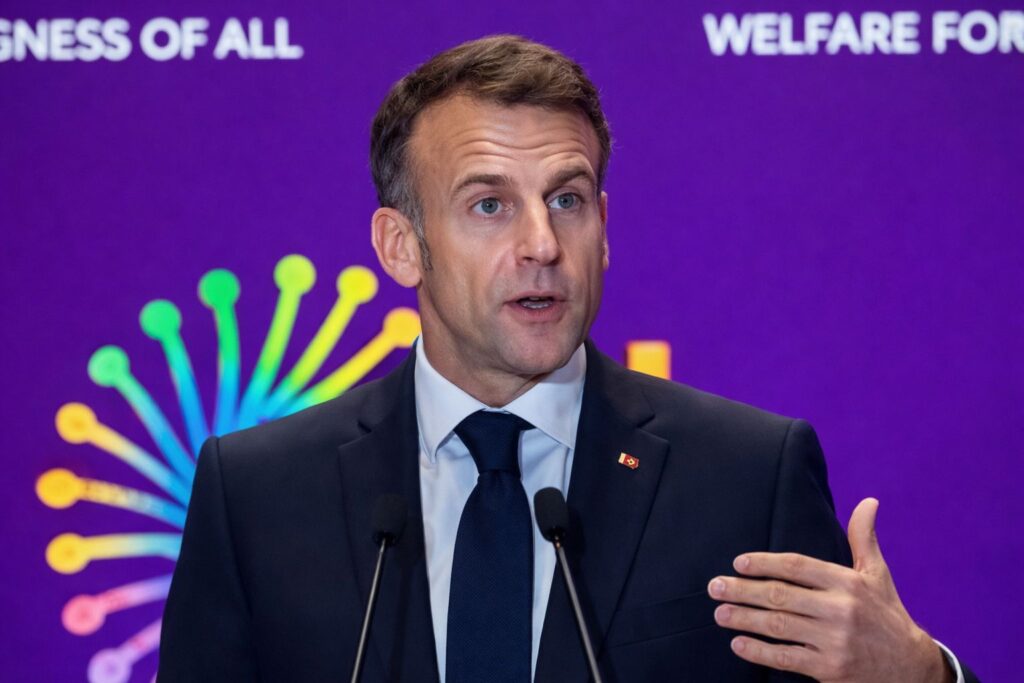
French President Emmanuel Macron said India’s demand to co-produce Rafale fighter jets and undertake greater maintenance responsibility is “legitimate,” publicly endorsing New Delhi’s push for deeper industrial participation as talks advance on a potential 114-aircraft deal.
“India wants to co-produce Rafale and handle more maintenance, which is legitimate,” Macron said, underlining that such ambitions reflect the evolving nature of defence partnerships.
His remarks come as India seeks to restructure major arms acquisitions around domestic manufacturing and long-term strategic autonomy.
Summit Remarks
Macron made the comments during interactions on the sidelines of high-level engagements in Paris, where he framed India’s request as part of a broader historical shift.
“It is in the direction of history,” he said, referring to countries seeking greater control over production and sustainment of critical defence platforms.
The statement represents one of the clearest political signals from Paris that France is open to expanding industrial cooperation beyond traditional export models.
114-Jet Plan
India is pursuing the acquisition of 114 multi-role fighter aircraft to address declining squadron strength in the Indian Air Force. The Rafale, built by Dassault Aviation, is considered a leading contender.
Unlike the 2016 agreement for 36 aircraft delivered in flyaway condition, the new programme places heavy emphasis on domestic manufacturing. Officials familiar with the discussions say India expects a majority of the aircraft to be produced locally if Rafale is selected.
Macron’s public backing strengthens France’s position in the competition while aligning with India’s localisation policy.
Maintenance Demand
India has also sought expanded control over maintenance, repair and overhaul operations. Lifecycle support represents a significant share of total fighter aircraft costs and directly impacts fleet readiness.
Macron acknowledged this dimension, stating that India’s desire to manage more of the maintenance ecosystem is justified.
“If India wants more responsibility in production and maintenance, it is understandable,” he said.
Industry executives say expanding maintenance capabilities in India would reduce turnaround times and improve operational availability.
Engine Talks
Discussions are also understood to include deeper cooperation in engine manufacturing and assembly. French engine maker Safran has previously expressed willingness to expand industrial partnerships in India, including local sourcing of components.
While sensitive propulsion technologies remain tightly controlled, phased manufacturing models are reportedly under consideration.
Any agreement on engine collaboration would mark a significant milestone for India’s long-term aerospace ambitions.
Naval Variant
India is separately evaluating the Rafale Marine variant for deployment on its aircraft carriers. A decision in favour of the naval version would broaden industrial cooperation and potentially standardise logistics across services.
A combined air force and navy framework could increase economies of scale and deepen technology integration.
Strategic Context
India and France have steadily expanded defence ties over the past decade, conducting joint exercises and increasing coordination in the Indo-Pacific.
France views India as a key strategic partner in maintaining regional stability. Macron’s remarks reinforce that alignment.
By endorsing co-production, Paris signals flexibility in adapting to India’s self-reliance policy under Atmanirbhar Bharat.
Industrial Stakes
Co-producing Rafale aircraft in India would generate high-skilled employment and integrate Indian suppliers into global aerospace supply chains.
For France, deeper localisation could secure long-term production stability and reinforce its footprint in one of the world’s largest defence markets.
The potential 114-jet programme is widely viewed as one of the most significant fighter aircraft deals currently under discussion globally.
Political Signal
Macron’s direct endorsement elevates the issue from technical negotiations to political commitment.
His statement suggests that France is prepared to explore a more collaborative industrial model, provided safeguards around proprietary technologies are maintained.
For India, securing co-production and expanded maintenance rights would mark progress toward reducing long-term dependency on foreign suppliers.
Negotiations Ahead
Despite the positive tone, negotiations remain complex. Technology transfer frameworks, cost structures and intellectual property protections must be agreed before any final contract is signed.
Defence procurement of this scale typically involves prolonged talks between governments and industry stakeholders.
Macron’s remarks, however, provide political momentum.
“India’s ambition is legitimate,” he said, reiterating France’s openness to deeper cooperation.
Whether that endorsement translates into binding industrial commitments will depend on the outcome of negotiations in the months ahead. But for now, Paris has publicly acknowledged India’s demand for a larger role in producing and sustaining one of the world’s most advanced fighter aircraft.readiness.


