

A young Kuki‑Zo tribal woman, who survived a brutal gang rape amid Manipur’s ethnic violence in May 2023, died on 10 January 2026 without seeing justice, prompting renewed calls from tribal organisations and political groups for accountability and systemic reforms.
The woman, then 18 when assaulted, lived with severe physical injuries and psychological trauma for almost two years before succumbing to prolonged health complications, according to family members and community sources. Despite filing a First Information Report (FIR) and the case being transferred to the Central Bureau of Investigation (CBI), authorities have yet to identify or arrest suspects, highlighting persistent concerns about the handling of sexual violence cases in the state.
Abduction and Assault During Ethnic Violence
The attack occurred amid one of the most prolonged episodes of communal unrest in Manipur’s recent history, triggered in early May 2023 by clashes between the Meitei community in the Imphal Valley and the Kuki‑Zo tribes from the hill districts. On 15 May 2023, the survivor was reportedly kidnapped from near an ATM in Imphal’s New Checkon area at gunpoint by four armed men while attempting to withdraw money, according to police records and eyewitness accounts.
In her FIR, she alleged that she was handed over to the attackers by members of a local vigilante group before being driven to multiple locations, including Langol and Bishnupur, where she was repeatedly gang-raped over several hours. During a July 2023 interview, she said she had been blindfolded, denied food and water, tortured throughout the night, and left for dead on a hillside, only managing to escape by pretending to relieve herself and fleeing downhill while injured.
After escaping, she was discovered lying by the roadside, severely injured. A local autorickshaw driver took her to a nearby hospital, where doctors provided emergency care before she was transferred to medical facilities in Nagaland and Assam, including Guwahati, for specialised treatment.
Medical Complications and Declining Health
Medical records and family statements indicate that the survivor never fully recovered from the effects of her ordeal. She suffered from uterine and internal injuries, breathing difficulties, recurring illnesses, severe pain, anxiety and depression as a result of her physical and psychological trauma. Her mother, Lhingnei Haokip, stated that her daughter was deeply affected physically and emotionally, becoming withdrawn and fearful following the assault and suffering from ongoing health problems that required frequent hospitalisation.
The Indigenous Tribal Leaders’ Forum (ITLF), a key tribal organisation, said she was treated in medical facilities across three states but continued to endure serious health issues linked to her injuries. Community leaders also noted that the emotional and mental toll, including insomnia and chronic stress, compounded her physical suffering, and she remained in a fragile state until her death.
FIR, CBI Probe and Lack of Arrests
Due to disrupted law and order during the conflict, the survivor was only able to file a Zero FIR on 21 July 2023, more than two months after the assault. A Zero FIR allows victims to lodge complaints at any police station irrespective of jurisdiction and is supposed to be forwarded to the appropriate authority for investigation. The Kangpokpi police station registered the FIR and transferred the matter to the CBI, which is now handling the investigation.
Despite the passage of nearly three years since the assault, neither the Manipur police nor the CBI has made any arrests, and no charges have been framed. Family members said they are unaware of any significant progress in the case, and authorities have not shared detailed updates on investigative developments. Civil society and tribal groups have repeatedly described this prolonged inaction as a failure of both policing and prosecutorial systems in addressing sexual violence during the ethnic unrest.
Community Outrage and Candlelight Vigils
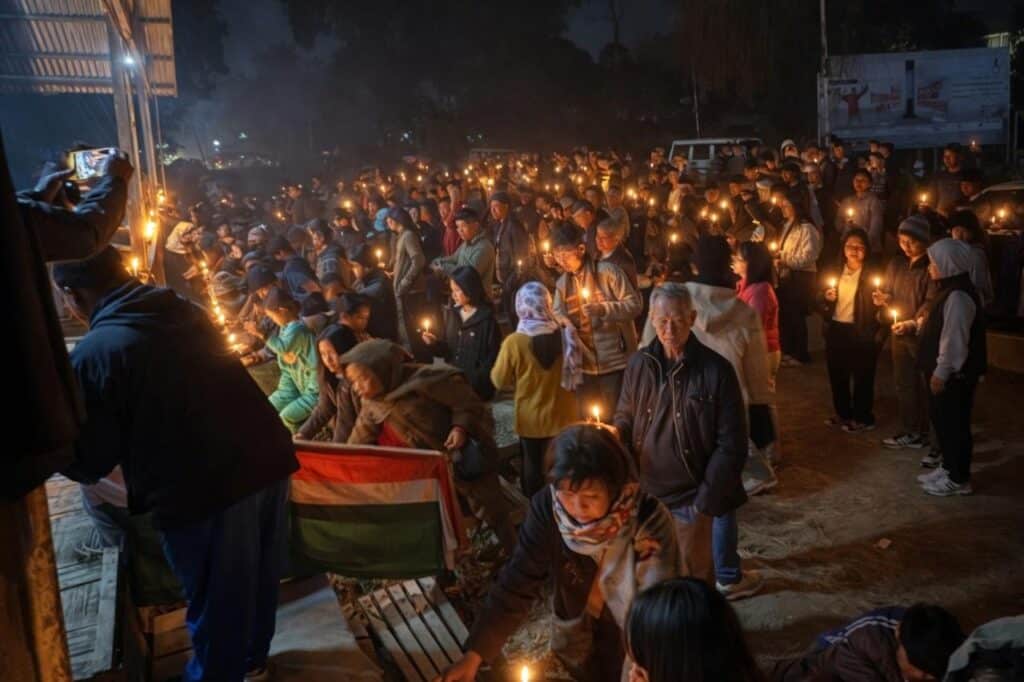
The woman’s death triggered vigils, protests and public statements of grievance from tribal organisations in Manipur and across the country. Groups including the Indigenous Tribal Leaders’ Forum (ITLF), the Kuki Students’ Organisation (KSO) and the Kuki‑Zo Women’s Forum held candlelight vigils in Churachandpur and Kangpokpi districts to honour her memory and press for justice.
Organisers of these gatherings reiterated long‑standing grievances about the targeting of Kuki‑Zo communities during the May 2023 violence and demanded that her death be officially recognised as a direct consequence of the ethnic clashes. The KSO’s Delhi and National Capital Region wing said that any official classification of her death as unrelated to the May 2023 violence would amount to “denial of justice and an erasure of responsibility.”
Several speakers at vigils also called on the federal government to expedite proposals for a separate administrative arrangement for tribal communities, arguing that coexistence under the current structure had become untenable. Community spokespeople said that delays in accountability and reparative action have deepened mistrust and fear among affected populations.
Political and Civil Society Reactions
Senior political figures addressed the case in public statements following the survivor’s death. CPI(M) leader and former Rajya Sabha MP Brinda Karat described the death as a “national shame”, stating that the survivor had been “victimised twice- first by politics that fuelled hatred and violence, and then by a system that failed to act with urgency.” Karat highlighted how nearly two years after the assault, the lack of justice underscored broader weaknesses in institutional responses to sexual violence.
Amnesty International India also commented on the case, describing the woman’s death as a “devastating indictment” of the state’s failure to deliver timely justice to sexual violence survivors in Manipur. The organisation called for “immediate, thorough, independent and impartial investigations” into allegations of sexual violence during the conflict, including accountability for negligent officials and reparations for survivors and their families.
Conflict Context and Human Rights Concerns
The assault and its aftermath occurred against the backdrop of prolonged ethnic clashes in Manipur that began on 3 May 2023. The conflict has killed at least 260 people and displaced more than 60,000, according to official statistics and media reports. Violence between valley-based Meitei communities and hill-based Kuki‑Zo groups has included killings, arson, looting, and reported use of sexual violence as a tactic of intimidation.
Human rights organisations have flagged the high incidence of sexual violence during the clashes and the low rate of prosecution as indicative of broader patterns of impunity. The survivor’s death without any arrests or legal closure has been cited by advocates as a stark example of how conflict-era sexual assault cases can languish without accountability, compounding trauma for victims and communities.
Case Status and Next Steps
As of January 2026, the case remains under investigation in a special CBI court in Guwahati, but no suspect has been arrested or formally charged. The survivor’s family and tribal organisations continue to press for transparent updates and a clear timetable for prosecution. Law enforcement agencies have not publicly disclosed new developments in the investigation, and requests for official comment from the Manipur Police and the CBI were not immediately answered by press time.


