

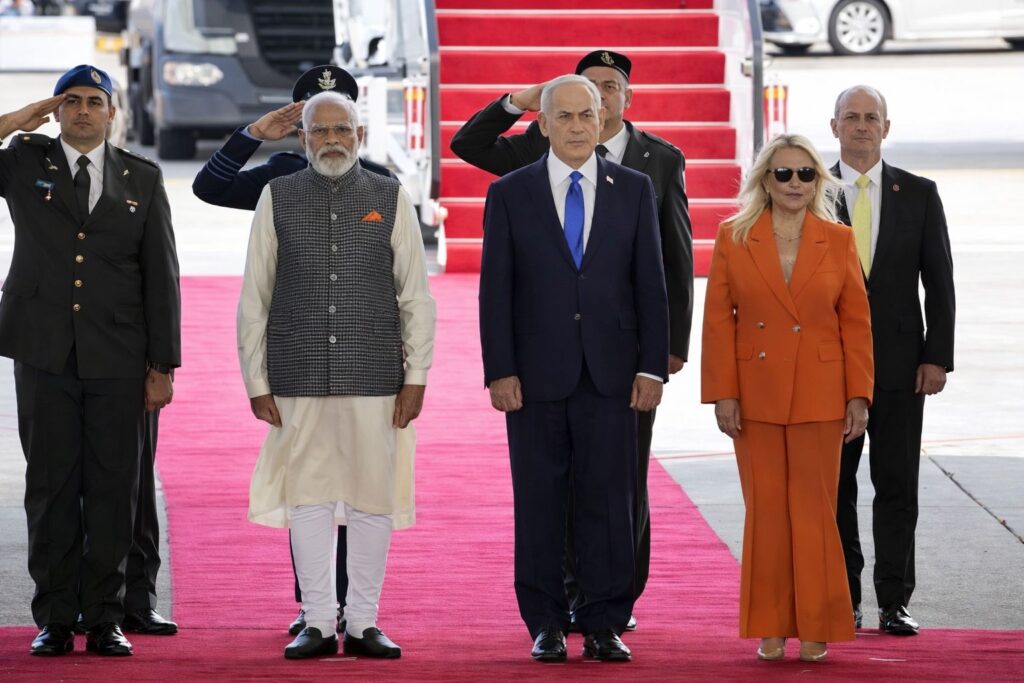
Prime Minister Narendra Modi held high-level talks with Israeli Prime Minister Benjamin Netanyahu in Tel Aviv on Tuesday, placing defence expansion, counter-terror coordination and the Gaza conflict at the centre of a visit both governments described as historic.
The Modi Israel visit comes at a moment of heightened regional instability, with Israel continuing military operations in Gaza and global powers divided over the trajectory of the conflict. Against this backdrop, New Delhi signalled a calibrated but firm deepening of strategic ties with Israel while reiterating its long-standing position on Palestinian statehood.
Ahead of departure, Modi set the tone for the visit, stating that it would “reaffirm the deep and long-standing strategic partnership between India and Israel.” He described bilateral ties as a “robust and multifaceted Strategic Partnership” that has “significantly strengthened in the last few years.”
“I look forward to discussions with Prime Minister Netanyahu to strengthen cooperation across diverse fields,” Modi said. He added that the visit would “set new goals for strategic ties and further strengthen cooperation across diverse domains including science and technology, innovation, defence, security, trade and people-to-people ties.”
Historic Address
A key highlight of the Modi Israel visit was his address to the Knesset, making him the first Indian Prime Minister to speak before the Israeli parliament. Indian officials described the address as a reflection of the maturity and transparency of bilateral relations.
Calling the opportunity an honour, Modi said addressing the Knesset symbolised “the strong parliamentary and democratic ties that bind our two nations.”
In his speech, he emphasised shared democratic values, innovation-driven growth and the need for coordinated responses to terrorism and emerging security threats.
Israeli President Isaac Herzog welcomed the Indian leader, stating: “Prime Minister Narendra Modi, the State of Israel and the people of Israel look forward to welcoming you to Israel.”
The optics of the address carried political weight, signalling sustained engagement despite ongoing hostilities in Gaza.
Defence Expansion
Defence cooperation formed the core of bilateral discussions. Israel remains among India’s leading defence suppliers, providing advanced missile systems, armed drones, radar platforms and electronic warfare technologies.
Officials briefed that both sides reviewed existing projects and discussed expanding joint research, development and manufacturing under India’s domestic production initiatives. Talks focused on co-development models aimed at reducing procurement timelines and increasing technology transfer.
Modi reiterated India’s “zero tolerance” stance on terrorism and called for global coordination against extremist networks. Netanyahu echoed that position, describing India and Israel as natural partners confronting similar security threats.
“India and Israel are partners in innovation, security and a shared strategic vision,” Netanyahu said ahead of the talks. He added that both nations are “building an axis of nations committed to stability and progress.”
Security officials indicated that cooperation in cyber defence, border surveillance and critical infrastructure protection will be further institutionalised through joint working groups.
Gaza Message
While defence dominated the agenda, the Gaza conflict shaped the diplomatic environment surrounding the Modi Israel visit. In public remarks, Modi called for the protection of civilians and stressed the need for humanitarian assistance to affected populations.
India reiterated its support for a negotiated two-state solution, advocating the establishment of a sovereign and viable Palestinian state living alongside Israel in peace and security.
Diplomatic sources said New Delhi conveyed concern over civilian casualties while condemning acts of terrorism. The language reflected India’s effort to balance deepening ties with Israel against its historic support for Palestinian aspirations.
India has maintained diplomatic relations with both Israel and the Palestinian leadership for decades, voting in favour of Palestinian rights at multilateral forums even as defence ties with Israel have expanded significantly.
Trade and Innovation
Beyond security, the Modi Israel visit placed strong emphasis on economic and technological cooperation. Bilateral trade has crossed $10 billion annually, driven by defence, agriculture, diamonds, chemicals and advanced technology sectors.
Modi highlighted cooperation in “science and technology, innovation and trade” as key pillars of the partnership. Israeli expertise in water management and agricultural innovation has been integrated into projects across Indian states facing climate stress.
Business leaders from both countries participated in sectoral meetings aimed at expanding joint ventures in artificial intelligence, space technology and climate resilience.
Officials said both sides are exploring new frameworks to accelerate startup collaboration and research partnerships, particularly in cybersecurity and digital infrastructure.
Regional Context
The visit unfolds amid broader geopolitical shifts in West Asia. Israel’s military operations in Gaza have drawn international reactions, with calls for ceasefire and humanitarian corridors intensifying.
India has sought to maintain a consistent position: condemning terrorism while urging restraint and dialogue. Officials emphasised that closer engagement with Israel does not alter India’s established policy supporting Palestinian statehood.
Analysts view the Modi Israel visit as part of New Delhi’s doctrine of strategic autonomy, allowing it to engage with diverse regional actors including Gulf nations and Iran while pursuing its national interests.
West Asia remains critical to India’s energy security and diaspora interests, with millions of Indian nationals residing across the region. Stability in the region directly affects oil markets, shipping routes and remittance flows.
Political Signals
For Israel, the visit signals sustained engagement from a major emerging economy during a period of international scrutiny. Netanyahu underlined the personal rapport between the two leaders, noting that they remain in frequent contact.
For India, the visit reinforces Modi’s positioning of New Delhi as a decisive global actor capable of balancing strategic partnerships in a polarised geopolitical landscape.
In his pre-departure remarks, Modi expressed confidence that the visit would “add new momentum to the bilateral friendship between our nations” and “advance our shared vision for a resilient, innovative and prosperous future.”
Strategic Shift
The Modi Israel visit underscores the transformation of bilateral relations over the past decade from low-profile engagement to an overt strategic partnership encompassing defence, technology and high-level political coordination.
While India continues to advocate dialogue and a two-state resolution, the expansion of defence and innovation ties with Israel reflects a pragmatic recalibration driven by security needs and technological priorities.
Both sides agreed to sustain high-level political dialogue and fast-track agreements under discussion. Working groups will continue negotiations on joint production frameworks, research collaboration and security coordination.
As the Gaza conflict continues to reshape regional politics, India’s diplomatic balancing act will face continued scrutiny. The Modi Israel visit signals a clear strategic intent: deepen defence and technological cooperation with Israel while reaffirming commitment to dialogue and regional stability.
The coming months will test whether this calibrated approach can withstand the pressures of a volatile West Asian landscape. For now, the visit marks a significant milestone in India-Israel relations, defined by defence expansion, economic engagement and carefully articulated diplomacy.


