

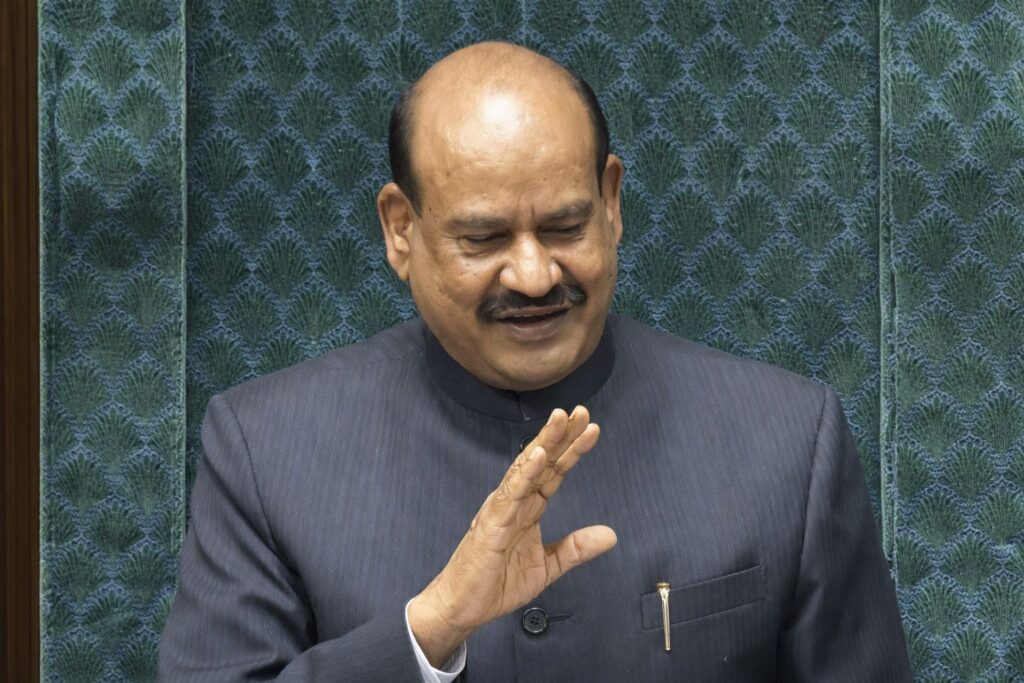
The Opposition on Tuesday escalated its confrontation with the government by submitting a notice of no-confidence against Lok Sabha Speaker Om Birla, an extraordinary step that has intensified the parliamentary standoff during the Budget Session. The move reflects a sharp erosion of trust between the Chair and Opposition parties, who accuse the Speaker of partisan conduct and of undermining established parliamentary conventions.
Sources said the notice has been backed by more than 100 Members of Parliament, comfortably crossing the constitutional threshold required for consideration. While the motion is unlikely to succeed due to the ruling alliance’s numerical dominance, its submission marks a rare attempt to place the functioning of the Lok Sabha itself at the centre of political contestation.
The government has dismissed the effort as symbolic and politically motivated. The Opposition insists the move is a constitutional intervention necessitated by what it describes as the systematic shrinking of space for dissent inside Parliament.
Why the Motion Was Filed
Opposition leaders say the no-confidence motion against Om Birla is the culmination of repeated grievances over the conduct of proceedings in the Lok Sabha. Central to their complaint is the alleged denial of speaking time to Leader of the Opposition Rahul Gandhi, including during major debates such as the Motion of Thanks to the President’s Address.
They have also objected to the suspension of Opposition MPs, frequent adjournments following protests, and what they describe as selective enforcement of parliamentary rules. Particular concern has been raised over the handling of remarks made by BJP MP Nishikant Dubey, which triggered protests from Opposition benches. Leaders argue that action was taken swiftly against Opposition members while similar scrutiny was not applied to ruling party MPs.
Another flashpoint has been claims made in the House suggesting that women MPs posed a threat to the Prime Minister. Opposition parties say such assertions were allowed to stand without adequate intervention from the Chair, further deepening concerns over neutrality.
Senior Congress leader K C Venugopal publicly signalled the Opposition’s intent a day before the notice was submitted. Criticising the functioning of the House, he said the Leader of the Opposition was being denied a basic right to speak. “As per parliamentary rules, the Leader of Opposition is a shadow Prime Minister. But here, the LoP is not being allowed to speak in the House,” Venugopal said.
He also accused the Speaker of bias, alleging that comments were made against Congress women MPs while the Opposition was denied space to respond. Referring to trade discussions with Washington, Venugopal said Rahul Gandhi sought to raise concerns over the US-India trade deal but was not permitted to do so. “The government wants to preserve the Parliament for itself,” he said.
Opposition leaders argue that these developments point to a broader pattern in which procedural authority is being used to manage debate rather than facilitate it.
Numbers, Process, Strategy
The notice was formally moved by Congress MPs Kodikkunnil Suresh and Mohammad Javed, who led the effort to secure support across Opposition parties. Sources said at least 118 MPs signed the motion, well above the minimum 55 required for a no-confidence notice against the Speaker to be admitted.
The signatories cited the denial of speaking time to Rahul Gandhi and the recent suspension of eight Opposition MPs as immediate triggers for the move. Parties such as the Samajwadi Party and the Dravida Munnetra Kazhagam have backed the motion. The Trinamool Congress, while sharing concerns about the conduct of proceedings, has indicated a preference for first submitting a formal appeal to the Speaker before escalating further.
Under Article 94(c) of the Constitution, the Speaker can be removed by a resolution passed by the Lok Sabha after a mandatory 14-day notice period. If admitted, the motion would require the support of a simple majority of the House to pass, meaning at least 272 votes in the 543-member Lok Sabha.
That arithmetic heavily favours the government. The ruling National Democratic Alliance holds more than 290 seats, making the passage of the resolution virtually impossible unless there is a dramatic break within the ruling coalition.
Acknowledging the numbers, Congress general secretary Jairam Ramesh said the motion was not about electoral arithmetic but about parliamentary principle. He invoked a 1954 precedent, recalling that Jawaharlal Nehru, despite commanding an overwhelming majority, allowed extended participation by the Opposition in debates. The reference was intended to underline the Opposition’s argument that procedural fairness does not depend on numerical strength.
Government Pushback
The government has sought to play down the development, framing the no-confidence notice as an exercise in political theatre. Parliamentary Affairs Minister Kiren Rijiju said the Opposition lacked the numbers to carry the motion and accused it of using procedural tools to prolong disruptions during the Budget Session.
Senior BJP leaders have rejected allegations of bias against the Speaker, arguing that repeated protests and disorderly conduct by Opposition MPs have forced the Chair to take disciplinary action. They maintain that Om Birla has acted strictly in accordance with the rules of the House and that the authority of the Speaker must be protected from politicisation.
Government sources said the notice would be examined according to established procedures and dismissed claims that the Speaker’s impartiality had been compromised. The ruling party has also accused the Opposition of attempting to divert attention from legislative business and economic priorities by manufacturing a confrontation over procedure.
Despite the government’s public confidence, the episode has added to perceptions of deepening institutional strain, with the role of the Speaker itself becoming a focal point of political conflict.
What the Standoff Signals
No-confidence motions against a Lok Sabha Speaker are constitutionally permissible but exceedingly rare, typically reflecting a severe breakdown in parliamentary trust. The move against Om Birla comes amid repeated adjournments, stalled legislative business, and mounting friction between the government and the Opposition.
For the Opposition, the motion serves to consolidate INDIA bloc coordination and shift the political narrative from legislative obstruction to democratic accountability. By targeting the Speaker, parties aim to argue that the logjam in the Lok Sabha is not merely a result of protest politics but of how authority is being exercised.
For the government, the challenge lies less in the outcome of the motion and more in managing the optics of a Parliament seen to be in permanent disruption. With key economic and legislative measures lined up during the Budget Session, continued deadlock risks overshadowing policy messaging.
Even if the motion does not proceed to a vote, its submission alone represents a significant escalation. It signals that the battle inside Parliament has moved beyond individual bills and speeches to the rules, roles, and authority that govern the Lok Sabha itself.
As proceedings continue, the confrontation over Om Birla’s conduct is likely to shape the tenor of the session, reinforcing a broader reality: the crisis in Parliament is no longer only about politics, but about the functioning of India’s central democratic institution.


