

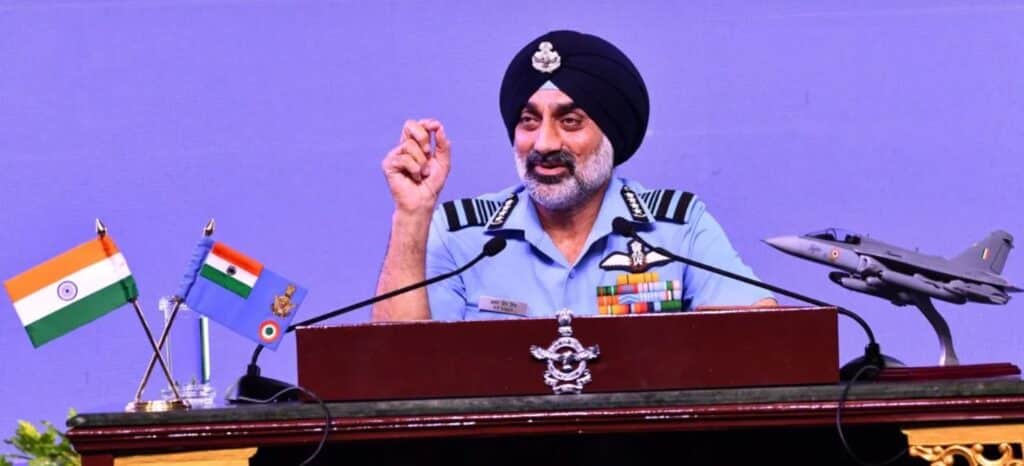
Air Chief Marshal A.P. Singh dismissed Pakistan’s claims in blunt terms, calling their version “Manohar Kahaniyan” and saying it’s more about saving face than reality. “Let them be happy — after all, they also have to show something to their audience to save their reputation. That doesn’t matter to me,” he said, adding that Pakistan has shown no evidence — no photos of wrecked hangars or hit runways — while India has publicly displayed images of Pakistani damage. Singh brushed off their boast that they shot down many IAF jets: “If they think they shot down 15 of my jets, let them think about it… I won’t say anything about what happened, how much damage was done, how it happened, because let them find out.”
Operation Sindoor: India’s Boldest Air Offensive Since Balakot
In a statement that has sent shockwaves through regional and global defence circles, Indian Air Force (IAF) Chief Air Chief Marshal (ACM) A.P. Singh confirmed that India downed five Pakistani fighters — of the F-16 and JF-17 class — during Operation Sindoor, executed in May 2025.
According to the IAF, the operation also saw precision strikes on Pakistani radars, command-and-control nodes, runways, and aircraft hangars, inflicting heavy damage on key strategic assets. Singh further indicated that Indian stand-off munitions damaged a C-130 transport aircraft and an Airborne Early Warning & Control (AEW&C) system, including at least one long-range strike beyond 300 km — a feat that signals a new level of reach and confidence in Indian airpower.
While Indian outlets have reported higher figures — between eight and thirteen Pakistani aircraft destroyed in air and ground engagements — Pakistani and China-aligned media have dismissed the claims as “implausible.” The fog of information warfare remains thick, but even conservative estimates mark Operation Sindoor as India’s most audacious and technologically advanced aerial action to date.
Why the F-16 and JF-17 Matter: Symbolism Beyond the Battlefield
The downing of U.S.-made F-16s and China-Pak co-developed JF-17s goes beyond combat — it’s a symbolic blow to the military reputations of Washington and Beijing. Both supplier states face renewed scrutiny over their export credibility and the survivability of their aircraft in contested airspace.
For New Delhi, this operation is a triumph of stand-off precision and Suppression/Destruction of Enemy Air Defences (SEAD/DEAD) capability. The IAF’s use of S-400 air defence systems and networked radar coverage reportedly outperformed expectations, raising questions about the Pakistan Air Force’s (PAF) sheltering tactics and airbase hardening.
India’s strategic messaging is clear: it now possesses credible deep-strike and counter-air power that can neutralize fourth-generation fighters while staying below the nuclear escalation threshold.
Geopolitical Shockwaves: A New South Asian Air Order
1.U.S.–India–Pakistan Triangle
The public mention of F-16s in ACM Singh’s remarks subtly pressures Washington, which now faces awkward questions about end-use compliance and spares support to Pakistan. Analysts expect quiet diplomatic backchannels from the U.S. to cool tensions while reviewing its future fighter support policies.
2. China’s Stake in the Game
The inclusion of JF-17s — jointly produced by China and Pakistan — raises eyebrows in Beijing. The losses may push China to bolster Pakistan’s intelligence, surveillance, and electronic warfare (ISR/EW) capabilities, while reassessing its aircraft’s combat survivability in face of Indian radar and missile systems.
3. Russia’s Strategic Win
India’s strong performance using Russian-origin S-400 air defence systems highlights the resilience of its multi-aligned defence posture — balancing U.S. ties with Moscow’s hardware. This underscores the emergence of a multipolar Asian security order, where India navigates alliances on its own terms.
Inside the Operation: Precision, Planning, and Power Projection
Sources within the Indian defence establishment reveal that ISR (Intelligence, Surveillance, Reconnaissance) played a central role. The strikes leveraged satellite-linked targeting, decoy drones, and stand-off precision-guided munitions exceeding 300 km range.
Targets such as AEW&C systems, C-130 aircraft, and radars were prioritized to blind and paralyse the Pakistani Air Force’s command structure early in the engagement. Indian planners aimed for a short, decisive, and bounded operation — and by all accounts, succeeded.
Pakistan’s response was limited, and a ceasefire understanding reportedly followed within days, underscoring both nations’ desire to avoid uncontrolled escalation.
Post-Sindoor Reality: Terror Camps Shift, India Stays Vigilant
Following the operation, terror camps across the border have reportedly shifted deeper into Pakistani territory, adopting smaller, concealed hideouts. The IAF, however, insists that these remain within strike range and under surveillance.
Defence experts believe Sindoor has forced Pakistan to rethink its air defence posture, with renewed focus on hardened shelters, counter-SEAD tactics, and rapid runway repair systems.
The Sky is No Longer the Limit
For India, the next frontier is integration and indigenization — faster production of homegrown AEW&C platforms, loyal wingman drones, and precision-guided munitions (PGMs), coupled with space-based ISR and cyber warfare integration.
Diplomatically, Sindoor’s message is unmistakable: India will act, not react. The world has seen a new India — one that’s strategically assertive, technologically confident, and unafraid to project power when provoked.
By downing Pakistani F-16s and JF-17s and striking deep into enemy territory, Operation Sindoor has sent a clear message to the world: India’s air dominance is not aspirational, it is operational — and the balance of power has shifted.


