

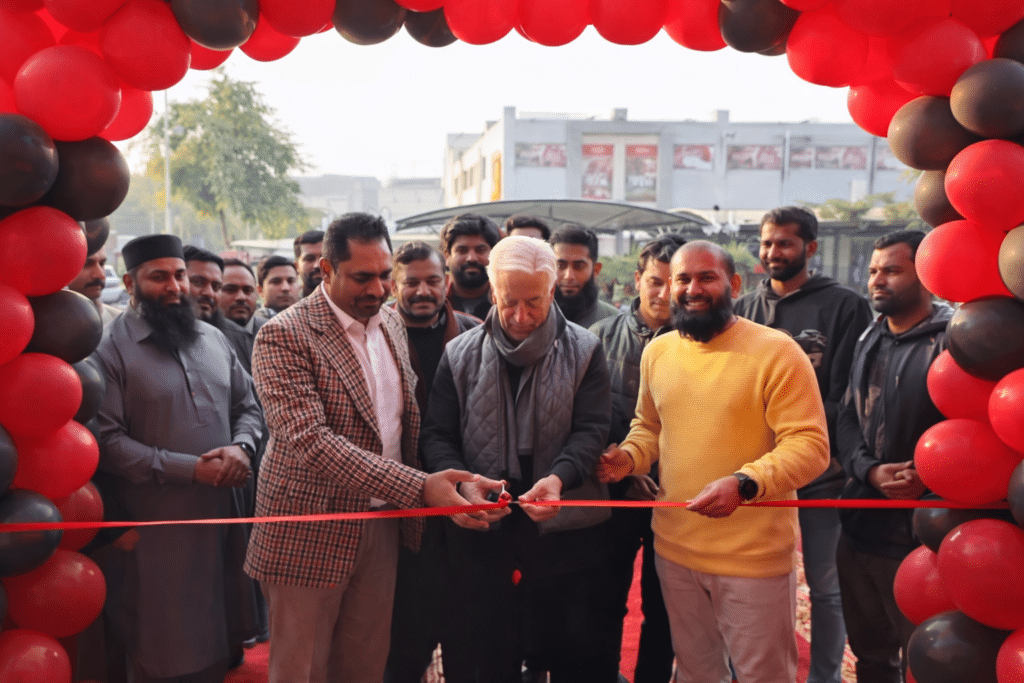
Pakistan’s Defence Minister Khawaja Asif inaugurated what was presented as a Pizza Hut outlet in Sialkot Cantonment on January 20, cutting a ribbon at a ceremony attended by local organisers and filmed for social media. Within hours, Pizza Hut Pakistan publicly disowned the outlet, declaring it unauthorised and accusing it of illegally using the brand’s name and trademarks.
The episode triggered a wave of ridicule online, raised questions about official verification and oversight, and prompted the multinational food chain to file a formal complaint with authorities.
The inauguration
Video footage from Sialkot shows Khawaja Asif standing at the entrance of the outlet, cutting a ceremonial ribbon beneath signage bearing Pizza Hut’s distinctive branding. The setting, visuals and format closely resembled official franchise openings commonly held across Pakistan.
The event appeared routine. Floral decorations were visible. The minister posed for photographs. The outlet was publicly presented as part of the global American pizza chain.
At the time of the inauguration, there was no public indication that the outlet lacked authorisation.
Brand disavowal
Shortly after images and videos circulated online, Pizza Hut Pakistan issued a public clarification, stating that the Sialkot outlet had no affiliation with Pizza Hut Pakistan or its parent company, Yum Brands.
The company said the establishment was “unauthorised”, was misusing the Pizza Hut name and logo, and did not follow official recipes, food safety standards, quality controls or operational protocols.
Pizza Hut Pakistan also confirmed that it had filed a complaint with the relevant authorities to stop the misuse of its trademark and to pursue action against those responsible.
The clarification immediately altered the context of the defence minister’s appearance, turning a ceremonial visit into a national controversy.
The legal angle
Trademark misuse involving international brands carries legal and regulatory consequences. By formally lodging a complaint, Pizza Hut Pakistan signalled that the issue extended beyond reputational embarrassment to potential violations of intellectual property law.
Such cases typically involve investigation into consumer deception, unauthorised branding and risks to public health where food standards are not regulated. The company’s statement made clear that customers should not associate the Sialkot outlet with its official operations.
Authorities have not yet publicly disclosed the status of the complaint.
Viral reaction
The incident spread rapidly on social media platforms, particularly X, where users shared side by side clips of the ribbon cutting and Pizza Hut’s disavowal.
The reaction was largely mocking and critical. Many questioned how a serving defence minister could inaugurate a branded outlet without basic verification. Others framed the episode as symbolic of broader governance failures.
Comments ranged from sarcasm to outright condemnation. Memes proliferated. Several users described the incident as an international embarrassment, while critics used it to attack the credibility of political leadership.
The ridicule crossed borders, with Indian users and media outlets amplifying the story and highlighting the irony of the situation.
Political silence
Despite the scale of the backlash, neither Khawaja Asif nor the Ministry of Defence issued a public statement explaining the circumstances of the inauguration or responding to the brand’s clarification.
The silence has drawn further criticism. Observers note that public officials routinely attend local inaugurations, but argue that the involvement of a senior cabinet minister in launching a globally branded outlet carries added responsibility.
Informal defences from political supporters suggested that ministers are not expected to verify business licences at local events. However, no official position has been articulated by the government.
Why Sialkot matters
The location of the incident has added to scrutiny. Sialkot Cantonment falls under military administration, typically associated with stricter regulatory oversight.
Critics have questioned how an unauthorised outlet using international branding was able to operate openly in a cantonment area and host a high profile inauguration without intervention from local authorities.
The issue has sharpened focus on institutional checks, particularly where civilian commercial activity intersects with sensitive administrative zones.
Due diligence debate
The episode has reignited debate in Pakistan about due diligence in public engagements. Ribbon cutting ceremonies are common, but critics argue that when officials lend their presence to private enterprises, especially those claiming affiliation with global brands, basic verification is essential.
Analysts note that in the digital age, optics matter as much as policy. What might once have been a minor local embarrassment can now escalate into a national and international issue within hours.
The incident has been cited as an example of how small lapses can undermine credibility at the highest levels.
Brand protection
For Pizza Hut Pakistan, the swift disavowal was aimed at protecting consumer trust and brand integrity. By distancing itself from the outlet, the company sought to ensure customers were not misled about the quality or safety of food being sold under its name.
International franchises operating in Pakistan have long struggled with imitation outlets and unauthorised branding. The public clarification underscored the company’s intent to enforce its rights.
Political fallout
While the incident has not triggered formal political action, it has become a reference point in broader criticism of governance standards. Commentators argue that such episodes reinforce perceptions of lax oversight and casual official conduct.
Supporters of the government have dismissed the controversy as exaggerated, but critics counter that symbolism matters, particularly when senior ministers are involved.
The lack of an official explanation has allowed the narrative to be shaped largely by social media reaction and corporate clarification.
A fast moving scandal
The sequence of events unfolded within a single day. A ribbon was cut. A brand disowned the outlet. A complaint was filed. A defence minister was mocked online across borders.
The speed of the fallout illustrates how quickly public appearances can backfire in a hyper connected media environment.
What remains is a lingering question over accountability, both for those who operated the unauthorised outlet and for the systems that allowed a senior government figure to be associated with it.


