

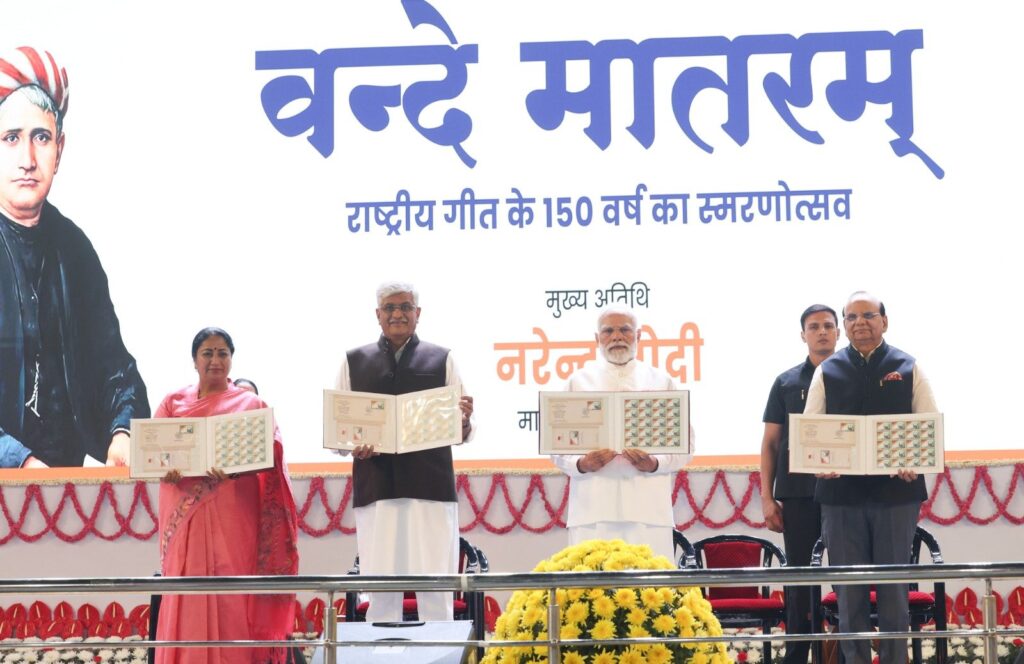
PM Modi led a significant cultural moment on November 7, 2025, when he inaugurated the 150th anniversary of Vande Mataram at the Indira Gandhi Indoor Stadium in New Delhi. The event marked the beginning of a year-long national celebration dedicated to revisiting the legacy, emotional power, and historical journey of India’s national song. In the presence of thousands, PM Modi participated in a mass ceremonial singing, accompanied by school choirs, youth organizations, classical musicians, and representatives from cultural academies across the country. The dignified ceremony also included the release of a commemorative postage stamp and a special ₹150 coin, symbolizing the song’s 150-year legacy. A major highlight was the launch of a National Citizen Participation Portal, built to encourage public involvement through cultural competitions, academic programs, and storytelling contributions.
Historical Legacy
Originally composed in 1875 by Bankim Chandra Chatterjee and later integrated into his novel Anandamath, Vande Mataram quickly became a rallying call of India’s freedom struggle. The song was sung in protest marches, whispered in underground revolutionary meetings, and echoed in prison yards. Leaders of India’s independence movement — including Bipin Chandra Pal, Subhas Chandra Bose, Lala Lajpat Rai, and countless unsung activists — drew strength from its words. In 1950, the Constituent Assembly officially recognized the first two stanzas as the National Song of India, acknowledging its timeless cultural resonance.
PM Modi’s Address
During his speech, PM Modi described Vande Mataram as “the heartbeat of a nation that refused to bow.” He emphasized that the song reflects not only patriotism but also a deeper civilizational identity rooted in heritage, spiritual continuity, and self-respect. He said:
“Vande Mataram is the sound of awakening. When the drums of foreign rule tried to silence our voice, this song taught India to rise again.”
This statement, widely shared across social media platforms, began trending soon after the event, resonating strongly with youth and cultural groups. PM Modi also reiterated that Vande Mataram must not be viewed only as a historic chant, but as a continuing expression of India’s confidence in its future.
The National Participation Portal
The newly launched citizen-engagement portal is central to the year-long celebration. Schools, universities, cultural clubs, and individual citizens will be able to take part in patriotic choir competitions, essay and art contests, regional music festivals, archival documentation projects, and oral history storytelling drives. Families of freedom fighters will be invited to share previously untold stories and personal memories, which will be digitally preserved for public record. The portal also includes a feature for communities to register local singing events, encouraging participation from villages, districts, and small towns. The intention is to revive the cultural presence of Vande Mataram at the grassroots level, rather than limit it to official ceremonies.
Political and Cultural Significance
This commemoration arrives at a time when conversations around national identity and cultural pride hold increasing relevance in India’s socio-political atmosphere. For the ruling government, celebrating Vande Mataram aligns with a broader commitment to re-centering indigenous voices, traditions, and narratives within public memory. While critics suggest that cultural symbols can also carry political implications, many scholars argue that such events strengthen civic awareness and re-engage younger generations with the story of the freedom struggle. Notably, leaders from both the government and the opposition, including Amit Shah and Mallikarjun Kharge, offered tributes, reflecting the song’s cross-party emotional influence.
A Continuing Voice
As thousands of voices rose together in the stadium, the moment felt both historic and immediate, a reminder that patriotism is not confined to the past but lives in collective memory and shared participation. The year-long initiative promises not only to honor history but to make it an active part of contemporary India, connecting generations through emotion, music, and a sense of belonging.
Vande Mataram endures not just as a song, but as a living affirmation of identity– a reminder that the soul of a nation is carried in the voices of its people!


