

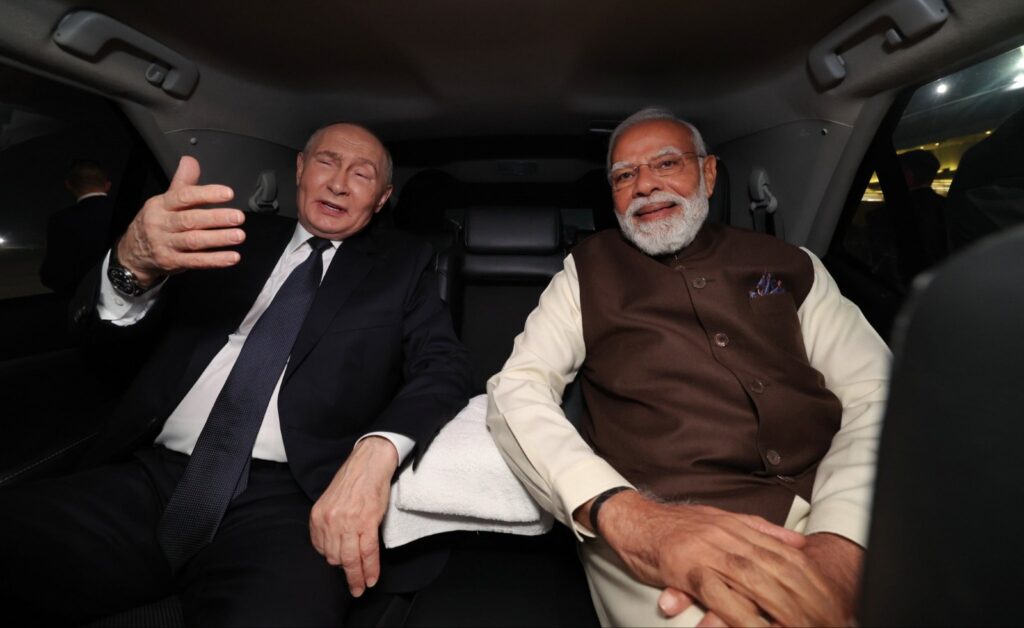
Vladimir Putin’s India visit began with a moment that instantly caught global attention Prime Minister Narendra Modi personally receiving Putin at the Delhi airport, followed by both leaders sharing the same car as they left together.
This rare gesture, now widely described as “car diplomacy,” set the tone for a summit loaded with strategic intent, signaling the depth of India–Russia ties at a time when the international landscape is sharply divided.
The visit marks the 23rd Annual India–Russia Summit and coincides with 25 years of their Strategic Partnership, underscoring a long-standing relationship now poised for a significant upgrade.
Strengthened Political Trust
The visit opened with a reaffirmation of the personal rapport between Modi and Putin. In a moment that drew wide coverage, Modi told Putin, “Since the Ukraine war began, we have spoken constantly. Like a true friend, you have kept us informed about everything that has been going on. Trust is a great strength.” This statement highlighted the steady communication between the two leaders despite global turbulence.
The two sides emphasised mutual respect, strategic autonomy and the importance of a stable multipolar world order. Indian officials described the meeting as a reaffirmation of long-term strategic thinking rather than a transactional engagement.
Defense Cooperation at the Core
Defense remains the strongest pillar of bilateral relations. Russia’s ratification of the Reciprocal Exchange of Logistic Support Agreement (RELOS) equips both nations with access to each other’s military facilities for joint operations, humanitarian missions and logistical movement.
This aligns with India’s long-term strategy of building a wider Indo-Pacific operational footprint while maintaining strategic autonomy.
India and Russia reviewed major defence platforms, including
- S-400 air defence systems (India has already received three units),
- the AK-203 assault rifle manufacturing project in Amethi,
- long-term maintenance for Russian-origin fighter jets and submarines,
- and technical discussions related to Russia’s Su-57 fifth-generation fighter.
Although no formal announcement on the Su-57 was made, the very inclusion of the topic reflects Russia’s willingness to explore high-end technology cooperation despite Western sanctions.
Russia remains India’s largest legacy defence supplier, responsible for nearly 60 percent of India’s military inventory.
Trade Rebalancing and the 2030 Economic Framework
Bilateral trade crossed USD 65–70 billion last year, driven largely by India’s import of discounted Russian crude oil, making Moscow India’s second-largest crude supplier.
However, the trade balance remains skewed. The new 2030 economic cooperation roadmap aims to rebalance this through diversified cooperation in
- manufacturing,
- pharmaceuticals,
- coal and mining,
- transport connectivity,
- and digital technologies.
Several agreements under negotiation include alternative payment mechanisms to reduce dependence on the US dollar, especially amid sanctions and the dollar-rupee-ruble settlement challenges.
The roadmap could become one of the most comprehensive economic frameworks between India and any major power.
Fertiliser Security and Strategic Agriculture
One of the most advanced joint projects is the proposed India–Uralchem fertiliser venture. The project includes establishing a urea plant in Russia with significant equity participation from Indian public-sector companies.
India imports nearly 85 percent of its urea requirements, making supply security critical. The joint venture is expected to
- stabilise prices for Indian farmers,
- reduce import dependency,
- and ensure long-term supplies during global fertiliser shortages.
For India’s agricultural economy, valued at over USD 400 billion, this forms a crucial strategic pillar.
Cooperation in Health, Skilled Labour and Culture
Beyond strategic sectors, both sides explored collaboration in
- healthcare,
- vaccine research,
- medical equipment manufacturing,
- and skilled labour mobility.
Russia has expressed interest in employing more Indian IT professionals, engineers and healthcare workers as its domestic workforce shrinks.
Modi gifted Putin a Russian-language edition of the Bhagavad Gita, symbolising cultural affinity and the shared civilisational heritage narrative both leaders often invoke.
Strategic Autonomy and Global Balance
India’s foreign policy posture was clearly visible during the visit. Despite Western pressure to distance itself from Moscow following the Ukraine conflict, New Delhi maintained its doctrine of strategic autonomy.
For India:
- Russia remains a vital source of energy, defence and nuclear cooperation.
- The long-standing partnership ensures multi-vector diplomacy free from bloc politics.
For Russia:
- India is one of the few major economies still maintaining robust engagement.
- It offers Moscow access to an enormous consumer market as Russia pivots further towards Asia.
The Path Forward
The success of the visit will hinge on converting the diplomatic momentum into measurable outcomes. Key areas to watch include the rollout of the 2030 economic roadmap, execution of the fertiliser joint venture, and progress in defence contracts. Improving rupee-ruble trade settlement mechanisms, expanding connectivity routes through the International North–South Transport Corridor (INSTC), and strengthening Arctic cooperation will also influence the trajectory of the partnership.
Putin’s India visit stands as a significant geopolitical moment. The personal chemistry between the leaders was evident, but the larger importance lies in the structural frameworks being established across defence, trade, agriculture and strategic sectors. If these commitments translate into action, the visit could mark a substantial reset in India–Russia relations, positioning the partnership for renewed relevance amid a rapidly shifting global order.


