

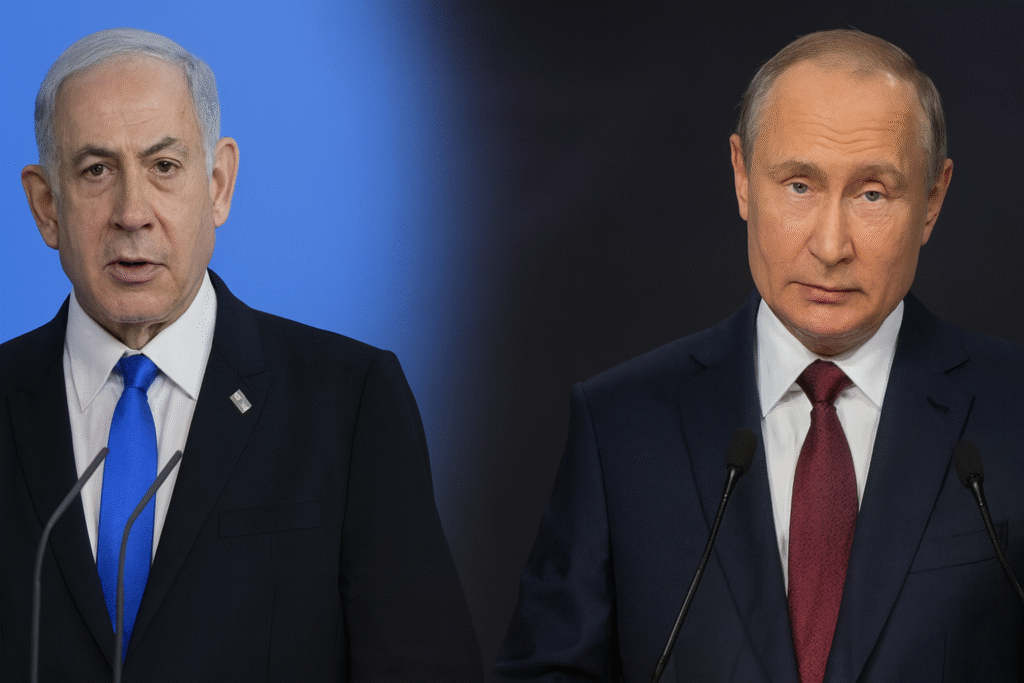
Putin and Netanyahu are shaping India’s diplomatic landscape as New Delhi prepares for a major engagement with Russia and simultaneously works with Israel to fix a new date for Prime Minister Benjamin Netanyahu’s postponed visit. Russian President Vladimir Putin is set to travel to India in early December, while Netanyahu’s visit, though delayed, remains firmly on the diplomatic calendar with both sides affirming the strength of their partnership.
Indian officials confirm that Putin’s visit is progressing with full momentum. Preparations are underway for what is expected to be one of the most strategic bilateral meetings of the year. Meanwhile, Netanyahu’s postponement, initially surrounded by speculation, has now been clearly explained by the Israeli government, which reaffirmed its confidence in India’s security and assured that coordination for a new date is already in motion.
Putin’s India Visit Takes Center Stage
Putin’s upcoming visit is a major geopolitical moment for New Delhi. As global power blocs harden and competition intensifies, Russia is seeking to deepen ties with nations that maintain independent foreign policies. India continues to uphold its principle of strategic autonomy, balancing relations with the West while preserving its long-standing partnership with Moscow.
The annual India Russia summit remains one of India’s most important diplomatic platforms. This year’s discussions are likely to cover defence upgrades, long-term energy supply agreements, expansion of nuclear cooperation, and new possibilities in space and navigation systems. Several of these discussions are expected to lead to concrete agreements or joint announcements.
Indian and Russian officials have been working closely to shape the agenda. Potential deals include technological collaboration in high-end defence manufacturing, support mechanisms for strategic equipment, expanded cooperation in advanced reactors, and long-term arrangements for Russian crude oil supplies at stable pricing. For Moscow, India remains a vital strategic partner in Asia. For New Delhi, Russia continues to be essential for defence preparedness and energy security.
Netanyahu Visit Postponed but Not Cancelled
Netanyahu’s December visit was postponed after internal assessments in Israel, which initially led to speculation linking the decision to India’s security situation. However, the Israeli government swiftly issued a strong clarification that clearly reaffirmed its trust in India.
The official statement from the Israeli Prime Minister’s Office said:“Israel’s bond with India, and between PM Netanyahu and PM Modi, is very strong. The Prime Minister has full confidence in India’s security under PM Modi. Both teams are already coordinating a new visit date.”
Indian officials also clarified that connecting the postponement to a specific incident in Delhi was inaccurate. Instead, Israel’s domestic political environment and scheduling factors played a larger role. This is the third time Netanyahu’s visit has been postponed in 2025, reflecting Israel’s internal dynamics rather than any political friction with India.
Despite the delay, the India Israel strategic partnership remains robust. Once rescheduled, the visit is expected to include progress in areas such as cybersecurity, intelligence collaboration, AI-driven defence innovation, missile technology, and agricultural technology. These areas align with India’s goals under Make in India and ongoing defence modernization.
What Deals Could Be Signed ?
Both visits have significant implications for India’s strategic interests and geopolitical posture.
With Putin, India is preparing to engage in high-value agreements across defence, energy, nuclear technology, and advanced manufacturing. Potential deals include modernisation of defence platforms, fresh supply-chain support for strategic systems, joint development in high-tech sectors, and long-term commitments for energy security. Cooperation in space technology, satellite navigation, and communication systems is also on the agenda.
From a geopolitical perspective, the Russia India partnership signals that India continues to operate as an independent actor in global politics. By engaging Russia while also strengthening ties with the United States, Europe, Israel, and key Asian nations, India reinforces its ability to maintain balanced relationships without being pulled into competing blocs.
On the Israel front, several agreements that were expected during Netanyahu’s visit remain active. These include collaborations in AI-enabled security systems, precision technology, counter-terror infrastructure, and agri-tech innovations. These deliverables remain ready for announcement once the visit is rescheduled.
Together, these developments reflect how India is positioning itself as a geopolitical bridge, capable of engaging nations with conflicting global priorities while safeguarding its own national interest.
Why These Two Visits Matters?
Putin’s visit reaffirms the long-term depth of the Russia India strategic partnership, which has remained resilient across decades of global change. Cooperation in defence, nuclear energy, space, hydrocarbons, and military technology continues to form the backbone of this relationship.
Netanyahu’s future visit represents India’s growing engagement with West Asia, where it has built strong ties with Israel, the UAE, Saudi Arabia, and other regional powers. This expanding presence supports India’s interests in energy security, counter-terrorism, digital innovation, and logistics.
By managing both engagements simultaneously, New Delhi showcases its ability to navigate complex global politics while preserving its diplomatic independence.
The Bigger Picture
India is expected to announce Putin’s final visit dates soon, along with details of key discussions on defence, energy and technology. At the same time, officials from both countries are working to finalise Netanyahu’s revised itinerary, which may shift to early 2026. Both engagements are set to drive progress in defence cooperation, high-tech partnerships and strategic trade.
These parallel developments highlight a crucial moment in India’s diplomacy. With Putin’s visit confirmed and Netanyahu’s visit rescheduled, New Delhi is managing two significant relationships that sit across different global power blocs. This reinforces India’s position as an independent, balanced and influential global player, and underlines its growing role in major geopolitical conversations.


