

India’s Parliament was plunged into disorder on February 2, 2026, after Leader of the Opposition Rahul Gandhi attempted to quote from an unpublished memoir by former Army chief General Manoj Mukund Naravane, triggering sharp objections from the government and forcing an adjournment of the Lok Sabha.
The confrontation unfolded during the debate on the Motion of Thanks to the President’s Address, when Mr Gandhi referred to excerpts attributed to Naravane’s memoir Four Stars of Destiny. The book, which remains under review by the Ministry of Defence, contains reflections on India’s military engagements with China, including the 2017 Doklam standoff and the 2020 eastern Ladakh crisis.
The government objected immediately, arguing that parliamentary rules do not allow references to unpublished material that cannot be verified or formally placed on record. The Speaker upheld the objection, setting off a political clash that highlighted deep divisions over national security, transparency, and the limits of parliamentary debate.
What Rahul Gandhi said
Mr Gandhi told the House that the excerpts he was quoting had already appeared in the public domain through a magazine article and were not speculative. Insisting on their authenticity, he said the passages were “100 percent genuine” and drawn from General Naravane’s own account.
As ministers repeatedly interrupted him, Mr Gandhi challenged the government’s reluctance to allow the quotes to be read aloud. “They say they fight terrorism, and they are afraid of one quote? What is there that they are so nervous about that I am not allowed to read it?” he asked, according to accounts of the proceedings.
He argued that the issue was not procedural but substantive, linking the memoir’s contents to questions of national security and India’s handling of China. Opposition MPs echoed his view, saying Parliament should not be prevented from discussing material that raises concerns about border management and strategic decision-making.
Government objections
The response from the treasury benches was swift and forceful. Defence Minister Rajnath Singh interrupted Mr Gandhi to ask whether the memoir had been published. When Mr Gandhi acknowledged it had not, Mr Singh said it could not be cited in Parliament.
Home Minister Amit Shah reinforced the objection, urging the Speaker not to allow references to material that had neither been officially released nor authenticated. He said permitting such quotations would set a dangerous precedent, particularly on issues involving national security.
Speaker Om Birla sided with the government, citing parliamentary convention that only published or verifiable documents can be quoted and placed on record. He ruled that excerpts from an unpublished book could not be read out in the House.
The ruling prompted protests from opposition MPs, including Samajwadi Party leader Akhilesh Yadav, who argued that if the content concerned national interest, it should be debated rather than blocked. Amid sustained shouting and repeated interruptions, the Speaker adjourned the Lok Sabha for the day.
Who is General Naravane
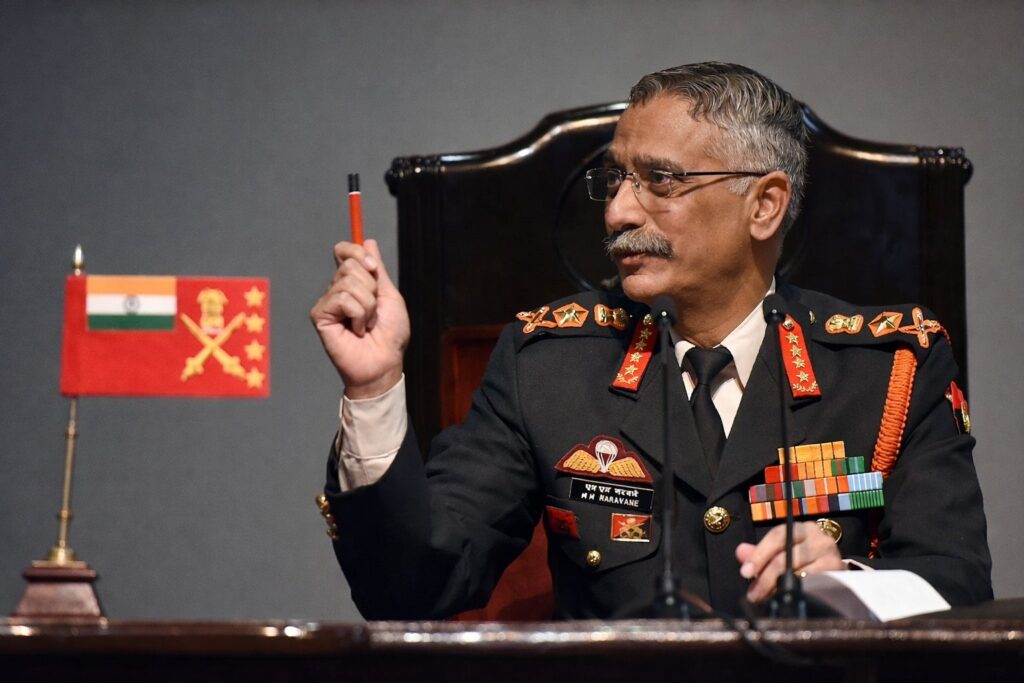
General Manoj Mukund Naravane served as India’s 28th Chief of Army Staff from December 2019 to April 2022, a period marked by heightened military tensions with China along the Line of Actual Control. A career infantry officer, he commanded troops across multiple theatres before rising to the Army’s top post.
During his tenure, the Indian Army was involved in managing the aftermath of the deadly Galwan Valley clash in June 2020 and in maintaining forward deployments across eastern Ladakh amid a prolonged standoff with Chinese forces.
Since his retirement, Naravane has largely stayed out of public controversy, though his forthcoming memoir has drawn attention because of its potential insights into civil-military relations and strategic decision-making during sensitive episodes.
The memoir at the centre of the storm
Titled Four Stars of Destiny, Naravane’s memoir was scheduled for publication in 2024 by Penguin. Advance listings briefly appeared online before being withdrawn. The book has not been banned but remains under review by the Ministry of Defence, a standard process for manuscripts by former senior military officials.
The author has said publicly that the delay lies with the clearance process rather than with him. Speaking earlier about the book, Naravane remarked that it was “maturing like aged wine” while awaiting approval, a comment that was later cited during the parliamentary controversy.
According to the publisher’s description and media reporting, the memoir traces Naravane’s four-decade military career and reflects on leadership, operational challenges, and India’s evolving security environment.
What the excerpts suggest
Although the full manuscript is not in the public domain, excerpts reported by magazines have indicated that the book touches on sensitive episodes involving China. These include references to Chinese military posture during the Doklam crisis and the Ladakh standoff.
During his speech, Mr Gandhi referred to a passage that he said described Chinese tanks positioned close to Indian defences in the Kailash range area. That claim became a focal point of the government’s objections, with ministers arguing that such details could not be discussed on the basis of an unpublished account.
Other reported excerpts suggest that the memoir reflects on the interaction between political leadership and the armed forces during moments of crisis, as well as on internal debates surrounding defence reforms such as the Agnipath recruitment scheme.
Because these passages have been circulated only in part, and without official clearance, both supporters and critics of the government have drawn sharply different conclusions about their implications.
The political stakes
The uproar over Naravane’s memoir goes beyond a procedural dispute. For the opposition, the episode was an opportunity to question the government’s handling of China and to argue that uncomfortable facts were being suppressed.
Outside Parliament, Mr Gandhi said the statements he was attempting to read were not his own views but those of a former Army chief. He accused the government of preventing both the publication of the book and a full parliamentary discussion on its contents.
The government, however, framed the issue as one of discipline and national security. Ministers stressed that allowing references to unpublished material could undermine established safeguards designed to prevent the disclosure of sensitive information.
Rules versus accountability
Parliamentary experts note that the Speaker’s ruling was consistent with convention. Unpublished documents cannot be authenticated, nor can they be formally incorporated into parliamentary records.
At the same time, the episode has reopened debate about how democratic institutions should handle sensitive information once it enters the public domain indirectly, through media reports or leaks.
Memoirs by retired military leaders often occupy a grey area, balancing personal recollection with institutional confidentiality. When such accounts intersect with live political debate, the tensions become harder to manage.
What happens next
There is no indication when Four Stars of Destiny will be cleared for publication. Until then, its contents are likely to remain a subject of political contention rather than public scrutiny.
For now, the Lok Sabha disruption has ensured that a book few have read has become a symbol of a larger struggle over who controls the narrative on national security, and how far Parliament can go in interrogating it.
What began as a reference to an unpublished memoir has ended as one of the sharpest parliamentary flashpoints of the session, underscoring how questions of China, military transparency, and political authority continue to collide at the heart of India’s democracy.


