

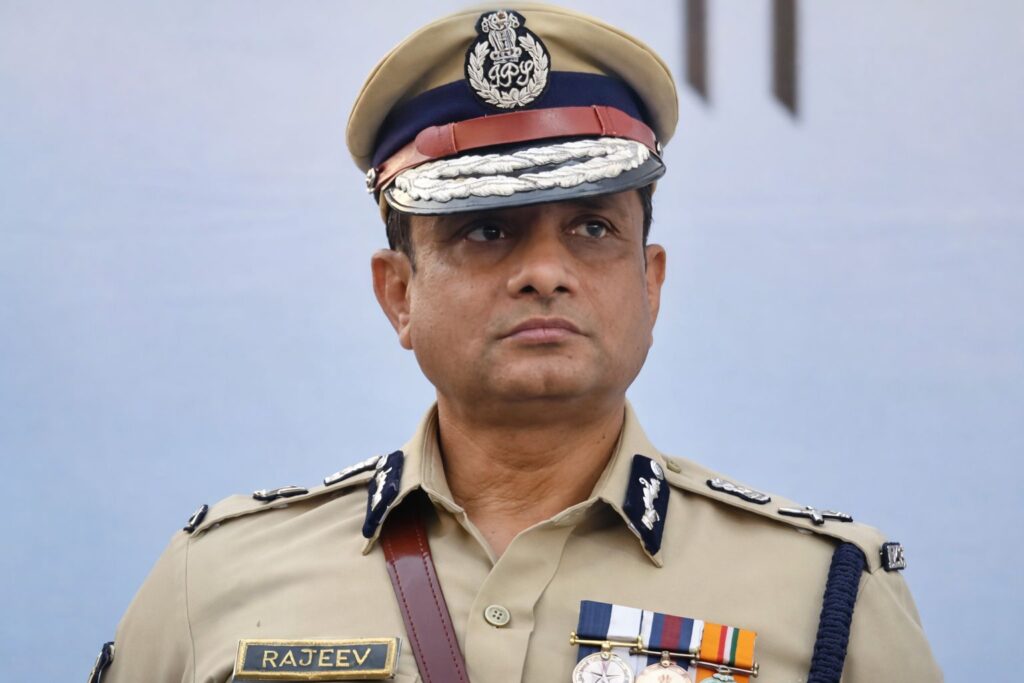
The nomination of former West Bengal Director General of Police Rajeev Kumar to the Rajya Sabha marks one of the most closely watched political decisions ahead of the 16 March 2026 elections to the Upper House.
Announced by the All India Trinamool Congress, Kumar’s candidature comes after a career that placed him at the centre of some of the most contentious confrontations between the West Bengal government and central investigative agencies. With five Rajya Sabha seats from West Bengal falling vacant and the Trinamool Congress holding a commanding majority in the state assembly, the party is widely expected to secure four seats, including Kumar’s.
The decision is being read not only as a political calculation but also as a statement of institutional confidence.
Official Announcement
The Trinamool Congress released the list of nominees through its official platform, stating:
“We are pleased to announce the candidature of Babul Supriyo, Rajeev Kumar (Former DGP, West Bengal), Menaka Guruswamy and Koel Mallick for the upcoming Rajya Sabha elections. We extend our heartfelt congratulations and best wishes to them. May they continue to uphold Trinamool’s enduring legacy of resilience and its unwavering commitment to safeguarding the rights and dignity of every Indian.”
Alongside Kumar, the party nominated Babul Supriyo, senior Supreme Court advocate Menaka Guruswamy and actor Koel Mallick. The selection replaced certain outgoing members, indicating a strategic reshaping of the party’s parliamentary presence rather than simple renomination.
Career at the Centre of National Attention
Rajeev Kumar’s tenure in the Indian Police Service spanned decades, culminating in his retirement as West Bengal’s DGP on 31 January 2026. Prior to that, he served as Kolkata Police Commissioner, overseeing law enforcement in one of India’s most politically active states.
His name entered national headlines during the investigation into the Saradha chit fund scam. In 2019, officers from the Central Bureau of Investigation sought to question him regarding evidence handling in the case. The move led to a dramatic standoff between state police and central investigators in Kolkata.
Chief Minister Mamata Banerjee publicly accused the Centre of misusing federal agencies. The matter reached the Supreme Court of India, which directed Kumar to cooperate with investigators while granting him protection from arrest. Kumar subsequently appeared before the CBI for questioning.
The episode became emblematic of broader tensions between the state government and the Centre, placing Kumar at the heart of a national debate on federalism and the autonomy of state institutions.
Presence During ED Searches
Kumar again drew attention when he was seen at premises linked to political consultancy operations during searches conducted by the Enforcement Directorate in connection with an alleged coal smuggling case.
Opposition leaders criticised his presence during the searches, questioning the propriety of a senior police officer being at such locations. Trinamool leaders defended him, asserting that his actions were consistent with his official responsibilities and oversight role at the time.
These episodes reinforced his image as a senior administrator operating in politically sensitive circumstances.
Political Reaction
The nomination triggered sharp responses from the Bharatiya Janata Party. Senior BJP leader Dilip Ghosh alleged that Kumar’s candidature was a reward for standing by Mamata Banerjee during confrontations with central agencies. He was quoted as saying that if Kumar accepted the nomination, it would prove he acted for political reasons rather than as an impartial administrator.
Trinamool leaders rejected the charge. A senior party source was quoted as saying that Kumar “has always been someone Mamata has trusted,” underscoring the confidence the leadership placed in him during periods of institutional strain.
Supporters within the party argue that Kumar’s experience during high-stakes investigations and federal disputes equips him with a practical understanding of governance that will be valuable in Parliament.
Administrative Record
As DGP, Kumar supervised law and order across West Bengal, including during elections, mass protests and high-profile criminal investigations. His tenure required coordination with central forces and engagement with judicial oversight.
Those close to the party describe him as an officer who maintained administrative continuity during volatile phases. His supporters contend that such experience brings operational insight to legislative discussions on internal security, policing reforms and Centre–state relations.
The Rajya Sabha frequently includes former civil servants and administrators. Kumar’s transition follows a pattern in which senior officials move from executive roles into legislative responsibilities.
Broader Slate and Strategy
The inclusion of Babul Supriyo, a former Union minister who joined the Trinamool Congress in 2021 and currently serves in the state cabinet, consolidates his standing within the party’s national strategy.
Menaka Guruswamy’s nomination signals an emphasis on constitutional expertise, given her record in significant Supreme Court litigation. Koel Mallick’s inclusion reflects cultural visibility and public recognition within Bengal.
Together, the nominees represent administration, law, politics and culture. Kumar’s presence, however, carries particular symbolic weight because of the institutional battles that defined his tenure.
Electoral Outlook
With the Trinamool Congress commanding a majority in the 294-member West Bengal Legislative Assembly, it has the numerical strength to secure four of the five Rajya Sabha seats from the state. The BJP is expected to win the remaining seat based on current arithmetic.
Unless cross-voting alters projections, Kumar’s election appears highly likely when voting takes place on 16 March.
Transition to the Upper House
If elected, Rajeev Kumar will enter Parliament after decades in uniformed service. His career has intersected with major investigative controversies, judicial proceedings and federal disputes. That experience will now shift into a legislative forum.
The nomination formalises a transition from state-level policing to national lawmaking. It places a former DGP, known for navigating high-profile institutional confrontations, within the constitutional framework of parliamentary debate.
As the election date approaches, attention will focus not only on the outcome, which appears predictable, but also on how Kumar’s administrative background shapes his contributions in the Upper House.


