

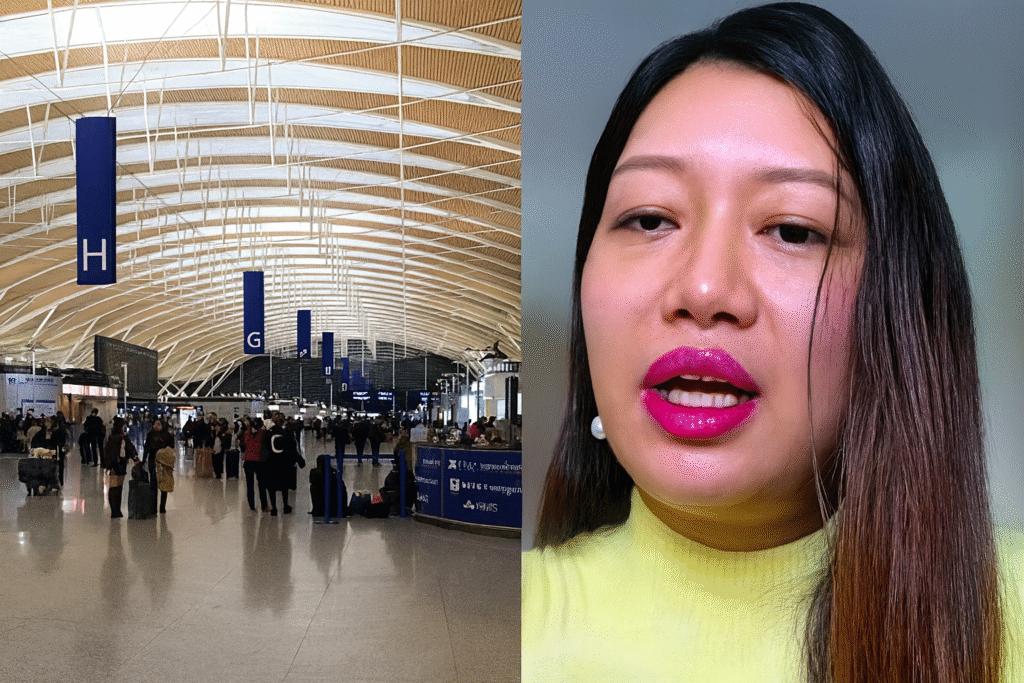
On 21 November, what should have been a routine international transit turned into a geopolitical flashpoint after Prema Wangjom Thongdok, a UK-based professional originally from Arunachal Pradesh, was unexpectedly stopped at Shanghai Pudong International Airport. She was travelling from London to Japan with a standard layover in Shanghai, a route she had taken without issue in the past. However, this time, airport authorities singled her out during document screening, questioning the validity of her Indian passport solely because it mentioned Arunachal Pradesh as her birthplace. What began as a brief delay swiftly escalated into an 18-hour detention, turning her personal journey into a full-scale diplomatic issue and intensifying already strained relations between India and China.
“Your passport is invalid. Arunachal is China”
According to her account, officers at the Shanghai airport told her that her Indian passport was “invalid” because it listed Arunachal Pradesh as her place of birth. She said the officials mocked her origin, questioned her nationality and insisted she should apply for a Chinese passport. Staff members allegedly repeated that “Arunachal is China”, refusing to accept her Indian identity.
Her passport was seized and she was prevented from boarding her connecting flight. She was placed in a restricted holding area and left without food for hours. Due to China’s heavily controlled digital environment, she could not access normal internet services and had no way to contact home directly.
In a post on X, she wrote:
“They detained me for hours, kept saying Arunachal not India and called my passport invalid. I was scared and exhausted but I knew I had done nothing wrong.”
Stranded until she reached Indian officials
Unable to communicate, she eventually managed to get a message through a friend abroad, who contacted the Indian Consulate in Shanghai. Consular officials arrived promptly, provided her with food and intervened directly with airport authorities. After prolonged discussions, her passport was returned and she was cleared to leave on a late-night outbound flight.
She later posted:
“I want to thank everyone who reached out and especially the Indian mission. In moments like these, you truly understand the strength of being Indian. We are one nation.”
Chief Minister condemns the incident
The incident prompted a strong reaction from the Chief Minister of Arunachal Pradesh. In a public statement, he wrote that he was “deeply shocked by the unacceptable treatment of Prema Wangjom Thongdok, a proud Indian citizen from Arunachal Pradesh.” He added that subjecting her to humiliation and racial mockery despite holding a valid Indian passport was “appalling.” He reaffirmed that Arunachal Pradesh “is and will always be an integral part of India” and called the conduct a violation of international norms and “an affront to the dignity of our citizens.” The Chief Minister expressed confidence that the Ministry of External Affairs would take up the matter urgently to ensure such incidents are not repeated.
China denies accusations
Chinese authorities firmly denied that any harassment took place, insisting that immigration officers at the Shanghai airport acted strictly in accordance with established laws and verification procedures. A spokesperson stated that the passenger was given “necessary assistance, including rest, food and water” and that additional checks were required due to what they described as “discrepancies related to her place of birth.”
The official reiterated China’s long-standing position by saying that the region listed on her passport falls under what China considers its own territory. They explained that “documents mentioning areas belonging to China require standard administrative scrutiny.” This response aligned with Beijing’s continued assertion that Arunachal Pradesh is part of its domain, a stance that has repeatedly clashed with India’s territorial claims and added to rising diplomatic sensitivity surrounding the incident.
India issues a strong diplomatic protest
India issued a formal protest, calling the detention unjustified, unacceptable and a violation of international transit norms. Officials stressed that Arunachal Pradesh is an integral part of India and that no authority has the right to question the nationality of Indian citizens based on their state of origin. Indian representatives demanded accountability and assurances to prevent similar incidents in the future.
A reflection of deepening geopolitical tension
This incident in Shanghai reflects the broader context of the India–China border dispute. China has repeatedly tried to push its territorial narrative by renaming places, altering official maps and issuing alternative travel documents for residents of Arunachal Pradesh. Detaining a civilian in transit marks a new and concerning escalation.
Diplomatic observers suggest the episode may be part of a gradual strategy to undermine India’s territorial stance by challenging the legitimacy of documents issued to people from the region.
Human impact of unresolved borders
For Prema Wangjom Thongdok, the experience was both traumatic and revealing. Her public posts struck a chord nationwide, drawing attention to the difficulties faced by people from India’s northeastern states when dealing with regions that do not recognise their identity.
She reiterated her pride in her nationality, stating:
“No matter what anyone says, Arunachal is India and I am Indian.”
What this incident signals for the future
The Shanghai detention raises important questions about aviation protocols, the treatment of travellers in transit and the broader implications of geopolitical tensions spilling into civilian spaces. Analysts predict that the matter will influence upcoming diplomatic discussions between India and China, particularly those concerning border management and civilian movement.
For now, the 18-hour ordeal stands as a stark reminder that territorial disputes are not confined to official negotiations. They can surface unexpectedly, disrupt the lives of ordinary travellers and intensify international tensions with a single incident.


