

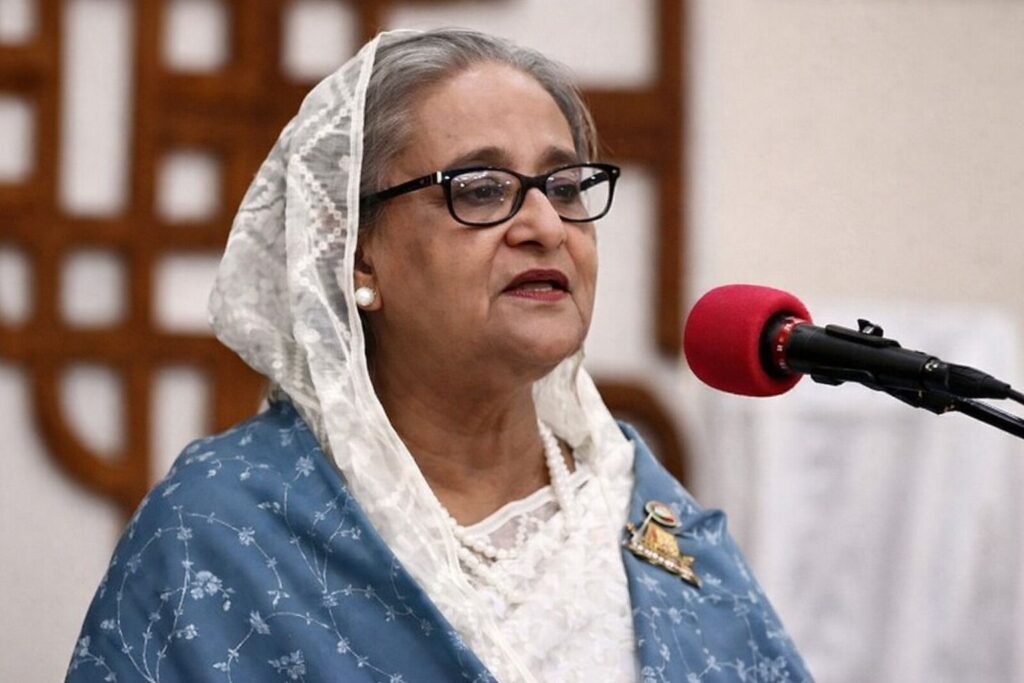
Sheikh Hasina has re-entered Bangladesh’s political battlefield with her most incendiary public intervention since leaving office, delivering a fierce audio address from exile at New Delhi’s Foreign Correspondents’ Club. In a speech that blends defiance, alarm, and political mobilisation, the former prime minister launched a blistering attack on Nobel laureate Muhammad Yunus and the interim leadership now steering Bangladesh toward elections.
Her remarks have reignited national and international debate over governance, legitimacy, political violence, and the country’s democratic trajectory at a moment of deep uncertainty.
A Speech From Exile
Hasina did not appear in person at the event, instead delivering a recorded audio message that underscored her status outside Bangladesh amid ongoing political and legal pressures. The address marked her first major public statement since leaving power, transforming what might have been a symbolic return into a strategic political intervention.
Speaking to diplomats, foreign correspondents, and policy observers, Hasina framed her message as a warning to the Bangladeshi people and the global community. She accused the interim leadership of dismantling democratic order and plunging the country into fear, instability, and lawlessness.
A Scathing Attack on Yunus
At the heart of Hasina’s speech was an extraordinary personal and political assault on Muhammad Yunus, whom she described as a “murderous fascist”, a “bloody fascist”, a “money launderer”, and a “power-hungry traitor.” She accused him of exploiting moral credibility while presiding over what she portrayed as a breakdown of governance.
“What Yunus runs today is not a government,” Hasina declared. “It is anarchy disguised as reform.”
She alleged that the interim leadership lacks democratic legitimacy and has failed to control violence, protect citizens, or maintain institutional stability.
Call to Remove Interim Government
In a striking escalation, Hasina urged the people of Bangladesh to rise against the Yunus-led administration, calling for its removal in the spirit of the country’s 1971 Liberation War.
“People must stand up and overthrow this illegitimate regime,” she said, invoking nationalist rhetoric and framing resistance as a patriotic duty.
This shift from criticism to mobilisation signals Hasina’s intent to remain a central political force, despite being out of power and physically outside the country.
Allegations of Violence and Abuse
Hasina accused the interim leadership of presiding over widespread violence, including torture, sexual abuse, and attacks on women and vulnerable groups. She alleged that law enforcement has failed to prevent abuses and that political opponents, minorities, and civil activists face growing danger.
“There is torture. There is sexual violence. There is fear everywhere,” she said.
These claims echo broader concerns raised by rights organisations, although critics note that allegations of repression and rights abuses were also directed at Hasina’s own administration during her years in office.
Minorities and National Security
A significant portion of Hasina’s address focused on the safety of religious and ethnic minorities. She claimed that attacks on minority communities have intensified since her departure and accused the interim authorities of failing to uphold constitutional protections.
“An open season has been declared on minorities,” she said.
She contrasted this with her own record, arguing that her government ensured stability, maintained communal harmony, and enforced a zero-tolerance policy on extremist violence.
Defending Her Political Legacy
Hasina portrayed her tenure as a period of national progress, economic expansion, and firm counter-terrorism policies. She cited infrastructure development, economic growth, and internal security measures as evidence of her leadership credentials.
Supporters credit her administration with modernising Bangladesh and strengthening its regional standing. Opponents, however, argue that this stability came at the cost of press freedom, opposition rights, and electoral competitiveness.
Her speech reflected an attempt to reshape historical narratives by positioning herself as a guardian of order in contrast to what she characterised as chaos under Yunus.
Hasina’s Five Key Demands
Hasina outlined a structured political agenda that included demands for the removal of the interim government, an immediate end to political violence, protection for minorities and women, cessation of what she described as politically motivated arrests, and the launch of an international investigation under United Nations oversight.
These demands signal a transition from rhetoric to political strategy, aimed at both domestic mobilisation and international engagement.
Accusations of Foreign Influence
Hasina alleged that the current leadership is acting under foreign influence and accused Yunus of undermining Bangladesh’s sovereignty. She warned that national interests are being compromised and suggested that external actors are shaping the country’s political direction.
“They are selling the country’s future,” she said, framing the crisis as both a domestic and geopolitical threat.
This narrative reinforces nationalist sentiment while deepening suspicions about the interim authority’s independence.
Liberation War References
Throughout the speech, Hasina invoked the legacy of her father, Sheikh Mujibur Rahman, and the 1971 Liberation War, framing her political struggle as a continuation of Bangladesh’s founding ideals.
Referencing slogans such as “Joy Bangla,” she cast her party, the Awami League, as the historical custodian of independence and national unity.
By linking contemporary politics to liberation-era symbolism, Hasina sought to rekindle emotional loyalty among supporters and position herself as a protector of Bangladesh’s founding identity.
Election Timing and Rising Stakes
The timing of Hasina’s speech comes just weeks before Bangladesh’s expected national elections, intensifying political tension over fairness, participation, and legitimacy. She argued that credible elections cannot occur without the Awami League’s involvement and warned that the current framework risks producing a contested outcome.
“The people deserve free and fair elections,” she said. “Not a staged process under an unelected regime.”
International observers are watching closely amid concerns about electoral integrity and political stability.
India’s Diplomatic Role
Hasina’s decision to deliver her address from New Delhi highlights India’s complex role in Bangladesh’s political equation. While India has historically maintained strong ties with her administration, Dhaka’s interim leadership has reportedly sought her extradition, a request that New Delhi has not publicly acted upon.
Her presence in India adds a diplomatic dimension to the unfolding crisis, raising questions about regional influence, asylum politics, and South Asia’s strategic balance.
A Political Comeback Moment
Political analysts interpret Hasina’s speech as more than a protest statement. It marks a calculated effort to reassert authority, rally supporters, and frame the national narrative ahead of critical political developments.
By blending nationalist symbolism, allegations of abuse, and direct calls for resistance, Hasina is positioning herself as both a former leader and an active challenger to the current power structure.
Yunus and Interim Government
As of now, Muhammad Yunus and the interim administration have not issued a detailed response to Hasina’s remarks. The leadership has previously defended its role as necessary to stabilise the country and oversee a democratic transition.
Whether Yunus chooses to confront Hasina’s accusations directly or maintain a low-profile strategy may shape the tone of the coming weeks.
Bangladesh at a Crossroads
Bangladesh stands at a defining political crossroads. With elections approaching, institutions under strain, and rhetoric intensifying, the country faces urgent questions about legitimacy, governance, and national cohesion.
Hasina’s return to public discourse has sharpened these debates, transforming her exile into a platform for renewed political influence.
“History will judge,” she said. “Some as protectors of the nation, and others as the ones who let it fall apart.”
Whether that judgment ultimately favours her vision or her critics will depend not on speeches, but on the credibility of Bangladesh’s democratic process and the stability of its institutions in the months ahead.


