

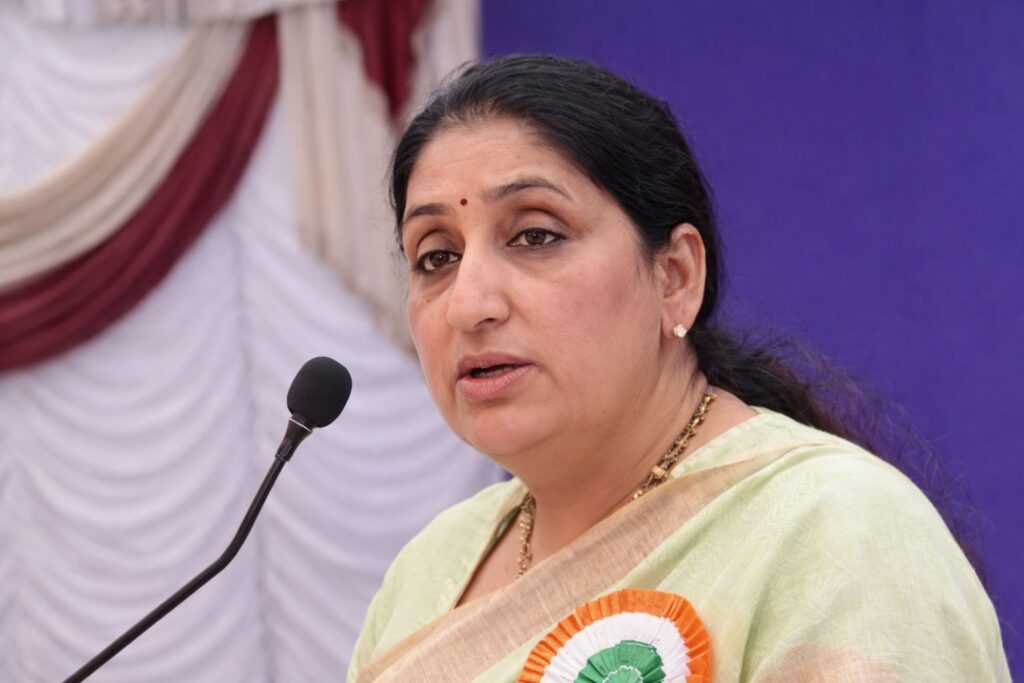
Maharashtra witnessed a swift and consequential political transition on Saturday as Sunetra Pawar was sworn in as Deputy Chief Minister, becoming the first woman to hold the post in the state’s history. Her elevation comes less than a week after the death of her husband, senior Nationalist Congress Party leader Ajit Pawar, whose sudden passing in a plane crash created an immediate leadership vacuum in the BJP-led Mahayuti government.
The oath-taking ceremony, held at Raj Bhavan around 5 pm, was deliberately restrained, attended by senior cabinet colleagues and coalition leaders. The decision behind it, however, reflects a rapid consolidation of power at a moment of political fragility.
Sunetra Pawar’s appointment resolves an urgent question of succession within the ruling alliance, even as it raises broader questions about experience, legitimacy, and the future balance of power within Maharashtra politics.
The political vacuum after Ajit Pawar
Ajit Pawar, 66, died on January 28 when a Learjet crashed near Baramati, killing all five people on board. A dominant figure in Maharashtra politics for over two decades, he had served multiple terms as Deputy Chief Minister and was widely regarded as the principal power centre of the NCP faction aligned with the Bharatiya Janata Party.
Within the Mahayuti coalition, Ajit Pawar played a critical role in maintaining numerical strength and internal discipline. His faction’s support was essential to the government’s majority in the legislative assembly, and his control over key portfolios had given him significant influence over fiscal and administrative decision-making.
His death therefore posed not only a personal loss but a structural challenge to the coalition. Senior leaders across parties acknowledged privately that any delay in resolving leadership could invite instability, factional manoeuvring, or external pressure from rival political formations.
How the decision was taken
Against this backdrop, leaders of the Ajit Pawar-led NCP faction moved quickly. On Friday morning, the party’s legislators met in Mumbai and unanimously elected Sunetra Pawar as their legislative leader. The decision followed internal consultations involving senior NCP figures and coalition partners.
Chief Minister Devendra Fadnavis was informed shortly after the meeting. According to officials, the BJP leadership agreed that maintaining continuity was the priority and raised no objections to her induction into the cabinet.
By evening, arrangements for the oath-taking were finalised with the Governor’s office. The speed of the process, from bereavement to appointment, underlined the urgency felt within the ruling alliance to secure stability.
A historic but scrutinised appointment
Sunetra Pawar’s swearing-in marks a significant first for Maharashtra. Since the post of Deputy Chief Minister was introduced in 1978, no woman had previously held the position.
Yet the historic nature of the appointment is inseparable from the scrutiny surrounding it. Sunetra Pawar has not previously held a ministerial role in the Maharashtra government, and her experience in executive administration is limited.
Supporters within the NCP argue that her elevation ensures continuity of leadership and honours the political mandate carried by Ajit Pawar’s faction. Critics counter that the decision reflects dynastic succession rather than institutional deliberation.
The government has maintained that the appointment was driven by constitutional necessity and coalition arithmetic, not symbolism.
Political background
Sunetra Pawar entered frontline electoral politics relatively late. In the 2024 Lok Sabha elections, she contested from Baramati, a traditional Pawar stronghold, but was defeated by Supriya Sule, a senior leader of the Sharad Pawar-led NCP faction.
Following that defeat, she was nominated to the Rajya Sabha, giving her a national parliamentary role but no direct administrative responsibilities within the state government.
Outside electoral politics, she has been associated with educational and environmental initiatives, including her role as a trustee of Vidya Pratishthan, which operates several educational institutions across western Maharashtra. She has also been linked to rural development and sustainability programmes.
These credentials have been cited by her supporters as evidence of administrative exposure, though critics argue they do not substitute for executive governance experience.
Constitutional position
Sunetra Pawar is not currently a member of either the Maharashtra Legislative Assembly or the Legislative Council. Under constitutional provisions, she is permitted to take oath as a minister but must secure membership of either House within six months.
Party sources say discussions are underway regarding the most viable route, including a possible by-election or nomination to the Legislative Council. No formal announcement has yet been made.
The question of portfolios remains open. Ajit Pawar previously held powerful departments including Finance and Planning. Officials indicate that the finance portfolio is likely to remain with the Chief Minister in the immediate term, particularly with the state budget approaching, while other departments such as state excise and sports may be assigned to Sunetra Pawar.
A cabinet reshuffle is expected shortly.
Coalition dynamics
The appointment has implications beyond the government. It has effectively frozen any immediate prospect of reconciliation between the rival factions of the Nationalist Congress Party.
Sharad Pawar, founder of the NCP and Ajit Pawar’s uncle, said publicly that he was not informed about Sunetra Pawar’s swearing-in and learned of it through media reports. His remarks highlighted the continued distance between the two camps.
Political observers note that the rapid elevation may also have been intended to prevent any attempt by rival factions to assert influence over Ajit Pawar’s support base in the aftermath of his death.
For now, the split within the NCP appears firmly entrenched.
Public reaction
Sunetra Pawar’s financial disclosures have drawn public attention. According to election affidavits, her family has declared assets of approximately ₹127 crore, with liabilities of around ₹17 crore, including real estate holdings, bank deposits, shares, and jewellery.
In April 2024, she was granted a clean chit by the Economic Offences Wing in a cooperative bank case, a point repeatedly emphasised by her supporters in response to allegations.
Public reaction to her appointment has been mixed. While some have welcomed the historic nature of the moment, others have questioned the speed of the transition and her preparedness for high office.
Within the bureaucracy, officials say administrative functioning remains unaffected.
The road ahead
Sunetra Pawar assumes office at a time of economic and political challenge for Maharashtra. The state faces fiscal pressures, demands for infrastructure investment, and ongoing agrarian concerns. Managing these issues while navigating coalition politics will test her leadership early.
Her immediate priorities will include establishing authority within the cabinet, preparing for legislative membership, and maintaining cohesion within her party faction.
Whether her appointment delivers long-term stability or merely defers deeper political realignment will become clear in the months ahead.
For now, Maharashtra has entered a new chapter, shaped by urgency, succession, and an unprecedented shift in its political leadership.


