

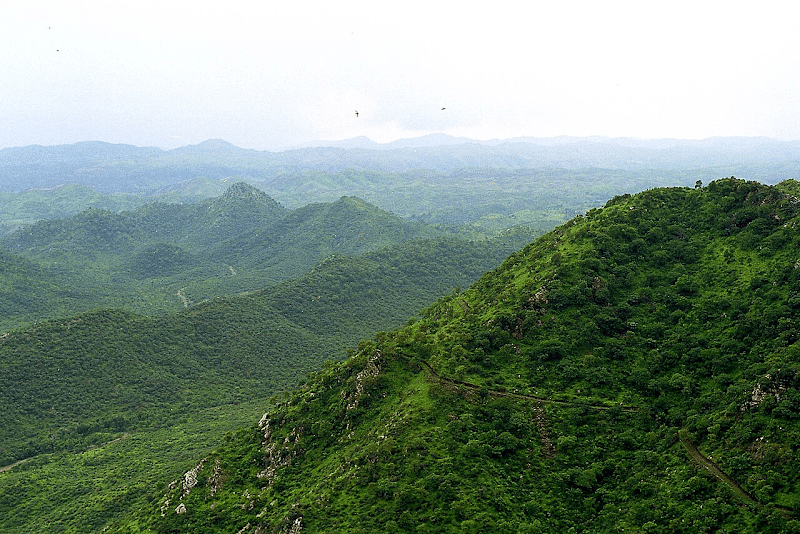
The Supreme Court’s decision to adopt a uniform definition of the Aravalli Hills has triggered a nationwide debate over environmental protection, mining regulation and the future of one of India’s oldest mountain ranges. While the Union government insists the move strengthens oversight and curbs illegal mining, environmental activists warn that large portions of the fragile ecosystem may remain exposed under the new framework.
The ruling, delivered on November 20, 2025, aims to bring clarity to decades of inconsistent interpretations that have governed mining activity across Delhi, Haryana, Rajasthan and Gujarat. However, the height-based definition has become the focal point of protests, political accusations and scientific scrutiny.
What the Supreme Court Has Ruled
The Supreme Court approved a standard definition to identify and protect the Aravalli Hills across states. According to the ruling, any landform rising 100 metres or more above its surrounding terrain qualifies as an Aravalli hill.
The court made it clear that protection is not limited to hilltops alone. Slopes, foothills and landforms located within a 500-metre buffer zone between qualifying hills are also covered under the protected category. Mining activity is prohibited in these zones.
In a significant safeguard, the court ordered a freeze on new mining leases until state governments submit detailed and scientifically backed sustainable mining and management plans. The court observed that varying definitions across states had contributed to regulatory loopholes and illegal mining, necessitating a uniform framework.
Government’s Position on Mining
The Union government has strongly defended the court-approved definition, rejecting claims that it opens the door to fresh mining in the Aravalli region. Environment Minister Bhupender Yadav has said there has been no relaxation for illegal mining and warned against misinterpreting the ruling.
According to official estimates, the Aravalli range spans nearly 1.44 lakh square kilometres, of which only 0.19 percent would technically qualify for regulated mining under the new framework. The government maintains that even this small fraction will remain subject to strict scrutiny and environmental clearances.
Officials argue that the new definition strengthens enforcement by clearly identifying restricted and prohibited areas, making it harder for illegal operations to exploit ambiguity.
Scientific Planning and Supreme Court Oversight
In an interview, Bhupender Yadav said that no new mining would be considered without a scientific plan approved under the Supreme Court’s supervision. He explained that expert institutions such as the Indian Council of Forestry Research and Education would be involved in evaluating proposals before any decision is taken.
The minister said mining would not be possible in more than 0.19 percent of the Aravalli area, adding that mining activity already existed in certain zones due to permissions granted earlier. However, he acknowledged that anomalies and illegal mining had caused serious damage in the past.
According to Yadav, the purpose of the uniform definition is to eliminate these anomalies and ensure strict compliance through clearer demarcation of protected zones.
Afforestation and Ecological Restoration Efforts
The environment minister has also emphasised that protecting the Aravallis goes beyond stopping mining. He said afforestation alone is not enough and that the focus must be on preserving the entire ecological system of the region.
Yadav noted that the Aravalli ecosystem includes grasslands, shrubs, medicinal plants and diverse vegetation, all of which are essential for sustaining wildlife. Referring to conservation initiatives under the International Big Cat Alliance, he said protecting species like tigers requires preserving their prey and habitat as well.
He added that the ministry has established more than 29 nurseries across the Aravalli range and plans to expand them to every district. These nurseries are based on studies of local flora to ensure ecological restoration reflects the natural composition of the region rather than just tree plantation.
Activists Flag Risk to Low-Lying Aravalli Landforms
Environmental groups argue that the controversy is not about intent but about impact. Activists warn that defining the Aravallis primarily through elevation risks overlooking large portions of the ecosystem.
According to conservation groups, nearly 90 to 95 percent of Aravalli landforms consist of low-lying ridges and hillocks that do not rise beyond the 100-metre threshold. Despite their modest height, these formations play a critical role in groundwater recharge and climate protection, particularly in semi-arid regions surrounding Delhi NCR, Haryana and Rajasthan.
Activists fear that such areas could remain vulnerable to mining and construction despite assurances from the government. This concern has fuelled calls for total safeguards across the entire Aravalli range, regardless of elevation.
Protests and Public Response
The ruling has sparked activists’ nationwide protests, with demonstrations reported in Rajasthan, Haryana and parts of Delhi NCR. Environmental groups, students and local residents have taken to the streets, warning that weakening protection of the Aravallis could have long-term consequences.
Protesters describe the Aravalli range as an ancient ecological shield for north India, highlighting its role in regulating temperatures, preventing desertification and protecting groundwater reserves. Many have demanded that the Aravallis be declared an ecologically sensitive zone with comprehensive protection against mining and commercial exploitation.
Political Storm Over Aravallis
The issue has also escalated into a political storm over Aravallis. Opposition leaders have accused the Centre of favouring mining interests under the guise of administrative clarity.
Congress leaders, including former Rajasthan Chief Minister Ashok Gehlot, have warned that the new definition could embolden illegal mining networks that have historically damaged the region. They argue that even small regulatory gaps can be exploited on the ground.
The Bharatiya Janata Party has rejected these allegations, calling them misleading. BJP leaders say the uniform definition actually strengthens enforcement and removes loopholes that illegal miners previously exploited.
A History of Illegal Mining
Illegal mining has long plagued the Aravalli range, particularly in parts of Haryana and Rajasthan. Despite repeated court orders, unauthorised quarrying, blasting and transportation of minerals have caused severe environmental degradation.
Investigations in the past have documented hills being flattened, forests destroyed and groundwater levels falling due to unchecked extraction. This history has heightened public scepticism and intensified scrutiny of any regulatory change affecting the region.
Scientific Concerns and Ecological Stakes
Scientists caution that geology alone cannot determine ecological importance. Research shows that only a small percentage of mapped Aravalli hills meet the 100-metre criterion, especially in Rajasthan where the range is fragmented.
Experts argue that ecological function does not always correlate with height. Smaller hills often play a disproportionate role in biodiversity, soil stability and water retention, making their protection critical for long-term sustainability.
The government maintains that the new definition does not override existing environmental laws and that multiple layers of regulation continue to apply.
What Lies Ahead
The Supreme Court’s freeze on new mining leases will remain in place until states submit sustainable mining and conservation plans. These plans are expected to identify no-go zones, strengthen monitoring and ensure accountability.
Whether the new framework becomes a tool for stronger conservation or a source of continued conflict will depend on enforcement and transparency on the ground.
A Crucial Moment for the Aravallis
The Aravalli Hills are more than a geological formation. They are a living ecosystem that supports water security, biodiversity and climate stability for millions. As legal definitions, political narratives and environmental realities collide, the future of this ancient range hangs in the balance.
How effectively the court’s ruling is implemented may determine whether the Aravallis continue to serve as a natural defence or suffer irreversible damage in the years ahead.


