

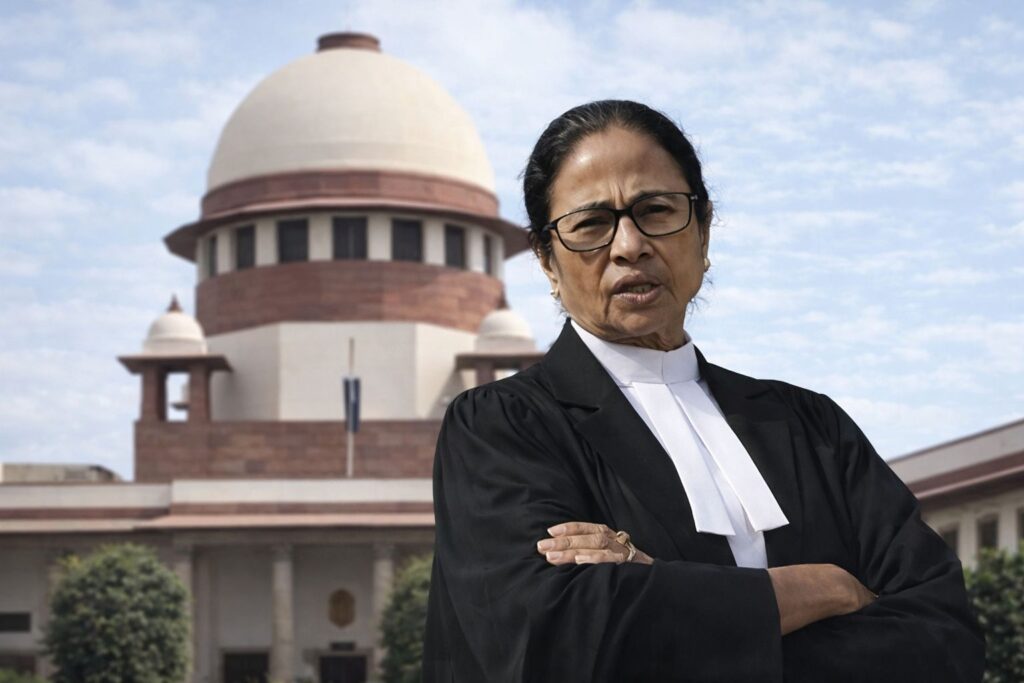
West Bengal Chief Minister Mamata Banerjee on Tuesday appeared before the Supreme Court to argue her own petition challenging the Election Commission of India’s Special Intensive Revision of electoral rolls, becoming the first sitting chief minister to personally address the apex court in a constitutional dispute.
The unprecedented appearance came amid growing political and legal tensions over the SIR exercise in West Bengal ahead of the 2026 assembly elections. Banerjee contends that the revision process risks large-scale disenfranchisement through arbitrary deletions, compressed timelines and procedural flaws that disproportionately affect ordinary voters.
The matter was heard by a three-judge bench led by Chief Justice of India Surya Kant, along with Justices Joymalya Bagchi and Vipul Pancholi, placing one of India’s most politically sensitive electoral disputes under direct judicial scrutiny.
In Court
Banerjee filed an interlocutory application seeking permission to appear as a party-in-person, citing the seriousness of the issue and its implications for voter rights. While represented by senior advocates, she addressed the bench directly during the hearing, an act rare enough to draw immediate attention from legal observers and political leaders alike.
Holding a law degree from Calcutta University, Banerjee told the court that the SIR exercise in Bengal had moved beyond routine verification and had become exclusionary in nature. She said the process was generating fear and confusion among voters, particularly in rural and migrant-heavy areas.
“This is not revision, this is deletion,” she submitted, arguing that genuine voters were being removed from the rolls for discrepancies that were clerical rather than substantive.
Her direct intervention transformed the hearing from a technical challenge into a broader constitutional debate on the right to vote, the scope of electoral oversight and the limits of administrative discretion.
SIR Challenge
The Special Intensive Revision is a comprehensive voter roll verification exercise undertaken by the Election Commission before elections to remove duplicates, correct errors and update records. In West Bengal, however, the state government alleges that the process relies on outdated base rolls, some dating back more than two decades.
According to the petition, notices have been issued to lakhs of voters for discrepancies involving spelling variations, age differences, surname changes after marriage or differences in parental names. Banerjee argued that such discrepancies were common in a linguistically diverse state like West Bengal and should not be grounds for removal from electoral lists.
She told the court that over 58 lakh names had been flagged for potential deletion, raising concerns about the scale and timing of the exercise so close to the assembly elections. The petition argues that conducting such an intensive revision within a compressed timeframe increases the risk of error and exclusion.
The state has also questioned the evidentiary standards being applied, arguing that voters are being asked to repeatedly prove identity and residence despite possessing valid government documents.
Targeting Allegation
A key argument advanced by Banerjee was that West Bengal was being selectively targeted by the Election Commission. She questioned why similar intensive revisions were not being undertaken simultaneously in states such as Assam or other regions with comparable demographic and migration challenges.
She told the bench that the uneven application of the SIR raised serious concerns about constitutional equality and federal balance. According to her submissions, electoral processes must be applied uniformly across states to maintain public trust.
Banerjee also objected to the appointment of micro-observers from outside the state, arguing that unfamiliarity with local language conventions and naming practices increased the likelihood of mistakes. She said errors were being compounded by officials who lacked cultural and linguistic context.
During the hearing, Banerjee described the Election Commission as functioning like a “WhatsApp Commission”, alleging that decisions were being taken mechanically without sufficient human oversight. The remark drew attention across political lines and underscored the sharp tone of the confrontation.
Human Cost
Banerjee told the bench that the SIR exercise had caused widespread distress among voters. She cited cases in which individuals were declared dead in official records despite being alive, forcing them to prove their existence to retain voting rights.
She also claimed that anxiety linked to notices and repeated verification demands had led to deaths, including that of a booth-level officer associated with the exercise. While these claims remain contested, they were presented as evidence of the emotional and social impact of the process.
“Justice is crying behind closed doors,” Banerjee told the court, urging judicial intervention to protect voters from what she described as administrative excess.
Her submissions framed the issue not merely as a legal dispute, but as a question of dignity, access and democratic participation.
Court Response
The Supreme Court issued notice to the Election Commission of India and the Chief Electoral Officer of West Bengal, seeking a detailed response to the allegations raised in the petition.
Chief Justice Surya Kant observed that voter list revisions must be conducted with care and sensitivity, particularly in states with linguistic diversity and high population mobility. The bench indicated that local context should play a central role in verification processes.
The court directed the Election Commission to file its reply within days and listed the matter for further hearing, signalling that the concerns raised would receive close judicial examination.
While the court did not halt the SIR exercise at this stage, its observations underscored the constitutional importance of protecting the right to vote.
Legal Context
Legal experts note that while Indian law permits any citizen to appear as a party-in-person, such appearances by serving heads of government are extremely rare. Banerjee’s decision to argue her own case has therefore added constitutional and symbolic weight to the proceedings.
Her appearance does not violate professional conduct rules, as she is not representing other parties. However, it raises broader questions about the evolving relationship between elected executives and the judiciary in high-stakes constitutional disputes.
The court’s eventual ruling could establish important precedents on how electoral revisions are conducted and reviewed.
Political Stakes
The dispute unfolds against the backdrop of the 2026 West Bengal Assembly elections, amplifying its political significance. The Trinamool Congress government has framed the issue as a fight to protect voter rights, while opposition parties have accused Banerjee of politicising an administrative process.
National political leaders have cited the case in debates over the neutrality of the Election Commission, making the outcome relevant beyond the state.
Why It Matters
The case places electoral administration under judicial scrutiny at a politically sensitive moment. Legal analysts say the Supreme Court’s ruling could shape how voter roll revisions are conducted across India, particularly in election-bound states.
Banerjee’s unprecedented courtroom appearance has transformed a procedural challenge into a high-profile constitutional test of voter rights, administrative accountability and federal balance.
As the court prepares for further hearings, the case is likely to resonate far beyond West Bengal, touching the core of how India safeguards democratic participation.


