

Tamil Nadu’s 2026 Assembly election is unfolding with an expanded political field, signalling a shift from its long-standing two-front electoral pattern. The entry of new political forces, combined with ongoing alliance movements and public controversies, has brought renewed attention to the state’s political landscape.
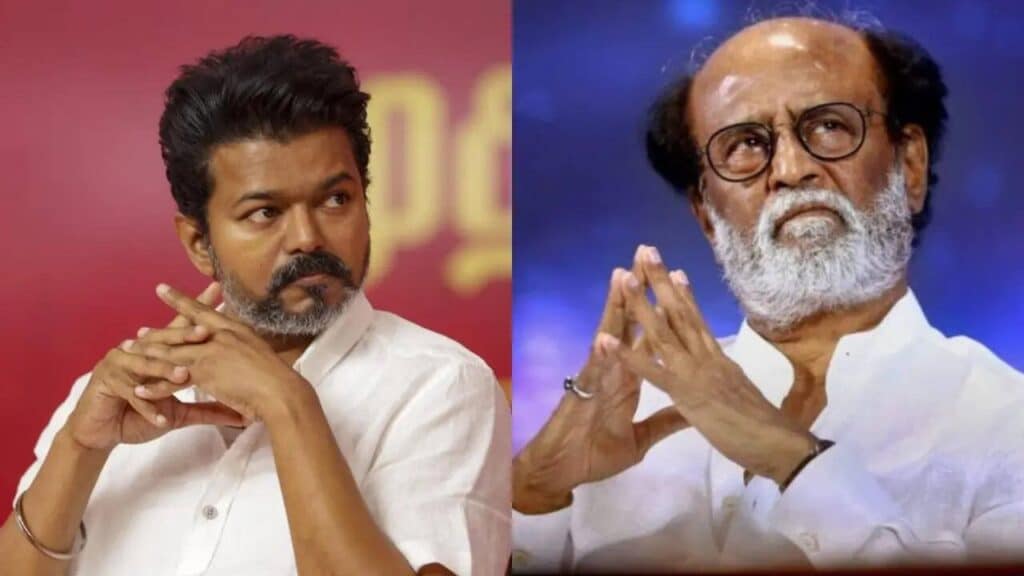
At the centre of this evolving contest are two of Tamil Nadu’s most influential public figures, Vijay and Rajinikanth. Vijay has formally entered electoral politics through Tamilaga Vettri Kazhagam and is preparing for a statewide contest, positioning his party as an alternative to established formations.
Rajinikanth, though not contesting, has re-emerged in political discourse following recent developments involving public statements and reactions from political parties. His response to remarks made by a TVK leader has drawn attention across the political spectrum, placing him back into the centre of election narratives. These parallel developments have shaped early momentum in the run-up to the polls and continue to influence the direction of political discussions in the state.
Vijay’s Position
Tamilaga Vettri Kazhagam has indicated that it will contest the Assembly election independently. The party’s position has been framed around presenting itself as an alternative to the ruling Dravida Munnetra Kazhagam led by Chief Minister M. K. Stalin.
At campaign events, Vijay has outlined his messaging on governance and public accountability. “We are entering politics to bring change that people can trust,” he said during a recent address. In another speech, he stated, “This is not about power for a few, it is about governance for all.” Party leaders have also indicated that preparations are underway to contest across constituencies without alliance support.
At the same time, efforts from the National Democratic Alliance to bring TVK into its fold have continued, even as the party proceeds with independent preparations for the election.
The Rajinikanth Row
A political controversy involving Rajinikanth has become central to the early phase of the campaign. A senior TVK leader, Aadhav Arjuna, publicly claimed that Rajinikanth had stepped away from politics due to pressure from the DMK.
Rajinikanth responded by rejecting the claim. “There is no truth in such remarks. My decision was entirely personal,” he said, addressing the issue directly.
Following this, Aadhav Arjuna issued an apology. “I sincerely apologise to Rajinikanth sir and regret my earlier statement,” he said.
The exchange drew reactions from across political circles and remained a prominent issue in campaign discussions.
Alliance Developments
Developments following the controversy have had an impact on alliance-level discussions. Outreach efforts involving Tamilaga Vettri Kazhagam and the National Democratic Alliance did not progress further after the remarks concerning Rajinikanth.
While no formal announcement has been made regarding alliance breakdowns, current developments indicate that Tamilaga Vettri Kazhagam is proceeding with an independent electoral strategy.
A Four-Cornered Contest
The entry of Tamilaga Vettri Kazhagam, along with the continued presence of other parties, has resulted in a four-cornered electoral contest in Tamil Nadu.
The election is being contested among:
- The Dravida Munnetra Kazhagam-led alliance
- The AIADMK-led National Democratic Alliance
- Tamilaga Vettri Kazhagam
- Naam Tamilar Katchi led by Seeman
Naam Tamilar Katchi has announced candidates across all 234 constituencies. The party had secured more than eight percent vote share in the previous Lok Sabha election and is recognised as a state party.
The presence of four active political formations marks a departure from the traditional two-front electoral pattern in Tamil Nadu.
Statements and Reactions
Public statements from key figures have contributed to the evolving political narrative.
Vijay, addressing supporters, said, “Young voters will decide the direction of this election.” He also stated, “Politics should be people-centric and transparent.”
Rajinikanth, after rejecting the claims made about him, said, “Time will give the right answers.”
Following the controversy, Aadhav Arjuna said, “I respect Rajinikanth sir and regret the statement made earlier.”
These remarks have been widely referenced in political discussions and campaign coverage.
Survey Indicators
Pre-poll survey data has indicated that the Dravida Munnetra Kazhagam alliance remains in a leading position ahead of the election.
The surveys also show that Tamilaga Vettri Kazhagam is emerging as a new entrant with measurable vote share, though it is not projected to secure a majority independently. The data suggests that the party could influence electoral outcomes in several constituencies.
The presence of multiple parties has contributed to a distribution of vote share across alliances and independent formations.
Campaign Activity
Campaign activity across Tamil Nadu has intensified with rallies, outreach programmes, and constituency-level mobilisation.
Vijay has addressed public gatherings focusing on governance, youth participation, and accountability. Party workers have been deployed at booth levels as part of election preparations.
Rajinikanth has not participated in campaign activity. However, his recent public statements and responses continue to feature in political discourse and media coverage across the state.
Electoral Developments
Recent developments, including the controversy involving Rajinikanth, the apology issued by a TVK leader, and the status of alliance outreach efforts, have remained central to the election narrative. The emergence of a four-cornered contest, along with survey indicators and ongoing campaign activity, continues to define the progression of the Tamil Nadu Assembly election.


