

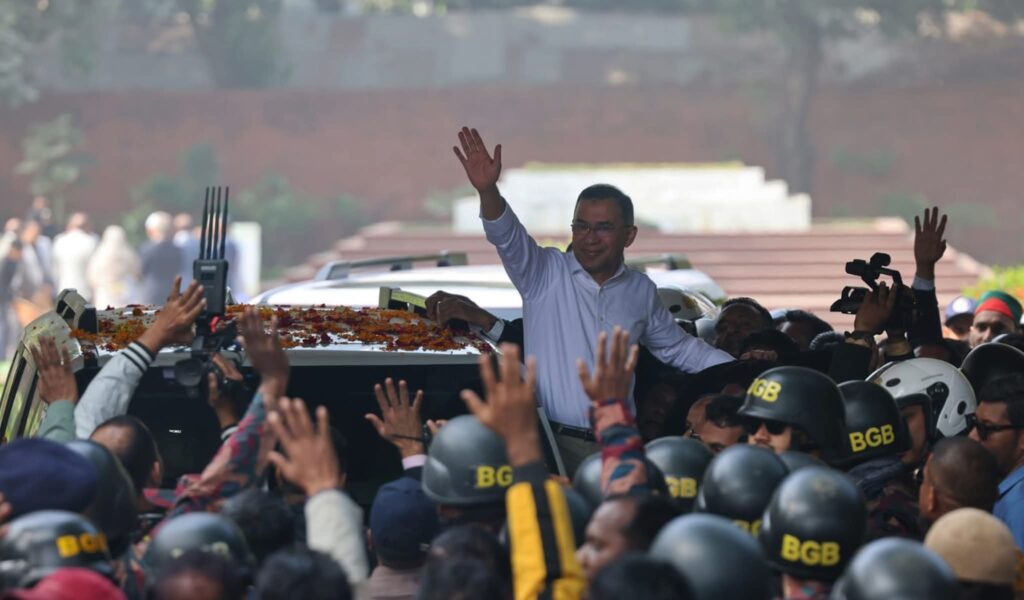
The return of Tarique Rahman to Bangladesh after 17 years marks a significant moment in the country’s political landscape. The senior Bangladesh Nationalist Party (BNP) leader’s homecoming has coincided with heightened security measures, particularly along sensitive regions including the India–Bangladesh border. Recent reports indicate that two Indian nationals were detained by the Border Guard Bangladesh (BGB) near the border, reflecting the increased vigilance prompted by ongoing political and social developments.
While cross-border detentions are not uncommon, the timing of these incidents underscores the interplay between political change, public mobilisation, and security concerns in Bangladesh.
Tarique Rahman’s Return and Political Implications
Tarique Rahman, acting chairman of the BNP, returned to Bangladesh after nearly two decades abroad. His prolonged absence did not diminish his influence within the party, where he continued to play a central role from exile. His return has energised party cadres and reshaped political dynamics in the lead-up to the 2026 national elections.
Upon arrival, Rahman participated in large rallies and public meetings across Dhaka, signalling the BNP’s intent to reassert itself as a major political force. The renewed mobilisation has also intensified scrutiny of public spaces, with security agencies adopting heightened measures to prevent unrest.
Voter Registration Ahead of 2026 Elections
Following his return, Tarique Rahman is completing formalities to participate in the upcoming elections. The Election Commission (EC) is set to decide on Sunday whether to include the names of Tarique Rahman and his daughter, Jaimah Rahman, in the national voter list. EC officials have stated that there is no legal barrier to registering Tarique Rahman as a voter under current law, and preparations are underway for his formal inclusion.
His official registration would strengthen his political legitimacy and allow him to exercise his electoral rights, further reinforcing his role in Bangladesh’s evolving political scenario.
Political Mobilisation and Rising Street Tensions
Tarique Rahman’s return has coincided with intensified political activity across Bangladesh. BNP supporters have staged demonstrations calling for electoral reforms, while rival political groups have also mobilised in response. The combination of large rallies and heightened political energy has occasionally resulted in street-level clashes and disruptions to public life. Cultural events have been postponed in several areas as authorities attempt to maintain order.
In this environment, the state has increased security measures, particularly in border zones, urban centres, and locations of potential unrest.
Two Indian Nationals Detained Amid Heightened Border Security
Amid heightened vigilance, the BGB detained two Indian nationals attempting to enter Bangladesh without valid documentation. Officials described the incident as an infiltration attempt. During preliminary verification, identity documents and currency were recovered, and the individuals were handed over to local authorities for further investigation.
This detention illustrates how border enforcement has intensified following political mobilisation, demonstrating the security establishment’s heightened alertness during a sensitive political period.
India–Bangladesh Border Context
The India–Bangladesh border, stretching over 4,000 kilometres, passes through villages, agricultural land, rivers, and forests. It is one of the most densely populated and complex frontiers in South Asia. Despite fencing and surveillance infrastructure, civilian crossings, seasonal river changes, and closely-knit communities make enforcement challenging.
The Border Security Force (BSF) in India and the BGB in Bangladesh maintain communication channels to manage routine incidents. During politically sensitive periods, patrols and checks are increased to prevent inadvertent or deliberate violations.
Communal Violence and Minority Concerns
Alongside political mobilisation, Bangladesh has witnessed targeted incidents of violence against minority communities, particularly Hindus. These incidents have drawn attention from civil society and political leaders in India. The combination of political protests and communal concerns has led to heightened alertness along border areas, influencing enforcement measures and public discourse.
India’s Diplomatic and Political Perspective
Indian authorities have monitored developments closely. Senior leaders have condemned violence against minorities while stressing regional stability and diplomatic engagement. Public demonstrations in India have expressed solidarity with affected communities in Bangladesh.
Regarding the detained Indian nationals, Indian consular teams are expected to coordinate with Bangladeshi authorities to ensure verification, humane treatment, and timely resolution.
Legal Framework for Border Crossings
In Bangladesh, unauthorised entry constitutes an offence under immigration laws. Individuals detained by the BGB are usually handed to police and produced before a magistrate. Depending on the circumstances, they may face temporary detention, legal proceedings, or repatriation.
India follows established consular protocols when its nationals are detained abroad, prioritising early resolution and adherence to legal procedures where no criminal intent is established.
Human Impact of Heightened Security
Communities along the border often live with longstanding familial, cultural, and economic ties that predate modern boundaries. Farmers, fishermen, and traders frequently operate in areas where the boundary is not clearly demarcated.
During politically sensitive periods, heightened vigilance increases the risk of inadvertent violations. Human rights groups emphasise humane treatment, transparency, and swift resolution in such cases.
Implications of Tarique Rahman’s Return
The return of Tarique Rahman after 17 years is a turning point in Bangladesh’s political landscape. It has energised opposition politics, reshaped electoral calculations, and increased public engagement.
At the same time, the intensified political activity has impacted security measures, particularly at border points. The detention of Indian nationals is a reflection of this context, highlighting how political developments can influence operational decisions in border enforcement.
Implications for India–Bangladesh Relations
The return of Tarique Rahman has reshaped Bangladesh’s political landscape, prompting increased mobilisation by the opposition and heightened security measures across sensitive areas, including the India–Bangladesh border. The recent detention of two Indian nationals reflects this enhanced vigilance and illustrates how political developments can influence operational decisions at the frontier.
For India, these developments highlight the need for coordinated diplomacy and careful border management. As Bangladesh prepares for the 2026 general election, maintaining open communication channels and ensuring the fair treatment of civilians will be essential to prevent routine border incidents from escalating amid a politically sensitive period.


