

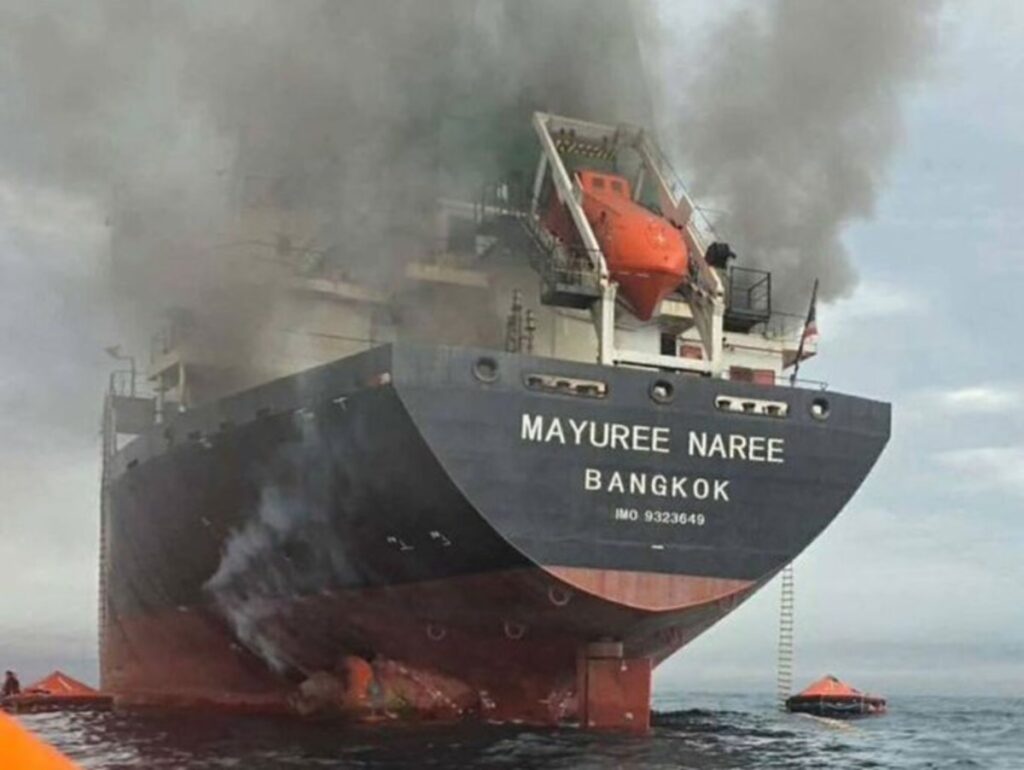
The grounding of a Thai-flagged cargo vessel off Qeshm Island marks a significant escalation in an already volatile maritime environment in the Strait of Hormuz, a narrow but strategically vital waterway that carries nearly one-fifth of the world’s oil supply.
The vessel, Mayuree Naree, operated by Precious Shipping, had earlier been struck by projectiles on March 11, triggering an explosion and fire that left it disabled and drifting for days. Its eventual grounding underscores the growing risks facing commercial shipping as geopolitical tensions intensify between Iran, the United States, and their regional allies.
What makes this incident particularly significant is not only the direct targeting of a civilian vessel, but also the broader implications it carries for maritime security, global trade stability, and energy markets. The episode reflects a shifting reality in which key trade routes are no longer insulated from conflict, and where even a single disruption can trigger cascading global consequences.
Attack and Response
On March 11, the Mayuree Naree was struck by two projectiles while transiting the Strait of Hormuz. The impact caused an explosion in the stern section and ignited a fire in the engine room, severely damaging the vessel’s propulsion and operational systems. With critical infrastructure compromised, the crew was forced to abandon ship under emergency conditions.
Iran’s Islamic Revolutionary Guard Corps later claimed responsibility for the strike, stating that the vessel had failed to respond to repeated warnings before entering what it described as controlled or restricted waters. “The ship failed to comply with maritime directives despite multiple alerts,” Iranian-linked sources stated, presenting the action as a form of enforcement rather than escalation.
The acknowledgement of responsibility is a notable development. Directly targeting a commercial cargo vessel, and publicly justifying the action, signals a more assertive posture in the enforcement of maritime control in the region.
Drift and Grounding
Following the attack, the vessel remained without propulsion and drifted through one of the most congested and strategically sensitive shipping lanes in the world. The absence of immediate recovery or towing assistance reflects the operational challenges of managing maritime incidents in conflict zones.
After several days adrift, the ship ran aground near Qeshm Island. This development has transformed the situation from a security incident into a complex logistical challenge. A grounded vessel in such a location poses risks not only to itself but also to surrounding maritime traffic.
“A disabled vessel in a constrained waterway like Hormuz becomes a navigational hazard with broader implications for shipping safety,” maritime analysts have observed.
The grounding also highlights limitations in coordinated response mechanisms in high-risk regions, where commercial priorities are often secondary to military considerations.
Crew Rescue Efforts
The human impact of the incident remains a central concern. Of the 23 crew members onboard, 20 were successfully rescued after evacuating the vessel. The rescue operation was conducted by the navy of Oman, which transported the survivors to safety before their eventual return home.
However, three crew members remain missing. Reports indicate that they were in the engine room at the time of the explosion, placing them at the centre of the initial blast and subsequent fire.
Thailand has since sought clarification and accountability regarding the incident. “We expect answers and responsibility from the concerned authorities,” officials stated, reflecting both humanitarian concern and diplomatic pressure.
The ongoing search for the missing crew continues to shape the international response, keeping the focus on both safety and accountability.
Global Trade Impact
The incident has intensified concerns about the security of the Strait of Hormuz, a critical artery for global energy supply. Approximately 20 percent of the world’s oil passes through this corridor, making any disruption highly consequential.
In the aftermath of the attack and grounding, shipping activity in the region has come under renewed scrutiny. Companies are reassessing risk exposure, with some opting for alternative routes despite longer transit times and higher operational costs.
“Even limited disruptions in Hormuz can trigger significant ripple effects across global markets,” analysts have noted, pointing to increased insurance premiums and heightened volatility in energy prices.
The broader geopolitical environment remains a key factor. Rising tensions involving Iran and the United States have contributed to a climate of uncertainty, with multiple reported incidents involving commercial vessels in recent weeks.
Environmental Risks and Outlook
The grounding near Qeshm Island introduces potential environmental risks that are still being assessed. Although no major oil spill has been confirmed, the structural condition of the vessel remains a concern for authorities monitoring the situation.
Technical teams are evaluating the risk of fuel leakage or cargo-related contamination, particularly given the ecological sensitivity of the surrounding marine environment.
“Preventing secondary damage is now as critical as addressing the initial incident,” environmental observers have noted.
Immediate priorities include locating the missing crew members, stabilising the vessel, and preventing environmental harm. At the same time, the incident raises broader questions about the future of maritime security in high-risk regions.
The Strait of Hormuz is increasingly emerging as a space where geopolitical tensions directly intersect with global trade. The grounding of the Mayuree Naree illustrates how quickly localised incidents can evolve into events with far-reaching international consequences.


