

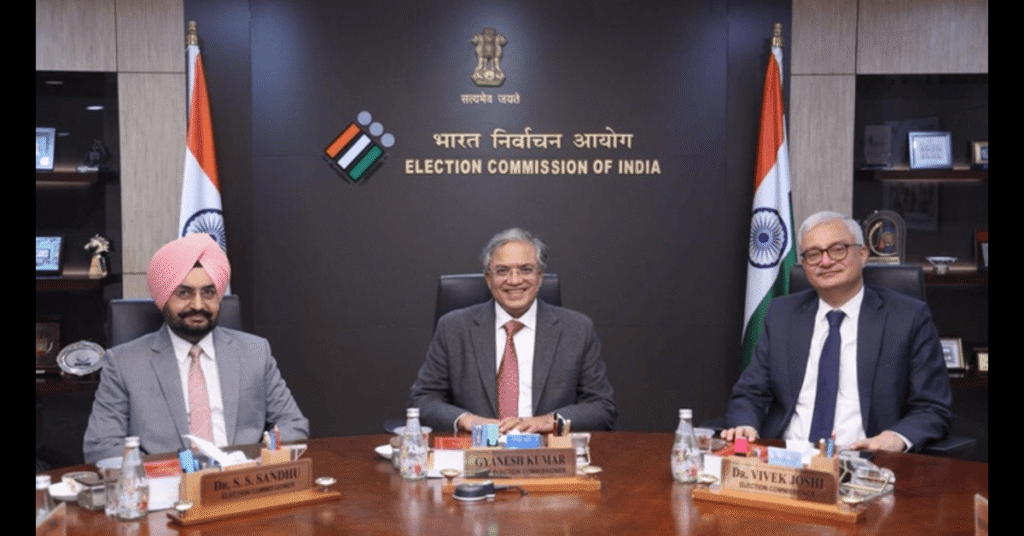
A high-level meeting between the Trinamool Congress (TMC) and the Election Commission of India (EC) has triggered a major political confrontation ahead of the West Bengal Assembly elections.
Held at the Commission’s headquarters in New Delhi on April 8, the interaction lasted just seven minutes, from approximately 10:02 AM to 10:07 AM. What was expected to be a formal discussion quickly broke down, with both sides now offering sharply conflicting accounts.
The TMC delegation included Derek O’Brien, Sagarika Ghose, Saket Gokhale, and Menaka Guruswamy. According to accounts from those present, the exchange became tense within the first few minutes, with meaningful discussion reportedly collapsing within two to three minutes.
The brevity of the meeting, combined with the intensity of the fallout, has turned what would normally be a routine political engagement into a major flashpoint in the election narrative.
TMC’s Claims
The Trinamool Congress has accused the Election Commission of abruptly ending the meeting and behaving in a dismissive manner.
Derek O’Brien said the interaction lacked substance and ended almost immediately. “What the Chief Election Commissioner told us was ‘get lost’,” he said, adding that “nothing happened in the meeting” and “not a single issue was discussed.” He also challenged the Commission to release the official transcript, stating, “We challenge them to make the transcript public.”
Other members of the delegation reinforced this version. Saket Gokhale said that the discussion never properly began, while Sagarika Ghose claimed the Chief Election Commissioner made only two remarks, questioning the authorised signatory and then asking the delegation to leave.
TMC leaders have also alleged that their concerns had been repeatedly ignored prior to the meeting. According to the party, at least nine letters had been sent to the Commission raising issues related to the electoral process, many of which had not received a response.
At the heart of these concerns is the claim that around 27 lakh voters have been removed from electoral rolls during the revision process. The party argues that such deletions raise serious questions about disenfranchisement and electoral fairness.
In a remark that captured the tense mood, a member of the delegation reportedly told officials while exiting, “Hope you sleep soundly tonight.” Another sharp response from within the party described the Commission’s position as misleading, with the claim that “they are lying through their teeth.”
EC’s Response
The Election Commission has strongly rejected the allegations and presented a contrasting account of the meeting.
According to Commission sources, the interaction became difficult due to the conduct of the TMC delegation. Officials stated that Derek O’Brien raised his voice and repeatedly interrupted proceedings, preventing the Chief Election Commissioner from speaking.
The Commission described such behaviour as “indecorous” and said it undermined the possibility of a constructive discussion. It has not confirmed the use of the phrase “get lost,” effectively dismissing that allegation without directly addressing it.
From the EC’s perspective, the meeting did not collapse due to dismissal but due to disruption. Officials indicated that repeated interruptions and a confrontational tone made it difficult to proceed in an orderly manner.
Notably, accounts suggest that apart from the Chief Election Commissioner, other commissioners present did not actively participate in the exchange, further contributing to the perception of a one-sided and tense interaction.
The absence of any official transcript or recording has left the matter unresolved, with both sides standing firmly by their respective versions.
Key Election Concerns
The confrontation is rooted in deeper disagreements over the conduct of elections in West Bengal, particularly around voter rolls and administrative neutrality.
The Trinamool Congress has raised concerns about the Special Intensive Revision of electoral rolls, alleging that large-scale deletions have taken place. The figure of 27 lakh voters cited by the party has become a central point of contention, with TMC arguing that such changes could significantly affect voter participation.
In addition, the party has questioned the neutrality of certain officials involved in election management. During the meeting, the delegation reportedly cited examples of multiple officers whom they believe have links to political opponents, raising concerns about impartiality.
The Election Commission has rejected these allegations, maintaining that electoral roll revisions are routine exercises aimed at ensuring accuracy by removing duplicate or invalid entries. It has also maintained that all administrative decisions are taken in accordance with established procedures.
This disagreement highlights a broader trust deficit between the state’s ruling party and the national election authority, one that has surfaced repeatedly in the run-up to the polls.
Political Impact
The fallout from the meeting has quickly extended beyond West Bengal, drawing reactions from other political leaders and shaping the broader narrative around the elections.
Arvind Kejriwal criticised the tone of the Election Commission, suggesting that such exchanges raise concerns about institutional neutrality. His remarks indicate that the issue is evolving into a wider national debate.
Meanwhile, the Election Commission has reiterated its commitment to conducting elections that are “fear-free, violence-free, intimidation-free, and inducement-free,” signalling a firm stance on maintaining order and credibility during the polling process.
With elections approaching in a politically sensitive state, the timing of this confrontation is significant. West Bengal has a history of intense electoral contests, and the current dispute risks adding to existing tensions.
The key question now is how voters will interpret these competing narratives. A direct and public clash between a political party and a constitutional authority is relatively rare and carries implications that extend beyond immediate electoral outcomes.
For now, a seven-minute meeting has evolved into a defining political moment, underscoring the high stakes, deep divisions, and the central importance of public trust in the democratic process.


