

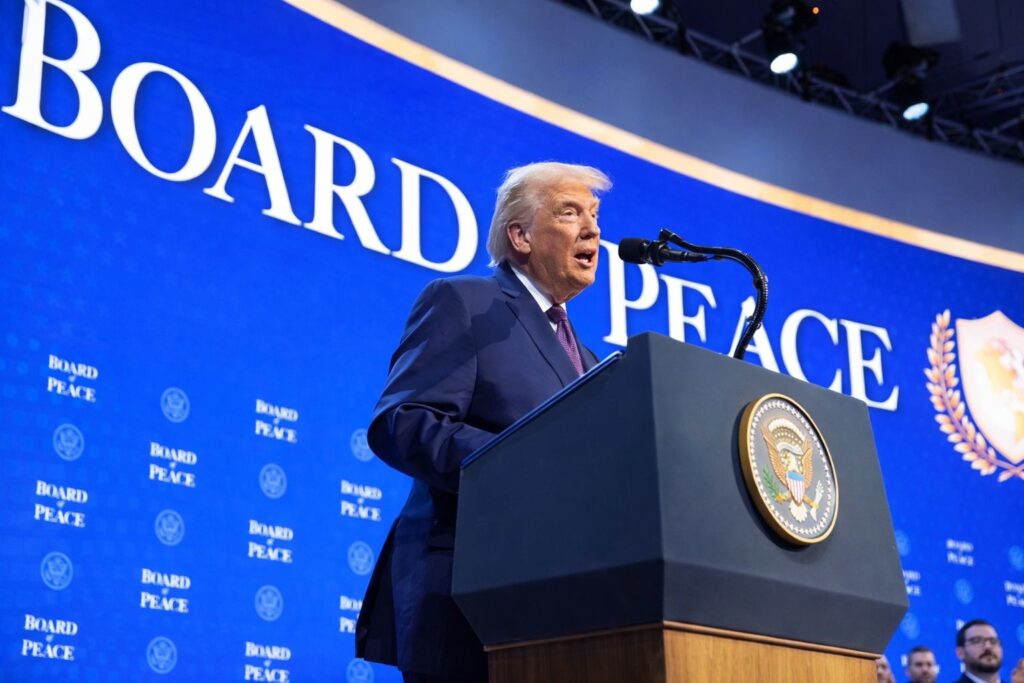
President Donald Trump’s decision to remove Canada from his newly launched Board of Peace has escalated into a broader international controversy, drawing in debates over Gaza, Pakistan’s disputed inclusion, India’s refusal to join, Russia’s uncertain stance, and growing fears that the initiative could challenge the authority of the United Nations.
The diplomatic rupture follows a high-profile speech by Canadian Prime Minister Mark Carney at the World Economic Forum in Davos, where he warned that the global rules-based order is fracturing under the weight of economic coercion by major powers. Though Carney avoided naming Trump, the remarks were widely interpreted as a pointed critique of Trump’s trade tactics, tariff diplomacy, and unilateral foreign policy approach.
Within days, Trump responded publicly, withdrawing Canada’s invitation to join the Board of Peace and transforming a policy disagreement into a high-visibility geopolitical clash.
The Board Takes Shape
Trump unveiled the Board of Peace on January 22 as a new international body intended to oversee the Gaza ceasefire, coordinate post-war reconstruction, and provide what he described as a faster and more decisive alternative to traditional multilateral institutions.
Trump has positioned himself as the board’s lifelong chairman, a feature that has immediately drawn scrutiny from diplomats and political analysts. Permanent membership reportedly requires a $1 billion contribution, which Trump says will fund peace enforcement, humanitarian operations, and reconstruction programs.
At the board’s launch, Trump framed the initiative as transformational, declaring:
“Once this board is formed, we can do pretty much whatever we want to do.”
Supporters view the model as results-driven and pragmatic. Critics argue it risks turning international peacekeeping into a transactional, pay-to-play power structure dominated by wealth and political leverage.
Gaza at the Core
Trump has repeatedly cast Gaza as the board’s primary mission, arguing that existing international bodies have failed to deliver durable peace or effective post-war governance.
During the signing ceremony, Trump issued a stark warning about Hamas, stating:
“If Hamas does not give up its weapons, we will end Hamas.”
The statement underscored a hardline security-oriented approach, reinforcing concerns that the board’s mission could extend beyond humanitarian stabilization into military and enforcement operations.
While Trump has publicly centered Gaza, reports indicate that the board’s official charter does not explicitly name Gaza, instead granting it a broad mandate that could expand to other global conflicts. Analysts say this legal flexibility raises concerns about unchecked authority and future geopolitical intervention.
Pakistan’s Controversial Entry
Pakistan’s inclusion has emerged as one of the board’s most contentious elements. Islamabad publicly backed the initiative, portraying its involvement as a contribution to international peace efforts. However, Pakistan’s membership reportedly came despite objections from Israel, which raised concerns about Islamabad’s position on Hamas and the Israel–Palestine conflict.
The move has introduced early diplomatic tension within the board. Observers say Pakistan’s participation reflects both strategic ambition and economic calculation, as it seeks greater influence in Middle East diplomacy and potential leverage with Washington.
Inside Pakistan, the decision has sparked domestic criticism, with sections of the public expressing concern that joining a Trump-led initiative could conflict with popular support for Palestine. The government now faces the challenge of balancing internal political sentiment with international diplomatic goals.
India’s Strategic Absence
While Pakistan joined, India has remained notably absent, a decision carrying significant geopolitical implications. Reports indicate India was invited but declined to attend the board’s launch, signaling caution about its legitimacy, governance structure, and legal standing.
Indian officials are reportedly wary that the Board of Peace could undermine the United Nations or evolve into a parallel global power center. The absence of India, alongside most G7 countries and nearly all UN Security Council permanent members except the United States, has intensified doubts about the board’s global credibility.
India’s skepticism is also shaped by Trump’s repeated claim that he prevented an India–Pakistan conflict, a statement New Delhi has publicly rejected. That history has reinforced India’s reluctance to align with Trump-led diplomatic initiatives.
Russia’s Uncertain Position
Trump has suggested that Russian President Vladimir Putin has signed onto the board, but Moscow’s position appears less definitive. Russian officials have indicated they will review or examine the proposal rather than committing fully.
This ambiguity has fueled speculation that Trump may be overstating international backing to project momentum, while Russia retains strategic flexibility to either engage or distance itself depending on geopolitical calculations.
The prospect of Russian involvement has unsettled Western governments, particularly amid ongoing tensions over Ukraine and broader sanctions regimes.
Jared Kushner and Gaza’s Future
Another politically sensitive aspect of the board is the reported role of Jared Kushner, Trump’s son-in-law and former Middle East adviser, who is said to be part of its executive leadership.
Kushner has previously promoted a Gaza redevelopment vision centered on economic transformation. Critics note that the proposal does not explicitly reference Palestinian statehood, fueling concerns that the board could prioritize commercial redevelopment over Palestinian political sovereignty.
Analysts argue this risks reinforcing perceptions that the initiative is shaped by political and economic interests rather than a balanced commitment to long-term peace.
Canada’s Break With Trump
Canada initially explored participation in the board but sought greater clarity on governance, voting authority, legal accountability, and financial obligations. Ottawa reportedly resisted the $1 billion permanent seat fee, raising concerns about transparency, independence, and institutional balance.
The relationship deteriorated after Mark Carney’s Davos address, where he warned that the world is entering “a rupture, not a transition.” He cautioned that powerful nations are increasingly using trade, sanctions, and financial influence as coercive tools, urging middle powers to cooperate in defending sovereignty and economic fairness.
Trump reacted publicly, posting an open letter withdrawing Canada’s invitation and asserting that Canada benefits disproportionately from the United States. In response, Carney rejected that framing, declaring:
“Canada doesn’t live because of the United States. Canada thrives because we are Canadians.”
The exchange has hardened diplomatic positions on both sides, straining a relationship historically viewed as one of Washington’s closest partnerships.
Western Reluctance
Beyond Canada, the board has struggled to secure support from major Western powers. The United Kingdom, France, Germany, and Italy have not joined, and only a limited number of heads of state attended the launch.
Several countries reportedly sent lower-level officials, underscoring a cautious and reserved response. Analysts interpret this as evidence that many governments remain unconvinced about the board’s neutrality, legal foundation, and long-term sustainability.
Elon Musk’s Public Mockery
The initiative has also drawn public skepticism from high-profile figures. Elon Musk mocked the project in a widely circulated remark, joking about whether it represented peace or a geopolitical land grab.
While symbolic, such comments reflect elite and public doubts about the seriousness and credibility of Trump’s initiative, contributing to perceptions that it could be more performative than institutional.
The United Nations Question
At the heart of the controversy lies a critical question: Is the Board of Peace a complement to the United Nations or a challenge to it?
Trump has long criticized the UN as slow, ineffective, and constrained by bureaucracy. By creating a smaller, leader-driven body with centralized authority and direct funding, he appears to be testing a model that bypasses traditional multilateral consensus-building.
Supporters argue that global institutions require reform and faster decision-making. Critics warn that sidelining the UN risks fragmenting international law, weakening collective security, and allowing powerful states to exert influence without accountability.
A Transactional Model of Power
The board’s $1 billion permanent membership fee has become a defining symbol of its identity. Trump frames the payment as a practical mechanism to ensure commitment and resources. Opponents argue it transforms diplomacy into a marketplace of influence, where financial power determines political authority.
Canada’s refusal to pay has become emblematic of resistance to this model, while Pakistan’s participation highlights how economic and diplomatic incentives can drive alignment.
Expanding Beyond Gaza
Trump has suggested the board could expand beyond Gaza to address other global conflicts, raising fears that it could evolve into a parallel conflict-management institution with broad discretion.
By signaling that the board could intervene in multiple crises worldwide, Trump has reinforced concerns about scope expansion, limited oversight, and the potential reshaping of global power norms.
Political Reaction in the United States
In the United States, reactions have split sharply along partisan lines. Trump’s allies praise the board as a bold reimagining of global leadership and view Canada’s exclusion as a justified response to diplomatic criticism.
Critics describe the initiative as personalized, diplomatically risky, and destabilizing, warning that public confrontations with allies and alternative power structures could weaken U.S. credibility over time.
A Symbol of a Changing Global Order
The clash between Trump and Carney has come to symbolize a broader transformation in international politics. Middle powers are seeking greater autonomy, while major powers experiment with new influence models outside traditional institutions.
The Board of Peace now stands at the center of that shift, representing both an attempt to reshape global conflict management and a lightning rod for debate over legitimacy, accountability, and geopolitical power.
Whether it becomes a meaningful force in resolving conflicts or remains a contested political experiment will depend on its ability to secure broader international support, deliver tangible results in Gaza, and navigate the widening divide between multilateral diplomacy and leader-driven global power.


