

Just days after the United States upended Latin America’s political map by arresting Venezuelan President Nicolás Maduro in a pre-dawn operation, President Donald Trump has opened a new and even more explosive front in global politics by declaring that the US will take Greenland “one way or the other.”
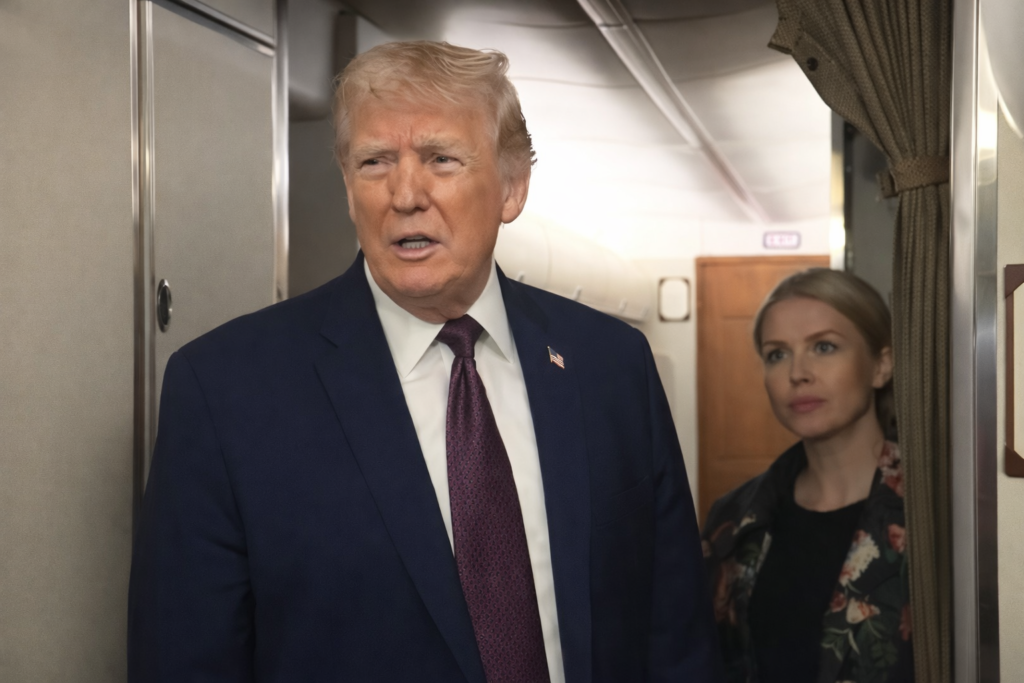
Speaking aboard Air Force One, Trump made his most direct and uncompromising statement yet about America’s intentions in the Arctic. He said, “If we don’t take Greenland, Russia or China will take Greenland. And I’m not going to let that happen. I’d love to make a deal with them. It’s easier. But one way or the other, we’re gonna have Greenland.”
The comment instantly sent shockwaves through Europe and across the Arctic region, because Greenland is not a disputed territory. It is a self-governing part of the Kingdom of Denmark and a NATO-linked territory whose future, under international law, is supposed to be decided by its own people.
Trump went further. He claimed that Russian and Chinese military vessels were already operating around Greenland. “You have Russian destroyers and submarines and you have Chinese destroyers and submarines all over the place,” he said.
Nordic governments quickly pushed back, saying intelligence and maritime tracking show no such deployments.
From Caracas to the Arctic
Trump’s Greenland threat comes in the immediate aftermath of the Venezuela operation, in which US forces captured Nicolás Maduro in Caracas and removed him from power. That move was already viewed by many governments as an unprecedented assertion of American force.
Now Greenland has emerged as the next focal point of what critics describe as a pattern of territorial and strategic expansion.
In Venezuela, the justification was energy security and narco-terrorism. In Greenland, the justification is China, Russia and critical minerals. The logic, however, is the same: Trump is arguing that regions vital to US power must fall under direct American control rather than remain under foreign sovereignty.
Why Greenland Matters
Greenland’s importance is not symbolic. It is military, geographic and economic.
The island lies between North America and Europe at the gateway to the Arctic. The United States already operates Pituffik Space Base, its northernmost military installation, which is vital for missile warning, missile defence and space surveillance.
In an era of rising Russian and Chinese missile capabilities, Greenland is one of the most strategically sensitive locations on Earth.
The island is also believed to hold large reserves of rare earth elements and critical minerals used in electric vehicles, advanced weapons, satellites and semiconductors. These materials are central to modern industrial power, and China currently dominates global supply chains.
For Washington, Greenland represents both a military shield and a resource frontier.
Trump’s NATO Warning
Trump has framed Greenland not as an alliance issue but as an American necessity. He has openly dismissed concerns about NATO, saying that if US actions affect the alliance, “it affects NATO,” adding that allies need the United States more than the United States needs them.
He also mocked Greenland’s current defences, implying NATO could not protect the territory from Russia or China.
For Denmark, one of America’s oldest allies, this language represents a direct challenge to alliance solidarity.
Greenland Pushes Back
Greenland’s political leaders responded with rare unity. In a joint statement, all major parties said, “We do not want to be Americans. We do not want to be Danish. We want to be Greenlanders.”
Greenland has its own parliament, its own government and control over its natural resources. While independence from Denmark remains a long-term goal for many, there is no political support for becoming part of the United States.
Europe Closes Ranks
European governments have rallied behind Denmark. France, Germany, Britain and others warned that any attempt to take Greenland by pressure or force would violate international law and destabilise NATO.
One senior European diplomat described Trump’s remarks as “a challenge to the post-war order.”
China and Russia React
China said the United States should not use other countries as a “pretext” to pursue its own interests in Greenland and stressed that Arctic affairs should be governed by international law.
Nordic governments also rejected Trump’s claim that Chinese and Russian warships are operating near Greenland, saying there is no evidence to support it.
The Rare Minerals Reality
Although Greenland has significant mineral deposits, experts note that turning them into usable supply would take years of investment, infrastructure and political approval.
Even US officials acknowledge that Greenland cannot rapidly replace existing global suppliers.
After Venezuela, a Pattern Emerges
The Greenland standoff follows the US operation in Venezuela, reinforcing the sense that Trump is pursuing a foreign policy in which strategic territory matters more than diplomatic norms.
First came oil and political power in Latin America. Now come Arctic dominance and resource control.
Diplomacy Under Strain
Danish and Greenlandic officials are preparing for talks in Washington, but Trump’s statement that Greenland will belong to the United States “one way or the other” has already hardened positions.
Greenland’s leaders insist they are not for sale. Europe sees a test of NATO.
And the world is watching whether the Arctic becomes the next great geopolitical flashpoint!


