

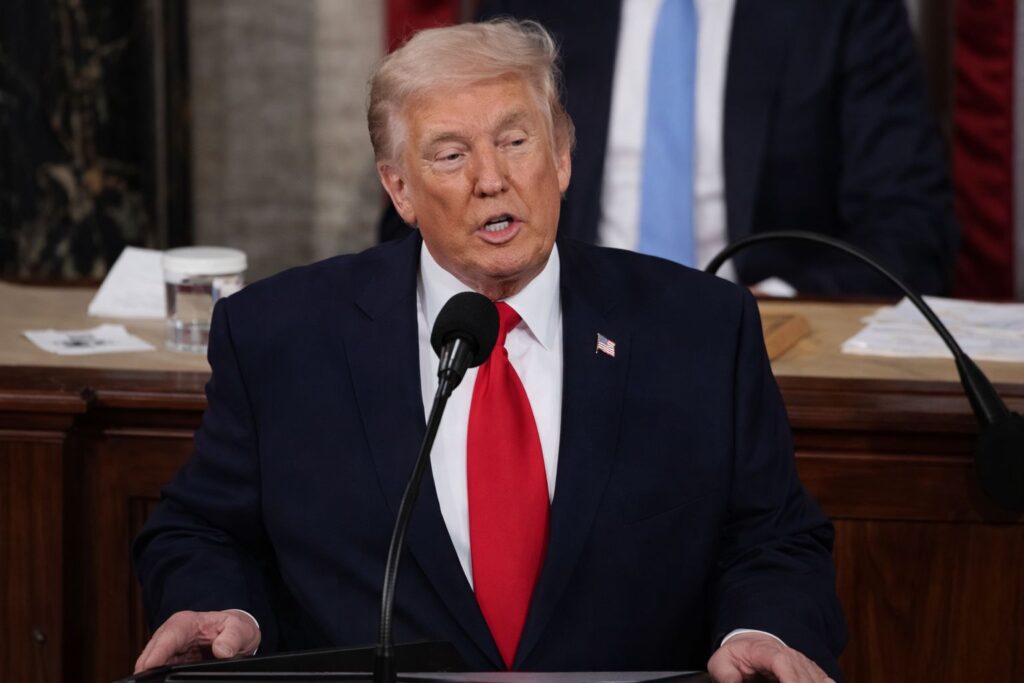
US President Donald Trump said during his State of the Union address that Pakistan’s prime minister “would have died” if not for his intervention, referring to the 2025 India–Pakistan military confrontation known as Operation Sindoor.
The remark, delivered before Congress in a nationally televised speech, immediately drew attention in Washington, New Delhi and Islamabad. Trump framed the episode as a near nuclear crisis that his administration helped defuse, asserting that millions of lives were at risk during the four day escalation between the two nuclear armed neighbors.
The Statement
Speaking about foreign policy achievements, Trump said the confrontation between India and Pakistan could have spiraled into catastrophic war. “Pakistan PM would have died if it weren’t for me,” he said, adding that his involvement prevented massive loss of life.
The comment appeared to compress a broader claim that US engagement helped avert wider conflict. However, Trump did not provide operational details or evidence that Pakistan’s political leadership was directly targeted during the crisis.
The White House has not released additional clarification regarding the specific circumstances referenced in the speech.
Operation Sindoor
Operation Sindoor was launched by India in May 2025 following a deadly militant attack on its security forces. Indian authorities described the operation as a limited and targeted strike against militant infrastructure across the Line of Control.
Pakistan condemned the strikes as aggression and responded with military action. For four days, both sides exchanged artillery fire and conducted aerial operations, raising international concern over escalation risks.
Military hotlines and diplomatic channels were activated as global powers urged restraint. The confrontation subsided after reciprocal signaling and backchannel engagement.
Neither India nor Pakistan has publicly stated that the crisis included a direct threat to Pakistan’s prime minister.
Nuclear Escalation Concerns
Trump characterized the episode as a potential nuclear flashpoint. India and Pakistan are both nuclear weapon states, and previous crises between them have drawn urgent international attention.
While the United States has historically encouraged de escalation during India–Pakistan confrontations, New Delhi maintains that disputes with Islamabad are strictly bilateral matters.
Indian officials have consistently rejected third party mediation, including during earlier episodes of tension.
India’s Position
The Ministry of External Affairs has not formally responded to Trump’s latest statement. However, India’s public position during and after Operation Sindoor emphasized that the action was focused on counterterror targets and was limited in scope.
There has been no official indication from New Delhi that Indian forces targeted Pakistan’s civilian or political leadership.
India’s military doctrine in recent cross border operations has centered on what it describes as preemptive or retaliatory strikes against militant infrastructure rather than state institutions.
Pakistan’s Reaction
Pakistan’s prime minister at the time of the crisis, Shehbaz Sharif, has not issued a detailed response to Trump’s remark.
Pakistani officials previously described the May 2025 confrontation as a serious escalation but stopped short of characterizing it as an existential threat to the country’s political leadership.
Domestic reactions in Pakistan have focused on the wording of Trump’s statement, with analysts debating whether it reflected a literal claim or rhetorical emphasis.
Diplomatic Context
The United States has played a behind the scenes role in previous India–Pakistan crises, often engaging both sides to encourage restraint. During the 2019 standoff following the Pulwama attack, Washington publicly called for de escalation while maintaining contact with both capitals.
Trump’s assertion places US involvement at the center of the 2025 episode. However, neither New Delhi nor Islamabad has officially confirmed that American mediation was decisive in ending hostilities.
India’s long standing policy under bilateral agreements with Pakistan rejects external mediation in resolving disputes.
Political Significance
State of the Union addresses are traditionally used by US presidents to outline legislative priorities and highlight foreign policy achievements. Trump cited multiple global flashpoints in his speech, presenting his administration as instrumental in preventing wider wars.
The reference to Operation Sindoor was part of that broader narrative. By describing the crisis as averted nuclear catastrophe, Trump underscored his claim of decisive intervention.
No independent verification has been presented publicly to substantiate the assertion that Pakistan’s prime minister faced imminent death during the confrontation.
Strategic Implications
Security analysts note that language used in high profile speeches can shape diplomatic perceptions. Suggesting that a foreign leader would have died without US involvement introduces a sensitive dimension to an already volatile regional history.
At present, there is no public evidence indicating that India targeted Pakistan’s political leadership during Operation Sindoor. Official descriptions from New Delhi focused on militant facilities and cross border security threats.
The absence of formal confirmation from either South Asian government leaves Trump’s statement as a political claim rather than an independently verified account of the crisis.
Current Status
India and Pakistan continue to observe a fragile ceasefire understanding along the Line of Control. Diplomatic communication channels remain open, though relations remain strained.
Trump’s remarks have revived debate over the extent of US involvement in the May 2025 confrontation. Until further official clarification is provided, the assertion that Pakistan’s prime minister “would have died” remains a contested and uncorroborated element of the episode.


