

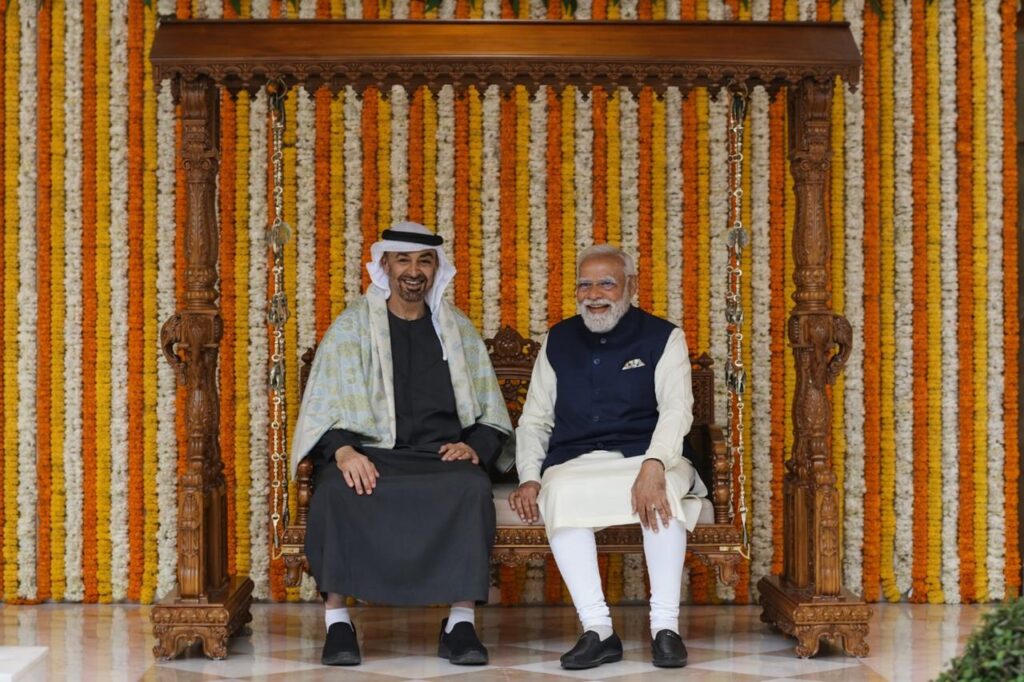
UAE President Mohammed bin Zayed’s brief but highly consequential visit to New Delhi on January 19 has triggered intense geopolitical scrutiny across diplomatic and strategic circles. Officially described as a working visit, the trip lasted barely two hours. Yet its compressed timeline, elevated protocol, and the scale of policy outcomes suggest a moment of urgency rather than routine diplomacy.
MBZ travelled for roughly four hours to hold a tightly scheduled meeting with Prime Minister Narendra Modi, who personally received him at the airport. That level of reception is rare for such a short visit and widely interpreted as a sign of strategic priority and mutual trust. Talks reportedly began almost immediately and included informal, private exchanges that are typically reserved for sensitive political and security matters.
Behind the formal announcements lies a deeper strategic recalibration shaped by shifting Gulf power balances, counterterrorism priorities, energy security, technological competition, and India’s expanding role as a defence and geopolitical actor in West Asia.
A Visit That Signalled Urgency
Diplomatic sources indicate that the visit was organised at short notice, reflecting fast evolving regional and global dynamics. The tightly packed schedule suggests that many policy decisions had been prepared in advance, with the face to face engagement designed to formalise political intent and signal alignment.
After the meeting, Prime Minister Modi said India and the UAE were committed to deepening cooperation across defence, security, technology, and economic development, calling the partnership vital for regional stability and long term prosperity. MBZ echoed that tone, describing India as a trusted strategic partner and stating that bilateral ties were entering a new phase anchored in long term confidence and shared interests.
These public statements framed the visit not as a symbolic exchange but as part of a broader strategic trajectory.
Defence Ties Enter a New Phase
One of the most significant outcomes of the visit was the signing of a Letter of Intent to expand defence cooperation. This marks a shift from conventional arms procurement toward joint production, technology transfer, military research, special forces training, and expanded joint exercises.
The framework positions the UAE among India’s emerging top tier defence partners and reflects growing Emirati interest in Indian defence platforms such as Akash and BrahMos. It also aligns with India’s ambition to strengthen its domestic defence manufacturing sector and expand its role as a global defence technology provider.
The agreement opens pathways for deeper military interoperability, shared innovation in emerging defence technologies, and long term co development of strategic capabilities. For both countries, it represents a move toward greater autonomy and resilience in an increasingly volatile regional security environment.
A Joint Stand Against Terror Financing
Counterterrorism cooperation formed a central pillar of the visit. India and the UAE jointly reaffirmed zero tolerance for terrorism, condemned cross border extremist activity, and committed to strengthening efforts to deny safe havens and funding networks for terrorist groups.
Both sides pledged closer coordination under Financial Action Task Force mechanisms, reinforcing anti money laundering systems, intelligence sharing, and financial surveillance to disrupt illicit funding flows. The message carries implicit strategic weight in South Asia and the broader Middle East, reinforcing India’s longstanding position that the financial infrastructure supporting terrorism must be dismantled.
Prime Minister Modi said both countries shared the conviction that terrorism and its funding should find no refuge anywhere in the world. The statement reflects a sharper operational alignment than in previous bilateral engagements.
Energy Security and the LNG Deal
Energy cooperation featured prominently in the discussions, highlighted by a long term liquefied natural gas agreement valued at approximately three billion dollars. The deal positions the UAE as India’s second largest LNG supplier, strengthening India’s energy security amid global price volatility and supply disruptions.
The agreement supports long term price stability, diversifies India’s energy supply chain, and reinforces the UAE’s strategic role as a key energy partner beyond crude oil exports. Both sides emphasised the importance of predictable and resilient energy flows as a foundation for economic stability and industrial growth.
The LNG deal also reflects a broader evolution in India–UAE trade relations from hydrocarbons toward diversified and technology driven energy cooperation.
Nuclear and Clean Energy Cooperation
Beyond fossil fuels, the leaders expanded discussions on civil nuclear collaboration, including large scale reactors and Small Modular Reactors, an emerging clean energy technology designed to deliver scalable, cost efficient nuclear power.
Talks covered nuclear safety standards, reactor maintenance, regulatory cooperation, and long term energy planning. The focus on Small Modular Reactors positions India and the UAE at the forefront of next generation nuclear energy, linking climate commitments with energy independence and technological innovation.
The cooperation signals growing convergence on clean energy geopolitics as countries seek reliable low carbon power sources to support sustainable economic growth.
Space, AI, and Digital Sovereignty
The visit also advanced cooperation in space infrastructure and satellite manufacturing, building on India’s growing reputation as a cost effective and technologically capable space power. Joint initiatives in satellite development, communications, and orbital technologies are expected to expand in the coming years.
The UAE expressed support for India’s national supercomputing expansion and its ambitions in artificial intelligence research and governance, including upcoming global AI initiatives. This alignment positions India as an emerging compute and AI hub, with Emirati backing for high performance digital infrastructure and innovation.
A notable and forward looking outcome was progress on the concept of digital embassies and sovereign data hosting. Under this framework, sensitive UAE government data could be securely stored in India under sovereign legal protections and advanced cybersecurity safeguards. This represents a new frontier in digital diplomacy and cross border data governance, extending strategic cooperation into cyberspace.
Trade Expansion and Gujarat Investments
India and the UAE reaffirmed their ambition to double bilateral trade to two hundred billion dollars by 2032 under the Comprehensive Economic Partnership Agreement. Growth is expected across manufacturing, defence, fintech, logistics, digital services, and advanced technologies.
A key element of this economic strategy is Emirati investment in Dholera and other parts of Gujarat, including aviation maintenance and repair operations, pilot training infrastructure, logistics hubs, and smart industrial development.
Dholera is being positioned as a manufacturing and supply chain gateway linking Gulf capital with Indian industry and Indo Pacific trade corridors. These investments reflect broader efforts to diversify global supply chains, reduce reliance on China, and strengthen India’s role as an industrial and logistics hub.
Regional Crises and Maritime Security
The timing of MBZ’s visit coincided with heightened instability across the Middle East. The leaders discussed the Gaza conflict, Iran Israel tensions, Red Sea shipping disruptions, and ongoing security challenges linked to Yemen.
Both sides emphasised the importance of regional stability, diplomatic de escalation, and the protection of maritime trade routes that are critical to global commerce. Maritime security in the Indian Ocean and Red Sea emerged as a shared strategic concern, given the UAE’s role as a logistics hub and India’s expanding naval presence.
These discussions reflect growing convergence on safeguarding trade corridors and managing the spillover risks of regional conflicts.
Saudi–UAE Rift and Gulf Power Shifts
The geopolitical backdrop of the visit includes a widening strategic divergence between the UAE and Saudi Arabia. Once closely aligned, the two Gulf powers now differ on Yemen policy, Sudan’s conflict, Libya, oil production strategies, and post oil economic competition.
Tensions have been amplified by Saudi Arabia’s expanding defence cooperation with Pakistan, while Turkey seeks a greater strategic foothold in the region. The possibility of a Saudi Pakistan Turkey security alignment has raised concerns in Abu Dhabi, prompting the UAE to diversify its strategic partnerships.
Strengthening ties with India offers the UAE a counterbalance that does not carry the political constraints of Western military alliances while providing credible defence, technology, and intelligence capabilities.
Why India Is the Preferred Partner
India brings a distinctive combination of strategic autonomy, defence technology expertise, counterterrorism experience, and maritime reach. It offers advanced military cooperation without binding defence treaties, allowing flexibility for Gulf partners.
India’s balanced relationships with Israel, Arab states, and the Global South position it as a neutral yet influential regional actor. Behind closed doors, discussions during the visit reportedly included intelligence sharing, cyber security coordination, maritime defence planning, and advanced military research.
MBZ publicly underscored the depth of the relationship, describing India as a reliable partner and stating that cooperation between the two countries is expanding across security, technology, and economic sectors.
Diaspora, Culture, and Soft Power
Soft power and cultural diplomacy also featured prominently during the visit. Prime Minister Modi presented MBZ with a traditional Gujarati handcrafted wooden swing adorned with floral motifs, celebrating India’s artisanal heritage and aligning with the UAE’s upcoming Year of Family theme in 2026.
Modi described the gift as a reflection of India’s living traditions and the importance of family values. Gujarat Chief Minister Bhupendra Patel later said the gesture showcased the state’s craftsmanship and reinforced people to people ties.
The symbolism resonates with the presence of more than three and a half million Indians living and working in the UAE. Prime Minister Modi thanked MBZ for safeguarding the welfare of the Indian community, calling the diaspora a vital bridge between the two nations.
A Quiet Strategic Realignment
While official statements emphasised trade, energy, defence, and technology, the speed, discretion, and geopolitical context of MBZ’s visit suggest a deeper strategic recalibration. The trip reflects the UAE’s effort to diversify its security and economic partnerships amid shifting Gulf alliances, and India’s growing stature as a defence, intelligence, and technology partner in West Asia.
It also points to the emergence of a more multipolar regional order in which India plays an increasingly confident and influential role. The two hour meeting may have been brief, but its implications for counterterror cooperation, defence co development, energy security, artificial intelligence leadership, digital sovereignty, and Indo Arab geopolitics are likely to unfold over years.
In modern diplomacy, influence is not measured by the length of a summit. Sometimes, the most consequential shifts begin with a short visit that quietly reshapes the strategic map.


