

UGC Announces New Equity Rules
The University Grants Commission (UGC) has sparked nationwide protests with its Promotion of Equity in Higher Education Institutions Regulations, 2026. The rules, notified on January 13, require every university and college to establish Equal Opportunity Cells and Equity Committees. Institutions must provide 24/7 grievance mechanisms, report complaints to the UGC, and face penalties, including potential loss of recognition or funding for non-compliance.
The UGC described the regulations as a step to strengthen anti-discrimination frameworks on campuses. The guidelines expand the definition of discrimination to include caste, religion, gender, disability, race, and indirect bias. They are intended to formalize mechanisms for complaints and create safer, more inclusive educational environments.
Despite the stated objectives, the rules have drawn criticism from students, faculty, and community groups, who describe them as ambiguous, one-sided, and potentially prejudiced against general category students. Concerns have focused on Equity Committees lacking representation for all groups, the absence of penalties for false or malicious complaints, and broad definitions that could be misapplied.
Campus Protests Spread Nationwide
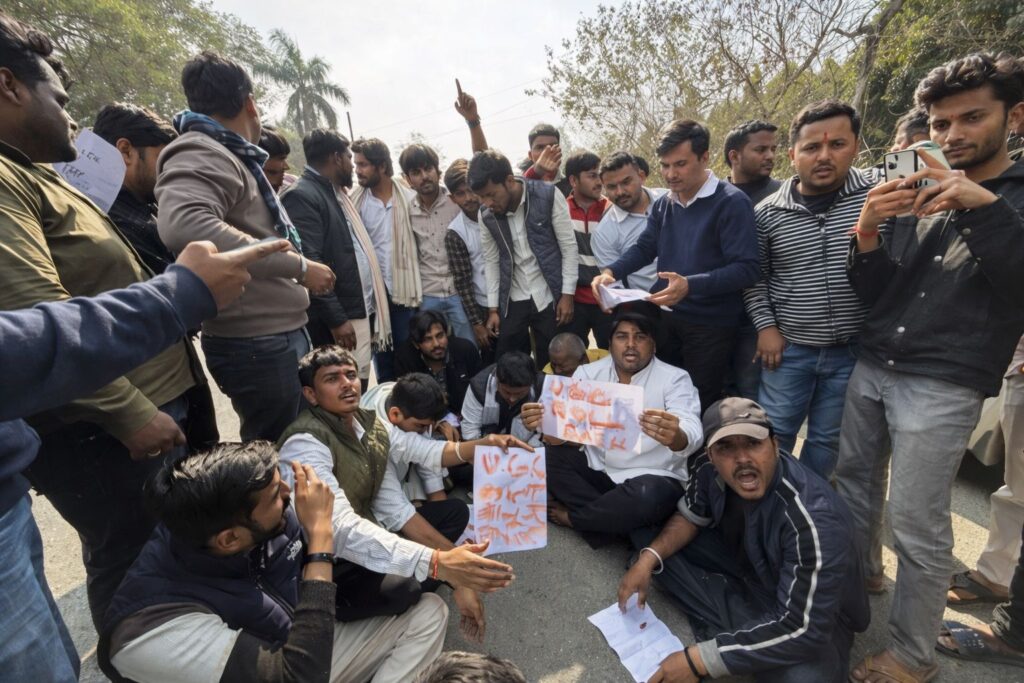
Protests erupted within days of the notification, beginning outside the UGC headquarters in Delhi and spreading to universities across Uttar Pradesh, Rajasthan, Bihar, and Delhi. Student groups and organizations, including the Savarna Sena, staged sit-ins demanding the withdrawal of the rules. At Lucknow University, students gathered in large numbers, expressing fears over vague definitions, procedural imbalance, and surveillance by Equity Squads.
The demonstrations quickly became a platform for political and administrative opposition. In Bareilly, city magistrate Alankar Agnihotri resigned, calling the rules “draconian” and warning of campus unrest. Several youth leaders from the BJP, including Raju Pandit in Noida, resigned, describing the rules as unfair and discriminatory toward general category students. Public interest litigation has been filed in the Supreme Court, challenging the regulations for violating principles of equality and due process.
Digital Backlash and Social Media Surge
The controversy has been amplified by social media platforms such as X (Twitter), Instagram, and Reddit. Hashtags like #UGCRollback and #ShameOnUGC have gained widespread traction, with thousands voicing concerns that the rules may discriminate against general category students and lack safeguards against false accusations.
Influencers, student organizations, and commentators have described the regulations as “one-sided” and even labeled them a “black law”, warning of potential reverse discrimination, increased campus conflict, and unwarranted monitoring by Equity Committees. Viral posts have emphasized that students from general or unreserved backgrounds could be treated as default suspects, a narrative that has resonated strongly online.
The Ministry of Education has responded by preparing clarifications to counter misinformation, reiterating the intended goals of the regulations and urging responsible implementation. This surge of online debate highlights how quickly policy discussions can spread digitally, influencing national perceptions of higher education reforms.
Government Response
Union Education Minister Dharmendra Pradhan addressed concerns directly, stating, “I assure everyone there will be no discrimination and no one can misuse the law.” He emphasized that the regulations aim to promote fairness and equity in higher education and urged institutions to implement them responsibly.
UGC officials also defended the regulations, noting they comply with Supreme Court directives from past discrimination cases. Authorities stressed that the rules are designed to protect historically disadvantaged students and strengthen anti-discrimination mechanisms, while acknowledging that misinterpretations online had contributed to unrest. Clarifications and stakeholder consultations are planned to ensure smooth implementation and public understanding.
Nationwide Impact and Outlook
The UGC equity regulations controversy underscores the delicate balance between social equity, institutional governance, and political dynamics in India’s higher education system. Universities are under scrutiny as they attempt to enforce the new rules amid ongoing protests, political resignations, and online debate.
The coming weeks are likely to be decisive. The Supreme Court petition, coupled with widespread campus demonstrations, could determine whether the regulations are revised, clarified, or upheld. The outcome may set a precedent for enforcing anti-discrimination policies, balancing equity with procedural fairness, and shaping public discourse on education reforms in India.
Until then, campus tensions remain high, and the debate over UGC equity rules continues to dominate both physical and digital spaces across the country.


