

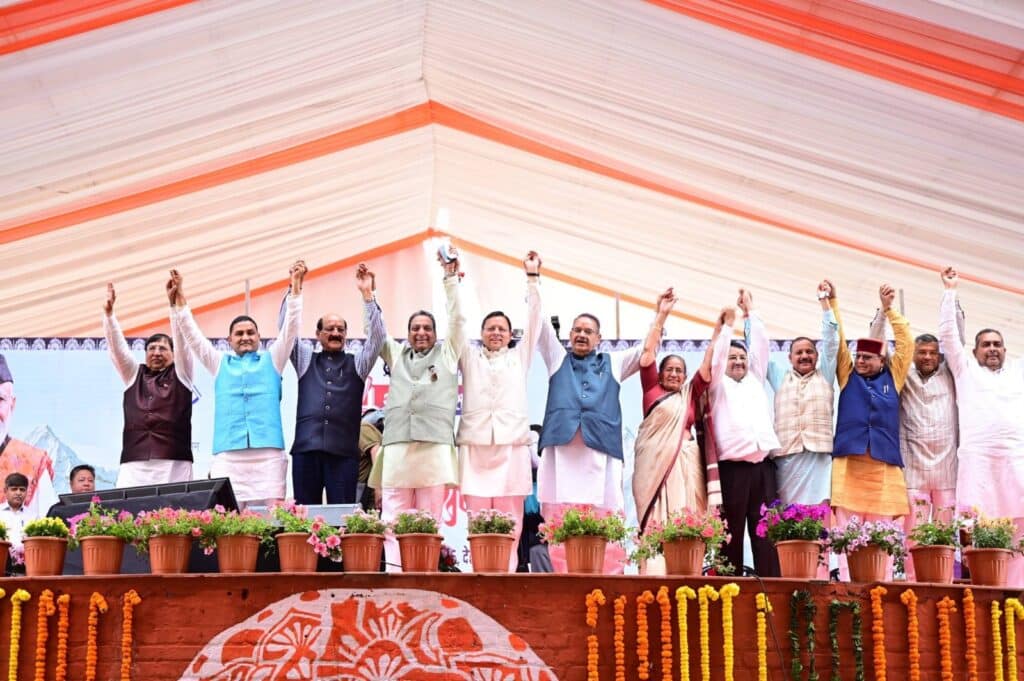
Chief Minister Pushkar Singh Dhami expanded his cabinet by inducting five new ministers and redistributing key portfolios, signalling a calibrated administrative and political reset ahead of the 2027 Assembly elections.
The expansion brings the council of ministers to its full strength and closes a gap that had persisted since 2022. It also fills vacancies created by the resignation of a senior minister and the death of another. The reshuffle reflects a balance between continuity and change, combining experienced leaders with new entrants while addressing regional and political considerations.
Officials indicated that the move is aimed at improving governance efficiency while strengthening the ruling party’s organisational reach across the state.
Five Inducted
Five MLAs were sworn in as cabinet ministers, including Ram Singh Kaira from Bhimtal, Madan Kaushik from Haridwar, Khajan Das from Rajpur Road, Pradeep Batra from Roorkee, and Bharat Singh Chaudhary from Rudraprayag.
The induction ensures representation from both the Garhwal and Kumaon regions, a factor that has historically influenced political strategy in Uttarakhand. The inclusion of leaders from diverse constituencies is expected to help the government address region-specific development concerns more effectively.
Party insiders said the selection reflects a mix of organisational experience, electoral performance, and regional balance.
Kaira’s Entry
Ram Singh Kaira has emerged as one of the most significant new entrants, having been assigned Urban Development, Environment, Climate Change, and Watershed Management portfolios.
The allocation places him in charge of sectors that are central to Uttarakhand’s development trajectory, particularly at a time when rapid urbanisation and environmental concerns are shaping policy priorities.
Speaking after assuming office, Kaira indicated that his immediate focus would be on strengthening urban local bodies, improving civic infrastructure, and addressing public grievances in cities and towns. “Our priority will be to make urban bodies more efficient, improve basic services, and ensure better planning to reduce public inconvenience,” he said.
He also emphasised environmental protection, noting that efforts would be intensified to promote afforestation, conserve water resources, and curb deforestation. His roadmap includes long-term planning to address drinking water challenges and ecological sustainability.
Uniyal Elevated
Senior minister Subodh Uniyal has been entrusted with the Medical Health and Medical Education departments, significantly expanding his role within the government.
Uniyal, who already holds portfolios such as Forest and Parliamentary Affairs, is now positioned at the centre of the state’s healthcare administration. The reassignment of the health portfolio from Dhan Singh Rawat marks a notable internal shift in responsibilities.
Government sources said the decision reflects the leadership’s confidence in Uniyal’s administrative experience and his ability to manage critical sectors. The move comes at a time when healthcare delivery remains a key governance priority in the state.
Portfolio Allocation
The reshuffle redistributed key departments among newly inducted ministers, aligning responsibilities with political and administrative priorities.
Madan Kaushik has been assigned Panchayati Raj, Disaster Management, and AYUSH, placing him in charge of grassroots governance and emergency response systems. Pradeep Batra will oversee Transport, Information Technology, and Science and Technology, sectors linked to infrastructure and digital growth.
Bharat Singh Chaudhary has been given Rural Development and MSME, focusing on rural economy and employment generation, while Khajan Das will handle Social Welfare and Minority Welfare, departments associated with social inclusion.
The allocation suggests an attempt to align governance responsibilities with both experience and regional influence.
Dhami Retains Core
Chief Minister Pushkar Singh Dhami has retained key portfolios including Home, Finance, Energy, Mining, Personnel, and Revenue, maintaining direct control over the state’s core administrative and financial machinery.
In a brief statement following the expansion, Dhami said the reshuffle was aimed at strengthening governance and accelerating development. “Our focus is on fast and transparent decision-making, balanced regional development, and effective implementation of welfare schemes,” he said.
By holding on to critical departments, the chief minister continues to exercise centralised oversight over policy execution and administrative coordination.
Internal Realignment
The cabinet reshuffle has also triggered a recalibration of roles among existing ministers. Dhan Singh Rawat has been relieved of the health portfolio and will now concentrate on education-related departments, while other senior leaders have seen adjustments in their responsibilities.
These changes indicate an internal realignment aimed at improving efficiency and accountability across departments. Political observers view the move as an effort to streamline governance while addressing performance-related concerns.
Political Calculus
The expansion carries significant political implications as Uttarakhand moves closer to the 2027 Assembly elections. The inclusion of leaders from both Kumaon and Garhwal reflects a conscious effort to maintain regional balance, a key factor in the state’s electoral dynamics.
Ram Singh Kaira’s elevation, in particular, underscores the importance of Kumaon in the ruling party’s strategy. His grassroots background and electoral track record are expected to strengthen the party’s position in the region.
At the same time, the blend of experienced leaders and new faces signals an attempt to balance continuity with renewal. Opposition parties have criticised the cabinet composition, pointing to the presence of leaders with past affiliations to rival parties, but the government has framed the reshuffle as a governance-focused exercise.
Kaira’s Political Rise
Ram Singh Kaira represents a grassroots political trajectory shaped by years of local engagement. He began his career in student politics and was elected student union president in the early 1990s, later participating in the Uttarakhand statehood movement.
He contested the 2012 Assembly elections unsuccessfully but gained prominence after winning as an independent candidate in 2017. In 2022, he secured a second term as a BJP MLA from Bhimtal, consolidating his political standing.
His rise to the cabinet reflects both his organisational role within the party and his sustained connect with local voters.
Governance and Electoral Outlook
The cabinet expansion led by Pushkar Singh Dhami marks a strategic shift that combines administrative restructuring with political positioning.
With Subodh Uniyal taking charge of the health sector and Ram Singh Kaira handling critical urban and environmental portfolios, the government appears to be focusing on sectors that directly impact public service delivery.
The reshuffle is expected to influence both governance outcomes and electoral dynamics in the run-up to 2027, as the administration seeks to strengthen performance while consolidating its political base.


