

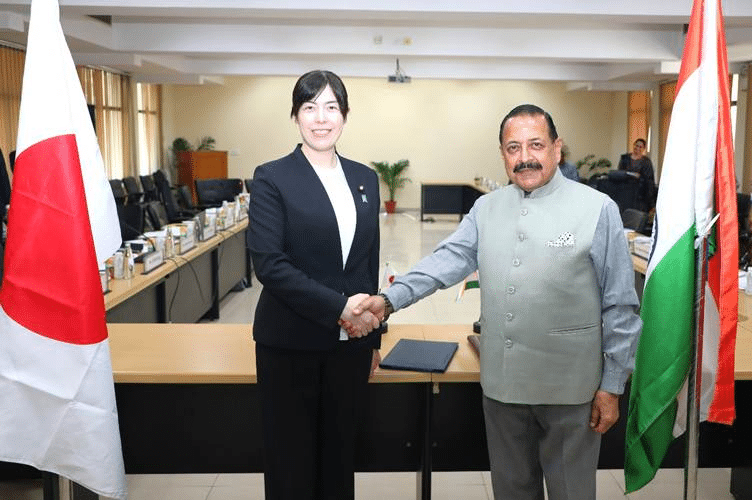
India and Japan on Wednesday signed two major agreements covering quantum technology and health research cooperation, marking a significant expansion of bilateral ties into high-priority scientific sectors. The agreements were finalised during talks in New Delhi between Union Minister of State for Science and Technology Dr Jitendra Singh and Japan’s Minister of State for Science and Technology Policy and Space Policy, ONODA Kimi.
The move comes as both countries seek stronger partnerships in advanced technology, secure supply chains, healthcare innovation and long-term economic resilience. Officials said the agreements are intended to create deeper institutional links, support joint research and strengthen collaboration between scientists, universities and innovation agencies in the two countries.
The latest development is also being seen as part of a wider shift in India-Japan relations, where science and technology are emerging alongside trade, infrastructure and strategic cooperation as central pillars of engagement.
Two Agreements Signed In New Delhi
The first agreement signed on Wednesday was a Memorandum of Cooperation in health and medical research involving Japan’s Agency for Medical Research and Development, India’s Indian Council of Medical Research and the Department of Science and Technology. Officials said the framework is expected to support cooperation in medical devices, biomedical innovation, diagnostics and public health research.
The second agreement was a Letter of Intent on cooperation in Quantum Science and Technology between Japan’s Cabinet Office and India’s Department of Science and Technology. This framework is aimed at promoting structured collaboration in one of the world’s fastest-growing scientific sectors.
The Ministry of Science and Technology said the agreements reflect a shared commitment to practical cooperation in areas that will shape future economic competitiveness and national capability.
Dr Jitendra Singh said the relationship between India and Japan had entered a stronger phase of scientific engagement.
“India and Japan share a natural synergy in science and technology, where Japan’s advanced capabilities and India’s skilled human resources complement each other,” he said.
Officials added that both sides agreed to maintain regular consultations to ensure the newly signed frameworks move quickly towards implementation.
Quantum Technology Becomes Central To Partnership
Quantum technology has become a major priority for governments around the world because of its potential impact on computing, cybersecurity, communications and industrial innovation. Unlike traditional systems, quantum platforms can process highly complex calculations at speeds not possible through classical computing methods.
India has already launched its National Quantum Mission, under which the government aims to develop domestic capabilities in quantum computing, quantum communication, sensing technologies and secure quantum networks. The programme is considered one of India’s flagship initiatives in frontier science.
Japan, meanwhile, has built a strong reputation in precision engineering, advanced electronics, semiconductor-linked systems and high-end research infrastructure. Officials said these strengths make Japan an important partner for India’s quantum ambitions.
During the discussions, both delegations reviewed possibilities for collaboration between Indian research institutions and Japanese quantum innovation hubs. These could include joint projects, academic exchanges, access to specialised facilities and coordinated development of next-generation technologies.
Dr Jitendra Singh said India had made steady progress in advanced sectors and was ready to deepen international cooperation.
Experts say the India-Japan framework is notable because quantum technology requires sustained cooperation between governments, universities and industry, making long-term international partnerships particularly valuable.
Health Research Cooperation Gains Momentum
Alongside quantum technology, the health research agreement is being viewed as an important practical step in strengthening scientific ties between the two countries. Officials said cooperation is expected in areas such as medical devices, disease surveillance, diagnostics, digital health systems and advanced biomedical research.
Japan is widely recognised for leadership in elderly care systems, robotics-assisted healthcare, precision diagnostics and high-end medical equipment. India has emerged as a major force in pharmaceuticals, vaccine production, telemedicine and cost-effective healthcare innovation.
The combination of these strengths could support collaborative projects with real-world public health value, particularly in affordable technology, disease management and improved healthcare access.
Officials said institutions from both countries are expected to identify specific areas of cooperation under the agreement in the coming months. These may include scientist exchanges, shared research studies and technical partnerships between laboratories and healthcare agencies.
ONODA Kimi praised India’s growth and expanding innovation environment during the meeting.
“India’s young researchers have demonstrated resilience, creativity and determination. Their ability to continue innovating after setbacks is highly impressive,” she said, according to officials briefed on the discussions.
Her remarks were seen as recognition of India’s growing role in the global research ecosystem and the increasing importance of its scientific talent base.
Leaders Emphasise Strategic Importance
The agreements were signed against the backdrop of a rapidly evolving global technology landscape, where countries are seeking dependable partners in critical sectors. Science and innovation are increasingly linked not only to economic growth but also to national security, industrial competitiveness and resilient supply chains.
Dr Jitendra Singh said the latest understandings build on momentum created during Prime Minister Narendra Modi’s visit to Japan last year, when both sides discussed expanding cooperation in advanced sectors.
“Following Prime Minister Narendra Modi’s visit to Japan, India-Japan cooperation in science and technology has gained renewed momentum and strategic depth,” he said.
Officials noted that India and Japan already work closely in infrastructure development, transport connectivity, clean energy, semiconductors and manufacturing partnerships. The expansion into quantum science and health research indicates a further broadening of the relationship into high-value knowledge sectors.
For India, closer cooperation with Japan offers access to advanced technology ecosystems, industrial expertise and research collaboration. For Japan, India offers scale, talent, expanding institutions and one of the world’s fastest-growing innovation markets.
Diplomatic observers said the move also reflects growing confidence between two Indo-Pacific partners seeking stable and trusted cooperation in a period of global uncertainty.
Implementation Talks To Follow
With the agreements now signed, the next phase is expected to focus on execution through direct coordination between participating institutions. Officials said discussions will continue on timelines, priority projects, research funding models and mechanisms for regular review.
Both sides also discussed researcher mobility, academic exchanges and stronger links between universities, startups and industry bodies. People familiar with the talks said internship opportunities in Japan for Indian researchers and deeper innovation partnerships were among the subjects raised.
Such steps are considered important because international science agreements often depend on sustained institutional follow-through rather than ceremonial announcements alone.
The signing in New Delhi is being viewed as another milestone in the steady evolution of India-Japan ties. What began largely through economic and infrastructure cooperation is now extending into frontier science, healthcare systems and advanced technology collaboration.
As both countries increase focus on innovation-led growth, Wednesday’s agreements suggest that science diplomacy will play a larger role in the next chapter of the India-Japan partnership.


