

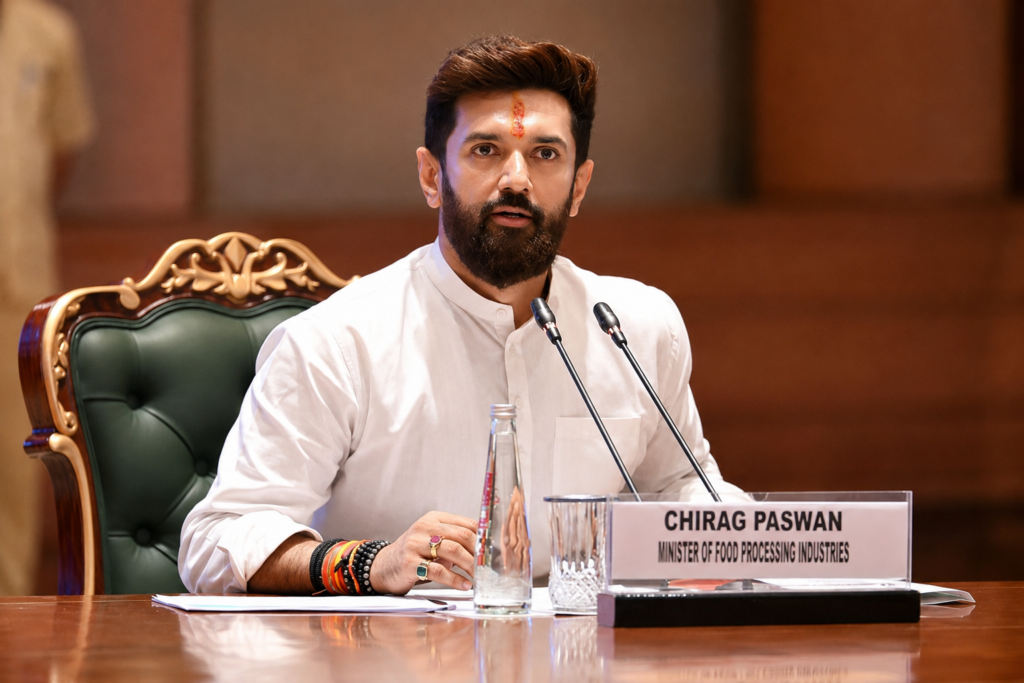
Union Minister Chirag Paswan has defended India’s reservation system as a constitutional entitlement rather than a discretionary benefit, amid an ongoing protest at Delhi’s Jantar Mantar calling for sweeping changes to caste-based quotas. Speaking to reporters at Patna airport on 23 August, shortly before departing for the capital, the Lok Janshakti Party (Ram Vilas) chief said reservation could not be withdrawn on the basis of public demand and called for the matter to be addressed through dialogue rather than agitation. His remarks were seen as a direct response to the demonstration that had gathered momentum over the preceding days, with organisers pressing for a wide-ranging overhaul of the existing quota framework. Paswan, who leads a party that has long positioned itself as a voice for Scheduled Caste communities, chose to address the controversy publicly rather than allow the debate to be shaped solely by the protesters or by his political rivals, underlining what he described as the enduring constitutional basis of the policy.
His intervention comes at a sensitive moment for the government. The protest at Jantar Mantar has drawn thousands of participants from several states, prompted a standoff with Delhi Police over venue permissions, and revived a long-running national debate over caste, merit and social justice.
What Chirag Paswan Said About Reservation
Speaking before his departure for Delhi, Paswan set out his position on reservation in unambiguous terms, describing it as a right guaranteed by the Constitution rather than a concession granted by the state.
“Reservation is not something that can be ended simply because someone demands it. Nor is it charity given to anyone. Reservation is a constitutional right,” Paswan said, according to accounts of the airport interaction.
He went on to link the policy to India’s history of social exclusion, noting that the Constitution had recognised the disadvantages historically faced by Scheduled Castes and Scheduled Tribes and had established reservation as a means of addressing that imbalance. He argued that the forms of discrimination which originally justified the policy had not been eliminated, and that the system therefore retained its relevance.
Paswan did not dismiss the protesters’ concerns outright. He acknowledged their right to express dissent but maintained that any grievances should be resolved through discussion rather than calls for abolition, adding that dialogue could help clarify the historical and constitutional rationale behind the policy.
This is not the first occasion on which Paswan has taken a firm public stand on reservation. Reacting last year to the Union Public Service Commission’s move to fill senior posts through lateral entry on a contractual basis, a step critics said bypassed reservation norms, he said plainly:
“Reservation provisions must be there in any government appointment. There is no ifs and buts in this. No reservation exists in the private sector and if it is not implemented in government positions as well… it is a matter of concern for me,” Paswan told reporters at the time, adding that his party was “absolutely not in support of such a measure.” He also noted his position within government gave him a means to press the issue: “As a member of the government, I have the platform to raise the issue and I will.”
Paswan has also had to publicly correct the record on his position in the past. During campaigning for the 2024 Lok Sabha elections, after Rashtriya Janata Dal leader Tejashwi Yadav repeatedly claimed at rallies that Paswan supported scrapping reservation for more affluent Dalit families, Paswan rejected the charge in direct terms:
“It is false. Tejashwi Yadav is speaking lies at rally after rally. He must stop it, else I may resort to legal action,” he said, challenging Yadav to “show any statement by me in which I may have spoken, on record, in favour of scrapping quotas for rich Dalits.”
The Jantar Mantar Protest That Prompted the Remarks
Paswan’s comments followed a large demonstration organised under the banner of the “Reservation Hatao Andolan”, a campaign that began on Instagram and has since grown to more than five million followers. The protest, held at Jantar Mantar on 21 August, drew participants from Bihar, Uttar Pradesh, Karnataka, Rajasthan and other states.
The gathering was contested from the outset. Delhi Police said no permission had been granted for a demonstration at Jantar Mantar and offered an alternative venue at Ramlila Ground, with attendance capped at 500 people until 4pm. A significant number of protesters declined to relocate and remained at Jantar Mantar beyond the deadline, prompting the deployment of police and Rapid Action Force personnel.
Protest organiser Abhishek Agnihotri said the demonstration would continue only at Jantar Mantar and that participants intended to raise their demands peacefully without obstructing law enforcement. Several attendees told reporters they had travelled to Delhi because they believed existing reservation policies in competitive examinations and government recruitment disadvantaged general-category candidates with higher scores.
Core Demands Raised by the Protesters
The demonstration reflected a range of overlapping grievances aimed largely at reforming, rather than entirely dismantling, the existing framework. The principal demands included:
- Introducing economic criteria alongside, or in place of, caste-based categories for reservation benefits
- Rolling back the University Grants Commission’s 2026 caste-equity rules, which have since been stayed by the Supreme Court
- Enforcing a “one family, one reservation” policy to prevent repeated benefit claims within the same household
- Reviewing the creamy layer provision and addressing so-called “quota within quota” arrangements
- Introducing stricter verification of eligibility for existing quota beneficiaries
- Calls, from some sections, for repeal of the Scheduled Castes and Scheduled Tribes (Prevention of Atrocities) Act
Taken together, the demands suggest the protest is driven not only by opposition to caste-based reservation in principle, but by broader concerns over employment competition and the perceived misuse of the system.
Political Reactions Beyond Paswan’s Statement
The protest has drawn wider political attention. Leader of the Opposition in the Lok Sabha, Rahul Gandhi, staged a separate dharna outside the Parliament Street police station, alleging that authorities had declined to register a complaint from a student who said they had sustained pellet-gun injuries during an earlier protest at the same venue on 20 July. Delhi Police has since indicated that a First Information Report will be registered in connection with the complaint.
The episode has added to an already charged atmosphere, with opposition leaders accusing the administration of heavy-handedness and protest organisers accusing the government of failing to engage with their demands. Misinformation has also featured prominently, with fact-checkers identifying a widely shared video falsely claimed to show large crowds at Jantar Mantar; the footage was later traced to an unrelated protest in Jaipur earlier in August.
Paswan’s position places him in a familiar, if delicate, role. As a Dalit leader within the ruling National Democratic Alliance, he has previously disputed claims made by Rashtriya Janata Dal leader Tejashwi Yadav that he supported diluting reservation for more affluent Dalit families. Paswan has repeatedly denied holding such a position and has stated publicly that reservation must remain intact in government appointments without exception.
Why the Reservation Debate Continues to Resurface
Reservation has remained among the most enduring and contested issues in Indian public life since it was first written into the Constitution to support historically marginalised communities. Protests on the subject, whether from groups seeking wider inclusion or from those seeking reform of existing quotas, tend to recur whenever competitive examinations, recruitment processes or education policy changes return the issue to public attention.
The current unrest follows a separate wave of student-led protests earlier this year over examination irregularities and alleged paper leaks, which contributed to the resignation of a senior education official. Some observers suggest that the reservation debate has drawn on the momentum generated by those earlier demonstrations.
For the present, the government’s position, as articulated by Paswan, is that reservation remains a constitutionally protected mechanism for social justice rather than a policy open to negotiation under public pressure. Whether this position leads to the structured dialogue he has proposed, or whether the protests gather further momentum, is likely to shape the next stage of the debate.


