

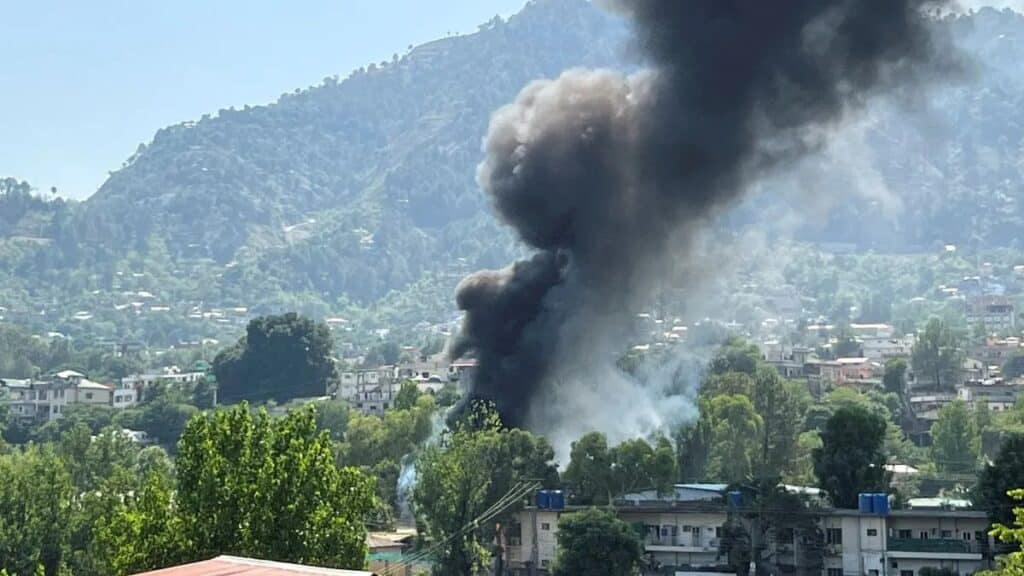
A Pakistan Army Aviation Mi-17 helicopter crashed near Muzaffarabad in Pakistan-occupied Kashmir (PoK) on Wednesday, killing all personnel on board and prompting a military investigation into one of the region’s most significant aviation incidents this year.
According to Pakistani military officials, the helicopter went down shortly after take-off after developing a technical fault. Rescue teams and emergency responders rushed to the crash site, but there were no survivors. While authorities have not yet released a final official casualty list, multiple local media reports said 21 people, including two pilots and 19 security personnel, were believed to have been on board the aircraft.
The crash occurred at a sensitive moment for Pakistan-administered Kashmir, where security forces have been operating under heightened alert amid recent political unrest and demonstrations. Officials have stressed that there is currently no evidence linking the crash to the security situation in the region, but the incident has nevertheless attracted widespread attention because of its timing and location.
A formal board of inquiry has been ordered to determine the exact cause of the accident.
The Crash
Initial reports indicate that the Mi-17 helicopter crashed moments after taking off from a military facility near Muzaffarabad. Pakistan’s military said the aircraft experienced a technical malfunction during the take-off phase, causing it to lose control before crashing.
Witnesses reported hearing a loud explosion and seeing thick smoke rising from the area shortly after the aircraft went down. Emergency services, ambulances and military rescue teams were immediately dispatched to the scene as authorities launched recovery operations.
The mountainous terrain surrounding Muzaffarabad reportedly complicated access to parts of the crash site. However, rescue personnel were able to reach the wreckage quickly and secure the area while recovery efforts continued for several hours.
The Mi-17 is one of the most widely used transport helicopters in Pakistan’s military fleet and is regularly deployed for troop movement, logistics support and operations in difficult terrain. Aviation experts note that technical failures occurring during take-off can be particularly dangerous because crews have limited altitude and time available to respond to emergencies.
Officials have not disclosed the precise nature of the suspected fault, and investigators are expected to examine the aircraft’s engines, rotor systems, maintenance records and operational history as part of the inquiry.
Unrest In PoK
The crash comes amid growing tensions in Pakistan-occupied Kashmir, where authorities have recently increased security deployments following protests and demonstrations organised by the Joint Awami Action Committee (JAAC).
The movement has been at the forefront of public protests over governance issues, economic concerns and local grievances. In recent weeks, demonstrations have drawn significant crowds across several districts, leading to confrontations between protesters and security forces.
Reports indicate that authorities deployed additional Rangers and paramilitary personnel in response to the unrest. Residents in Muzaffarabad and nearby areas have described an increased security presence, additional checkpoints and intensified patrols.
Although officials have not disclosed the exact mission of the helicopter, reports suggest it may have been transporting security personnel operating in the region. Pakistani authorities have emphasised that there is no evidence that the crash was linked to the protests or any form of hostile action.
The timing of the incident, however, has intensified public interest in the accident and increased scrutiny of security operations in the region.
Leaders React
Pakistan’s civilian and military leadership expressed condolences following the tragedy.
President Asif Ali Zardari conveyed his grief over the loss of military personnel and extended sympathies to the families of those killed in the crash.
Prime Minister Shehbaz Sharif described the deaths as a painful national loss and said the government stood with the bereaved families during their time of mourning.
Pakistan Army chief Field Marshal Asim Munir also expressed condolences and directed authorities to ensure a comprehensive investigation into the accident.
“We share the grief of the families of the martyrs and pray for strength and patience for their loved ones,” military statements said while reaffirming the army’s commitment to establishing the exact circumstances of the crash.
The deaths have highlighted the risks faced by military personnel operating in mountainous and strategically sensitive regions where aviation assets play a critical role in transportation and logistics.
Investigation Begins
Pakistan’s military has launched a formal inquiry to establish the cause of the accident.
Investigators are expected to analyse wreckage recovered from the crash site, review maintenance logs, inspect operational records and interview witnesses. The inquiry will seek to determine whether the crash resulted from a single technical failure or whether other factors contributed to the tragedy.
Military aviation specialists caution that investigations into helicopter accidents can take weeks or even months. Establishing the precise sequence of events often requires detailed examination of aircraft components, maintenance histories and operational procedures.
Authorities have also moved to counter speculation circulating on social media. While unverified claims suggested possible sabotage or hostile action, officials have repeatedly stated that there is currently no evidence supporting such theories.
Pakistan’s military has maintained that preliminary assessments point towards a technical fault, although investigators have stressed that final conclusions will only be reached after a thorough examination of all available evidence.
The findings of the inquiry are expected to be closely watched, particularly given the strategic importance of military aviation operations in Pakistan-administered Kashmir.
Why It Matters
The crash has significance beyond the immediate loss of life because of both the location and the wider context in which it occurred.
Muzaffarabad serves as the administrative capital of Pakistan-occupied Kashmir and is one of the region’s most important logistical and security centres. Located near the Line of Control (LoC), it plays a key role in coordinating administrative and security operations.
The incident has also renewed attention on Pakistan’s military aviation safety record. In September 2025, another Pakistan Army Mi-17 helicopter crashed during a training mission in Gilgit-Baltistan, killing five personnel. In August 2022, a military helicopter carrying senior officers, including Lieutenant General Sarfraz Ali, crashed in Balochistan, resulting in the deaths of all six people on board.
While investigators have not suggested any connection between those accidents and the latest crash, the incidents have periodically raised questions about maintenance standards, operational pressures and the challenges of flying military aircraft in difficult environments.
For Pakistan’s armed forces, the Muzaffarabad crash represents both a human tragedy and a significant operational loss. For the families of those killed, attention now turns to the investigation and the search for answers about what caused a military helicopter to crash moments after take-off.
As recovery efforts conclude and investigators continue their work, the findings of the inquiry will be crucial in determining whether the accident was an isolated technical failure or indicative of broader aviation safety concerns.


