

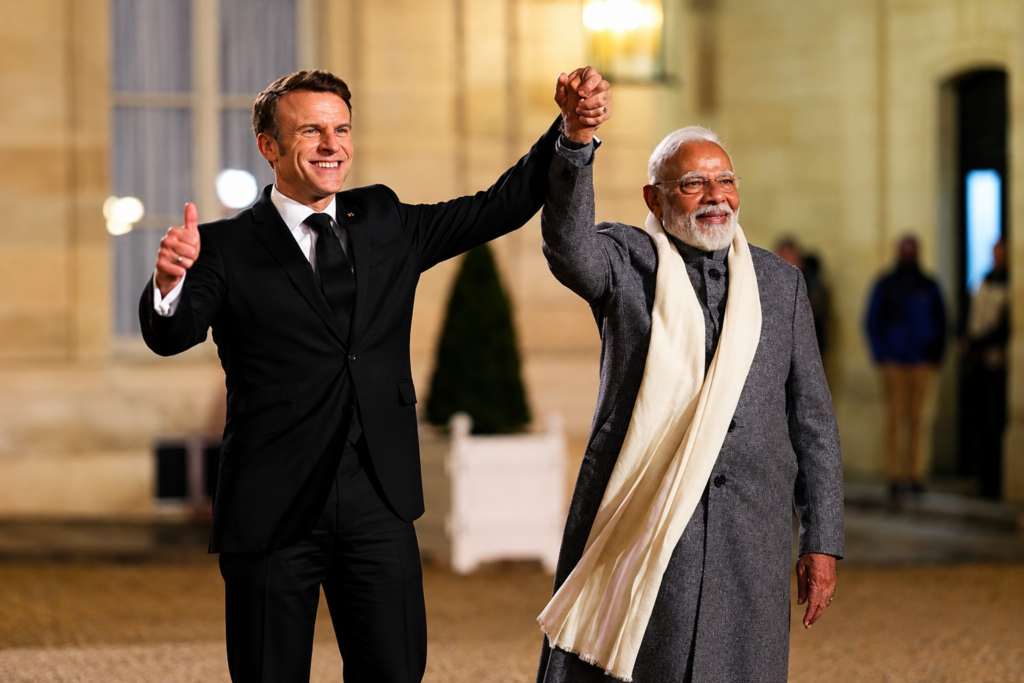
Prime Minister Narendra Modi on Sunday used the international platform in Nice, France, to make one of India’s strongest global pitches yet on technology, innovation and strategic economic partnerships, positioning the country as an emerging force in the deep-tech race. Standing alongside French President Emmanuel Macron at the launch of Bharat Innovates 2026, Modi projected India’s rapidly expanding startup ecosystem as a major pillar of future global growth at a time when the world is grappling with war, climate pressure, supply chain disruptions and economic fragmentation.
The summit, part of the India-France Year of Innovation 2026, marks an important diplomatic and economic moment for New Delhi. More than 100 Indian startups, investors, policymakers and technology institutions are participating in the event, which has been designed to deepen cooperation between India and Europe in frontier sectors. Modi’s France visit also comes at a critical time, just ahead of the G7 summit, where global leaders are expected to focus heavily on artificial intelligence, economic security and geopolitical stability.
At the heart of Bharat Innovates lies India’s broader effort to reposition itself in the global technology order. New Delhi is increasingly making the case that India should not be seen only as a large market for innovation, but as a country capable of creating and exporting the technologies that will shape the future.
India’s Startup Push
Addressing entrepreneurs, investors and technology leaders in Nice, Prime Minister Modi said India’s startup ecosystem has witnessed unprecedented growth over the past decade and is now contributing significantly to both national development and the wider global economy.
“Bharat innovates for a sustainable future and for the world,” Modi said in his keynote address.
He highlighted the scale of India’s startup expansion, noting that while Bharat Innovates itself features around 100 to 125 startups, the country now has more than 200,000 registered startups across sectors. That growth, he said, reflects the transformation of India into one of the world’s largest and fastest-growing innovation hubs.
Modi stressed that innovation is no longer confined to digital platforms or software services. He argued that the next phase of growth will be driven by frontier technologies that are expected to redefine industries, economies and national capabilities.
“This decade is about both disruption and development,” he said.
The Prime Minister identified artificial intelligence, quantum computing, biotechnology, space technologies and advanced materials as the five sectors likely to shape the future of humanity.
His remarks align with India’s recent policy direction, which has focused heavily on semiconductor manufacturing, AI infrastructure, renewable energy technologies and indigenous defence systems. For New Delhi, innovation has increasingly become part of a larger strategic framework tied to economic resilience and technological independence.
The Investment Pitch
Bharat Innovates has also emerged as a major investment platform aimed at accelerating India’s deep-tech ambitions.
Government officials and industry participants say the summit could facilitate nearly $1.5 billion in capital commitments for India’s deep-tech ecosystem, particularly in sectors such as artificial intelligence, semiconductors, climate-tech, biotechnology and industrial manufacturing.
The investment focus marks a significant shift in India’s startup landscape.
For much of the past decade, the country’s startup boom was largely driven by consumer-focused sectors like e-commerce, food delivery and fintech. But Bharat Innovates reflects a growing shift towards high-value strategic sectors where long-term research and innovation are central.
Industry experts say deep-tech startups often require longer funding cycles, stronger institutional partnerships and patient capital, unlike traditional consumer businesses.
The summit has been structured to directly connect Indian startups with European venture capital firms, sovereign funds, research bodies and industrial partners. Officials say this model is designed to improve cross-border collaboration and create faster access to global markets.
For Europe, the summit also offers a chance to identify alternative technology partnerships as concerns over overdependence on Chinese supply chains continue to grow.
For India, this creates a major opening.
Modi’s Global Warning
A major part of Modi’s address focused on the broader global crises shaping the current economic and technological environment.
“The world is going through an unprecedented phase of turbulence due to conflicts and the growing impact of climate change,” he said.
The statement comes amid multiple global flashpoints, including ongoing wars, trade disruptions and climate emergencies, all of which have placed new pressure on governments and industries.
Modi argued that such crises, while serious, also create opportunities for innovation and adaptation.
“Challenges also bring equal opportunities,” he said.
The Prime Minister linked technological development directly to global resilience, suggesting that countries investing in innovation today will be better equipped to deal with future shocks.
His comments fit into India’s broader diplomatic messaging, where New Delhi increasingly presents itself as a stable and innovation-driven economy capable of contributing to solutions in healthcare, energy, climate and digital governance.
The speech also carried an important geopolitical message. In a world increasingly divided by technology competition, India wants to establish itself as a trusted democratic technology power.
That ambition is expected to remain central during Modi’s upcoming meetings at the G7.
France Backs India
French President Emmanuel Macron used the summit to reaffirm France’s growing strategic and economic partnership with India.
Standing alongside Modi, Macron praised India’s rise as one of the world’s most dynamic innovation ecosystems and said France sees India as a long-term technology partner.
“India is one of the world’s most dynamic innovation ecosystems, and France wants to build the future together with India,” Macron said.
The statement reflects how the India-France relationship has evolved beyond defence and civil nuclear cooperation into a wider strategic partnership that now includes AI, semiconductors, energy and industrial technology.
Officials from both sides are expected to continue discussions on semiconductor cooperation, AI safety frameworks, critical minerals and supply chain resilience.
For France and the wider European Union, India’s importance has grown significantly as the region seeks to reduce strategic dependence on both China and the United States in sensitive technology sectors.
Macron’s remarks in Nice highlighted Europe’s increasing willingness to treat India as a central partner in that transition.
Europe and Beyond
The Nice summit is only the first stop in Prime Minister Modi’s six-day Europe tour, but it has already set the tone for India’s broader diplomatic strategy. After France, Modi will travel to Slovakia, marking the first bilateral visit by an Indian Prime Minister there since the country’s independence in 1993.
The Slovakia leg is expected to focus on trade, industrial cooperation and expanding India’s engagement in Central Europe.
From there, Modi will head to Évian-les-Bains for the G7 summit, where India is expected to push for stronger representation of developing nations in global decision-making.
Ahead of the summit, Modi said, “At the G7, India will voice the aspirations, priorities and concerns of the Global South.”
That message reflects India’s growing ambition to position itself as a bridge between advanced economies and emerging nations.
Taken together, Modi’s Europe tour underlines a broader strategy where technology, diplomacy and trade are increasingly interconnected. Bharat Innovates is central to that effort. It serves not just as a startup showcase, but as a statement of intent from New Delhi that India wants to play a larger role in shaping the future global economy.
The message from Nice was clear. India is no longer content with being viewed only as the world’s fastest-growing major economy. It wants to be recognised as one of the countries building the technologies that will define the next global era.


