

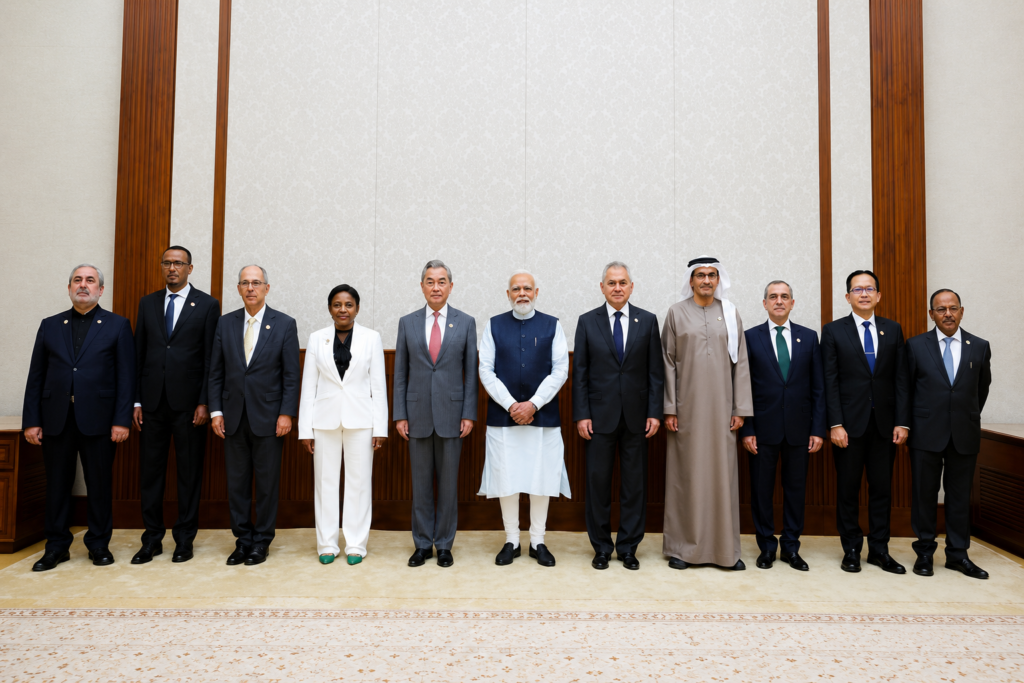
The expanding BRICS alliance took a decisive step into global security politics this week as Prime Minister Narendra Modi hosted national security advisers from the 11-member bloc in New Delhi, signalling the grouping’s growing role in addressing terrorism, cybersecurity, energy security and emerging technological threats. The high-level meeting, held under India’s BRICS chairmanship for 2026, reflected a broader shift in the bloc’s identity, moving beyond economic cooperation into strategic security coordination.
The 16th BRICS National Security Advisers’ Meeting came at a time of rising geopolitical instability, with conflicts in West Asia, cyberattacks on critical infrastructure and rapidly evolving digital threats reshaping the global security landscape. For India, the summit was both a diplomatic opportunity and a strategic test, as New Delhi seeks to position itself at the centre of the security agenda of the Global South.
Modi Raises Stakes
Prime Minister Narendra Modi’s direct engagement with the BRICS security chiefs gave unusual political significance to the summit, elevating it beyond a routine strategic consultation.
In his address, Modi stressed that the bloc must deepen cooperation to deal with increasingly complex threats.
“BRICS has a vital role in deepening security cooperation and addressing challenges like terrorism and cybersecurity,” he said.
His remarks reflected India’s broader effort to place security at the heart of BRICS policymaking. With the bloc now expanded from five to eleven members, the stakes have grown considerably. The inclusion of Iran, Egypt, Ethiopia, Saudi Arabia, the United Arab Emirates and Indonesia has widened BRICS’ geopolitical footprint, bringing together major energy producers, fast-growing economies and strategically important trade corridors.
For India, the message was clear: BRICS can no longer remain limited to trade and development. It must adapt to an era of cross-border threats.
Doval’s Warning
National Security Adviser Ajit Doval delivered the summit’s sharpest warning, arguing that the nature of modern threats has fundamentally changed.
His remarks highlighted the rise of hybrid warfare, where physical violence is increasingly merged with cyber disruption, digital sabotage and disinformation campaigns.
Doval identified three major concerns shaping today’s security environment:
- disguised and decentralised terrorism
- cyberattacks on critical infrastructure
- AI-driven misinformation and extremist networks
He warned that terrorist groups are becoming more sophisticated, using encrypted communications, anonymous financial systems and online recruitment channels to avoid detection.
“Innovative disruptive technologies, more camouflaged variants of terrorism, and cyber threats in an increasingly digitised world constitute an important threat for us,” he said.
For India, which continues to face terror threats and cyber intrusions, the warning reflects an urgent and immediate reality.
Agenda and Action
India’s Ministry of External Affairs spokesperson Randhir Jaiswal laid out the summit’s agenda, emphasising that the discussions were focused on practical cooperation rather than symbolic declarations.
“The agenda is how the BRICS countries together deal with non-traditional security challenges that the world confronts,” Jaiswal said.
He said the meeting reviewed the outcomes of BRICS Joint Working Groups on counterterrorism and the secure use of information and communication technologies.
“They would discuss the evolving nature of national security challenges and the role of new technologies in the emerging security threats,” he added.
The working groups have become increasingly important as BRICS attempts to institutionalise security cooperation. Their focus includes terror financing surveillance, cyber incident response, extremist propaganda and digital infrastructure resilience.
India has repeatedly argued for a zero-tolerance global framework against terrorism, saying existing international mechanisms have often failed to establish universal standards. Through BRICS, New Delhi now appears to be pushing for an alternative framework built around stronger intelligence cooperation and practical coordination.
Iran and China
The Delhi summit also became an important platform for bilateral diplomacy. On the sidelines, Doval held separate meetings with counterparts from Iran, China, Brazil, Ethiopia and South Africa.
The meeting with Iran carried particular significance given the continuing instability in West Asia. With BRICS now including major oil producers such as Iran, Saudi Arabia, Russia and the UAE, energy security has become deeply linked to the bloc’s strategic calculations.
Any escalation affecting the Strait of Hormuz could disrupt global oil supplies and shipping routes. For India, which imports more than 80 percent of its crude oil, that remains a major concern.
Equally important was Doval’s engagement with Chinese Foreign Minister Wang Yi. Both sides acknowledged what officials described as “gradual normalisation” in bilateral ties, a notable signal after years of tension following the 2020 border clashes.
While political trust remains fragile, BRICS has become one of the few stable diplomatic spaces where India and China continue regular high-level strategic dialogue.
A New BRICS
The biggest takeaway from the Delhi summit is the transformation of BRICS itself. For years, the grouping was largely defined by economic cooperation, development banking and calls for a multipolar world order. That identity is now evolving.
Terrorism, cybersecurity, energy disruptions and technological warfare are becoming central to the BRICS agenda. That shift matters because the bloc now represents nearly half the world’s population and controls a significant share of global energy production and trade infrastructure.
For India, this presents a strategic opportunity. As BRICS chair in 2026, New Delhi is positioning itself as a key architect of the bloc’s emerging security framework.
Whether BRICS can fully evolve into a structured security mechanism remains uncertain, given the competing geopolitical interests among its members. But the signal from Delhi is unmistakable.
The security challenges of the future will be borderless, digital and increasingly difficult to contain. And BRICS is now preparing to confront them together.


