

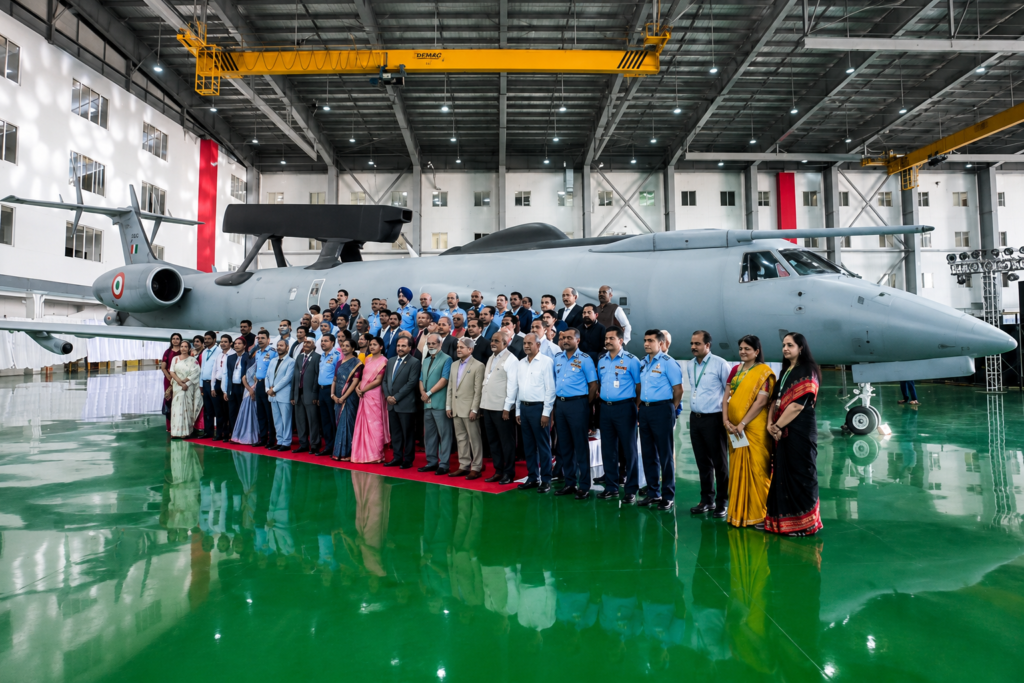
India’s indigenous Netra Airborne Early Warning and Control (AEW&C) system has received Final Operational Clearance (FOC), formally certifying the platform for unrestricted operational deployment with the Indian Air Force and marking the completion of a 22-year-long defence programme.
The Defence Research and Development Organisation (DRDO) handed over the FOC certificate to the Indian Air Force on June 25 in Bengaluru, completing the final phase of a programme sanctioned in 2004 to establish India’s first indigenous airborne surveillance platform.
The Netra AEW&C system completed its maiden flight in 2011 and received Initial Operational Clearance (IOC) in 2017. The FOC now confirms that all operational, technical and mission parameters have been validated.
The ceremony was attended by senior military officials, including Air Marshal Awadhesh Kumar Bharti, Deputy Chief of Air Staff, and DRDO Chairman Dr. Samir V Kamat.
“Netra has been a part of the Indian Air Force from before also, but it is a remarkable day in the sense that whatever we envisaged on this programme has now been delivered in full,” Air Marshal Bharti said.
FOC completes certification
Final Operational Clearance is the final stage of military aviation certification, confirming that a platform has completed all operational testing and is cleared for unrestricted frontline deployment.
With the FOC, all three Netra Mk1 aircraft currently in service with the Indian Air Force are now fully certified.
The three aircraft are operated by No. 200 Squadron based at Bhisiana Air Force Station in Punjab, where they form part of India’s airborne surveillance fleet.
DRDO Chairman Samir V Kamat said the certification marked an important milestone in India’s indigenous aerospace capability.
Operational deployments
The Netra AEW&C system has already been deployed in multiple operational scenarios before receiving final clearance.
Indian Air Force officials confirmed the aircraft was used during the 2019 Balakot airstrikes, the 2020 India-China military standoff in eastern Ladakh, and Operation Sindoor.
These deployments were part of the operational validation process and helped assess the system under active mission conditions.
The use of Netra during these operations established its role in airborne surveillance, target tracking and airspace monitoring.
System capability
The Netra AEW&C platform is designed to detect and track enemy aircraft, drones, cruise missiles and maritime threats over long distances.
It is mounted on the Brazilian-made Embraer EMB-145 aircraft and carries an Active Electronically Scanned Array radar developed by DRDO’s Centre for Airborne Systems.
The system provides 240-degree radar coverage and can track multiple airborne targets simultaneously.
The aircraft also has air-to-air refuelling capability, allowing longer surveillance endurance during extended missions.
Unlike ground-based radar systems, airborne early warning aircraft can detect low-flying targets hidden by terrain and monitor deeper into contested airspace.
The Netra mission package includes indigenous radar systems, communication suites, identification friend-or-foe systems, electronic support measures and secure data links.
Programme development involved multiple DRDO laboratories, including the Centre for Airborne Systems, Electronics and Radar Development Establishment, Defence Electronics Application Laboratory, Defence Avionics Research Establishment and Defence Electronics Research Laboratory.
Fleet strength
The Indian Air Force currently operates six major airborne warning platforms, including three Netra Mk1 systems and three Israeli-origin Phalcon AWACS aircraft.
These systems form the core of India’s airborne surveillance and battle management capability.
Military planners have identified the need for additional airborne warning systems to maintain sustained coverage across India’s western and northern sectors.
The FOC for Netra expands India’s fully certified airborne surveillance fleet and strengthens domestic capability in this sector.
Programme history
The Netra programme follows an earlier failed attempt by India to build an airborne warning system.
In 1999, India’s first AEW&C prototype based on an HS-748 Avro aircraft crashed during testing, killing eight personnel on board.
The incident halted the earlier programme.
At the FOC ceremony, DRDO and Indian Air Force officials dedicated the Netra achievement to those who lost their lives during that mission.
The current programme was developed after that setback and has now completed its full operational cycle.
Next phase
The government has already approved the next phase of the Netra programme under the Netra Mk2 project.
The Cabinet Committee on Security has cleared nearly Rs 11,000 crore for six larger AEW&C aircraft based on the Airbus A321 platform.
The Netra Mk2 system is expected to provide full 360-degree radar coverage, longer endurance and higher sensor capacity compared to the current Netra Mk1 fleet.
Air Marshal Bharti said additional airborne surveillance programmes are already under development.
“We have other programmes in the offing, and that is what the country needs,” he said.
The Final Operational Clearance of Netra completes the operational certification of India’s first indigenous AEW&C system and adds a fully cleared surveillance platform to the Indian Air Force inventory at a time of expanding regional air defence requirements.


