

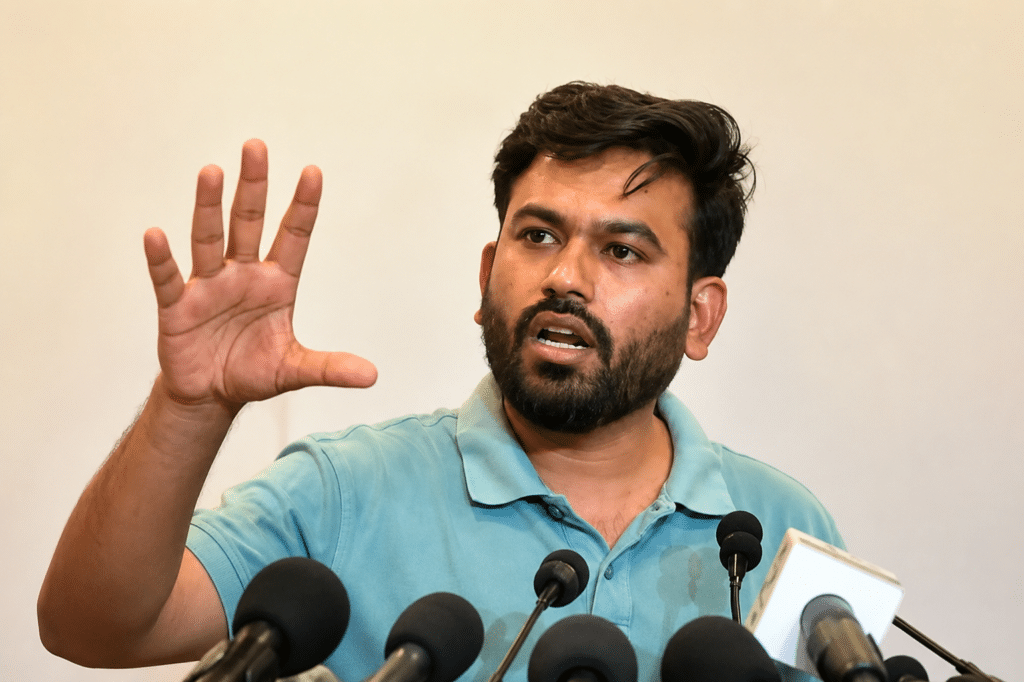
A fresh political controversy has emerged around the student-led agitation at Jantar Mantar in New Delhi after Cockroach Janata Party founder Abhijeet Dipke alleged that phones of protest organisers were under active surveillance. The allegation, made on the 13th day of the ongoing protest, has sharply widened the scope of what began as a movement against alleged examination irregularities, particularly the NEET paper leak controversy, into a larger national debate over privacy, state accountability and civil liberties.
The protest, which started on June 20, has steadily gathered momentum with students, education activists and civil society groups joining the demonstration. Over the past two weeks, the agitation has evolved beyond exam-related grievances and now includes demands for institutional reform, accountability from the National Testing Agency, quicker recruitment processes and stronger protections for students affected by repeated paper leaks and administrative failures.
The entry of education reform activist Sonam Wangchuk into the movement through an indefinite hunger strike has further intensified public attention. Dipke’s latest surveillance allegation has now added another layer of political sensitivity, raising serious questions over whether protesters’ private communications are being monitored during a democratic public protest.
So far, neither the Union government nor security agencies have issued an official statement addressing the allegations.
Surveillance Claim
Dipke’s allegation centres on what he describes as a breach of internal communication among protest organisers. According to him, individuals claiming to have knowledge from within government-linked systems approached members of the protest team and repeated private conversations held over WhatsApp.
Dipke claimed the conversations were repeated “word for word”, something he said deeply alarmed the organisers and made them suspect active monitoring.
The seriousness of the claim lies in the fact that WhatsApp uses end-to-end encryption, meaning access to private conversations would generally require either physical access to a device, spyware, or advanced metadata tracking.
At present, no technical evidence has been publicly presented to verify the allegation. However, privacy advocates say the claim raises legitimate concerns given India’s recent history with digital surveillance controversies, particularly the Pegasus spyware case that triggered national debate over state monitoring of journalists, activists and opposition leaders.
Legal experts note that any unlawful interception of communication without judicial or procedural oversight could violate constitutional protections.
Protest Expands
The protest initially began as a response to the NEET examination controversy, where allegations of paper leaks and irregularities sparked outrage among students and parents across India.
Dipke and his supporters have argued that the issue is part of a wider systemic failure affecting the education and recruitment ecosystem in the country. Protesters say repeated paper leaks have damaged trust in examination systems, while recruitment delays have left lakhs of candidates waiting for years.
Dipke has linked the issue to the growing emotional and financial burden on students.
“This is not just about one exam. This is about millions of students whose futures are being repeatedly destroyed by leaks, delays and failures of the system,” Dipke said during the protest.
The agitation has also highlighted cases of student suicides allegedly linked to exam pressure and uncertainty. Dipke has repeatedly used these incidents to underline what he calls the human cost of institutional negligence.
Among the protesters’ central demands are greater transparency in examination processes, accountability within the National Testing Agency and the resignation of Union Education Minister Dharmendra Pradhan.
As the protest enters its second week, participation has expanded with student groups from multiple states joining the demonstration.
Wangchuk’s Fast
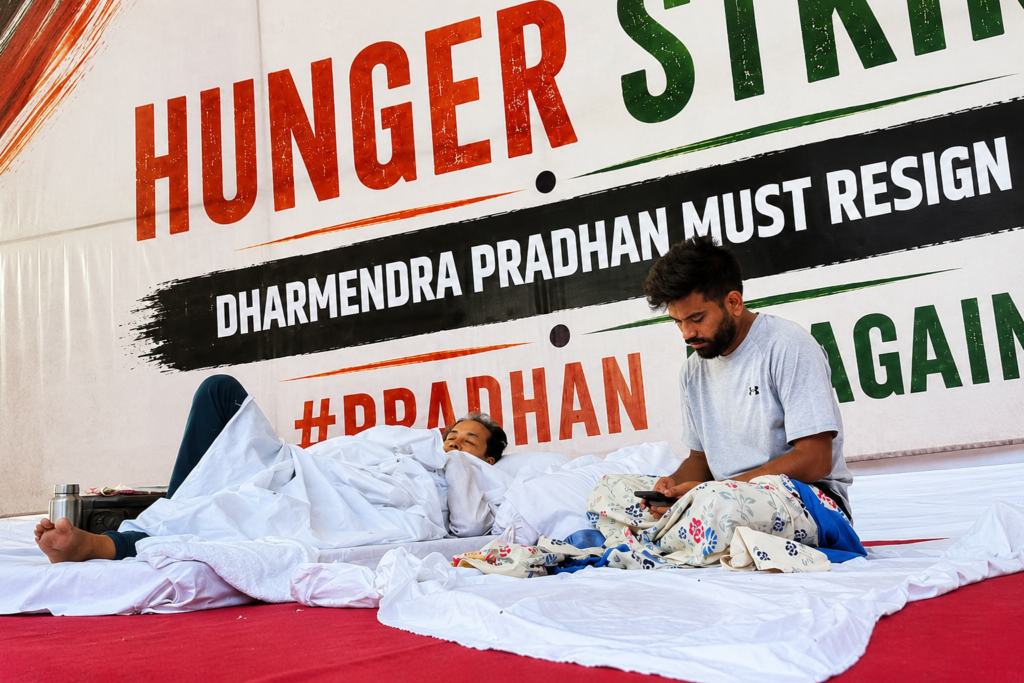
The movement received a major boost when Sonam Wangchuk joined the protest and began an indefinite hunger strike in solidarity with students.
Wangchuk, widely known for his work in education reform and environmental activism, said his decision to fast was driven by concern over what he described as repeated failures in protecting students’ futures.
On the fifth day of his fast, organisers said his blood sugar had fallen to 60 mg/dL, raising concerns over his health.
Dipke issued a warning over Wangchuk’s condition.
“His health is deteriorating. If anything happens to Sonam Wangchuk, the government will have to answer for it,” Dipke said.
Wangchuk himself addressed supporters and attempted to reassure them.
“This is a difficult phase, but the body adapts. My sugar level is low, but I remain committed to the cause of students,” Wangchuk said.
His involvement has significantly elevated the protest’s visibility, drawing wider national media attention and public support.
Many protesters now see Wangchuk’s hunger strike as the moral centre of the agitation.
Pressure At Site
The protest site has also seen growing tensions in recent days.
Dipke alleged that Delhi Police cut sanitation facilities at Jantar Mantar shortly after Wangchuk began his hunger strike. He described the move as an attempt to create logistical pressure on protesters and force the agitation to weaken.
“First they ignored us, then they tried to inconvenience us. Cutting sanitation facilities during a peaceful protest shows the attitude towards democratic dissent,” Dipke said.
Delhi Police has not publicly responded to the allegation.
Dipke had earlier also accused BJP workers of attacking reporters and protesters near the demonstration site. Videos from the area circulated online and sparked criticism from opposition voices.
These incidents, combined with the latest surveillance claims, have led organisers to describe what they call a pattern of escalating pressure.
The sequence of events, from paper leak allegations to hunger strikes, site tensions and now surveillance accusations, has transformed the protest into a wider confrontation over governance and civil rights.
Privacy Debate
The surveillance allegation has reopened larger questions around privacy protections in India.
In 2017, the Supreme Court ruled privacy to be a fundamental right under Article 21 of the Constitution, establishing clear legal limits on state intrusion into personal communication.
Legal analysts say that if Dipke’s allegations are proven, the implications could be significant, potentially leading to demands for judicial review or parliamentary scrutiny.
Technology experts have also pointed out that the claim of “word for word” access to encrypted conversations would indicate a far deeper level of monitoring than ordinary surveillance.
At the same time, experts caution that the allegations remain unverified and must be supported by evidence before legal conclusions can be drawn.
For now, the protest at Jantar Mantar continues, with organisers insisting they will remain until their demands are addressed.
As public pressure builds, the government faces increasing calls not only to address concerns over examination transparency but also to respond to growing questions over digital privacy and the treatment of peaceful protesters.
What began as a student protest over exam irregularities has now developed into a broader national debate over accountability, rights and the boundaries of state power in India.


