

India and Afghanistan’s Taliban-led administration have agreed to expand cooperation in agriculture following high-level talks in New Delhi, with both sides focusing on food security, irrigation, research and agricultural trade, according to India’s Ministry of External Affairs (MEA).
The discussions concluded a six-day visit by Afghanistan’s Minister of Agriculture, Irrigation and Livestock, Mawlawi Ataullah Omari, who led a senior delegation to India for meetings with government officials and representatives of leading agricultural institutions. The visit reflects continued engagement between the two countries on humanitarian and development issues, despite the absence of formal diplomatic recognition of the Taliban administration by New Delhi.
Agriculture remains the backbone of Afghanistan’s economy, providing livelihoods for millions of people and contributing significantly to the country’s food supply. Against this backdrop, both sides focused on improving agricultural productivity, strengthening food security and building long-term institutional partnerships through research, technology transfer and capacity building.
Ministerial Talks
During the visit, Omari held meetings with India’s Union Minister of Agriculture and Farmers Welfare and Minister of Rural Development, Shivraj Singh Chouhan, Minister of Food Processing Industries Chirag Paswan, and Minister of State for External Affairs Pabitra Margherita.
According to the MEA, the discussions reviewed ongoing cooperation while identifying new opportunities for collaboration in agriculture, irrigation, livestock, agricultural research, education, capacity building and agricultural trade.
“The two sides reviewed ongoing cooperation and explored new avenues for collaboration in agriculture, irrigation, livestock, agricultural research, education, capacity building and agri-trade. Food security, seed systems and enhancement of crop productivity featured prominently in the discussions. India reiterated its commitment to supporting Afghanistan’s agricultural sector through cooperation in climate-resilient and bio-fortified crop varieties.”
Officials also discussed modern farming techniques aimed at increasing crop yields while helping Afghan farmers adapt to changing climatic conditions. Climate-resilient farming, improved seed varieties and biofortified crops were highlighted as important tools for strengthening food security and improving nutrition across rural communities.
Livestock management was another key area of discussion, reflecting its importance to Afghanistan’s rural economy. Both sides explored cooperation in veterinary services, animal health and livestock development to support farming households and improve agricultural output.
Economic Partnership
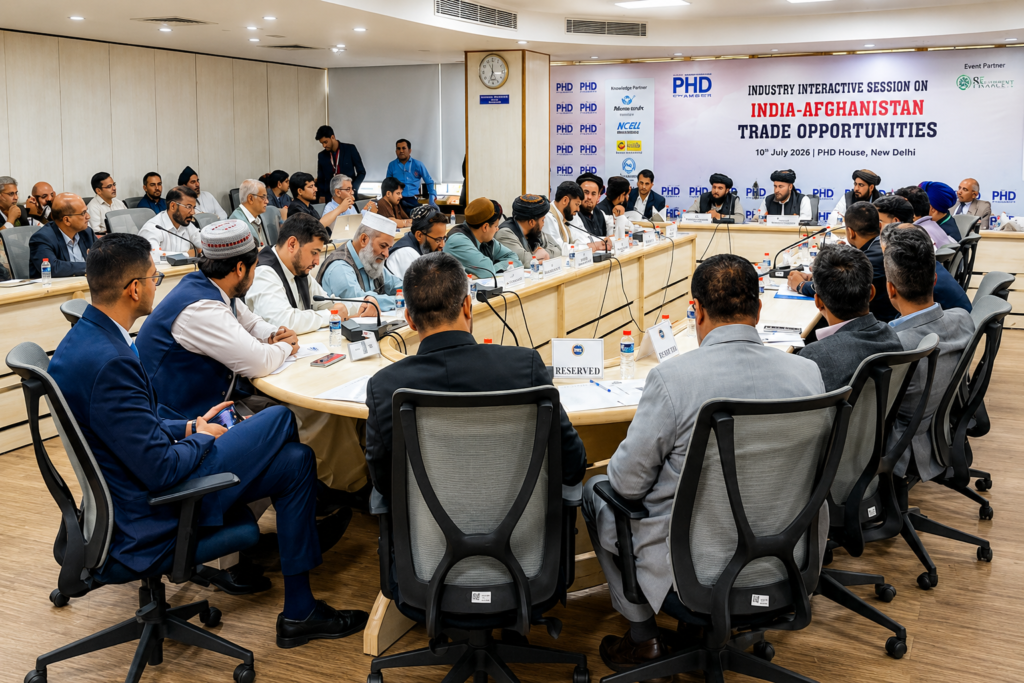
Speaking during a trade conference held alongside the visit, Omari called for stronger economic cooperation between the two countries and described India as a longstanding partner in Afghanistan’s development.
“We need your support, and the support of our old friend, the government of India, as well as its sincere business community, which has stood with us throughout history,” Omari said.
“When we see the warm welcome from the government, ministers, officials and the people of India, it boosts our morale.”
The Afghan minister encouraged greater participation by Indian businesses in Afghanistan’s agricultural sector, particularly in areas such as food processing, agricultural technology and trade. Increased commercial cooperation, officials said, could help Afghan farmers gain better market access while opening opportunities for Indian companies involved in agricultural equipment, storage, logistics and processing.
The discussions also emphasized the importance of strengthening agricultural value chains so that farmers can benefit not only from higher production but also from improved processing, packaging and marketing.
Institutional Cooperation
Beyond ministerial meetings, the Afghan delegation engaged with several of India’s leading agricultural and financial institutions to establish long-term cooperation.
Meetings were held with the National Bank for Agriculture and Rural Development (NABARD), the Indian Council of Agricultural Research (ICAR), and the Indian Agricultural Research Institute (IARI). Discussions focused on agricultural research, technology transfer, scientific collaboration, farmer training and institutional capacity building.
Officials explored opportunities to share expertise in seed development, crop improvement, pest management, sustainable farming practices and agricultural extension services. Such cooperation is expected to help strengthen Afghanistan’s agricultural institutions while improving technical knowledge among farmers and researchers.
The delegation also met representatives of the Federation of Indian Chambers of Commerce and Industry (FICCI) and the PHD Chamber of Commerce and Industry to discuss investment opportunities, food processing and expanding bilateral agricultural trade.
Industry representatives highlighted the role of private-sector investment in improving supply chains, reducing post-harvest losses and increasing value addition through modern food processing facilities.
Water Management
Water management emerged as one of the central themes of the discussions.
Afghanistan has experienced repeated droughts, water shortages and climate-related challenges that have affected agricultural production across many regions. Officials identified irrigation infrastructure, efficient water use and rainwater harvesting as priority areas for future cooperation.
India shared its experience in irrigation technologies, watershed management and water conservation practices that could support Afghanistan’s efforts to improve agricultural resilience.
The discussions also examined ways to increase farm productivity without placing additional pressure on limited water resources. Improved irrigation systems and sustainable resource management were seen as essential for ensuring long-term agricultural growth and reducing vulnerability to climate change.
Afghanistan’s Agriculture
Agriculture remains one of Afghanistan’s largest economic sectors and continues to employ a substantial share of the country’s workforce. However, decades of conflict, recurring droughts, limited infrastructure and economic challenges have constrained productivity and investment.
Many farming communities continue to face shortages of quality seeds, modern equipment, irrigation facilities and access to agricultural markets. These challenges have affected food production and contributed to ongoing food security concerns.
Officials from both countries agreed that improving agricultural productivity could play a significant role in supporting Afghanistan’s broader economic recovery by increasing rural incomes, strengthening domestic food production and expanding agricultural exports.
The cooperation framework discussed during the visit aims to address many of these challenges through technical assistance, research collaboration and knowledge sharing.
Bilateral Ties
Omari’s visit marked the fourth visit by a Taliban cabinet minister to New Delhi within the past year, following visits by Afghanistan’s acting foreign minister, public health minister and industry and commerce minister.
Although India has not formally recognised the Taliban administration, which returned to power in August 2021, it has maintained a technical mission in Kabul and continued engagement on humanitarian and development-related issues.
India has also remained one of Afghanistan’s longstanding development partners, providing humanitarian assistance that has included food supplies, medicines and other essential support. Much of this assistance has historically been transported through Iranian transit routes, although changing regional conditions have increased interest in diversifying trade and supply corridors.
The latest meetings reflect New Delhi’s policy of maintaining practical engagement with Afghanistan while supporting sectors considered important for humanitarian assistance, economic recovery and regional stability.
Next Steps
Both governments are expected to begin implementing the areas identified during the discussions through technical exchanges, institutional partnerships and infrastructure projects.
The proposed cooperation covers agricultural research, irrigation, seed development, livestock management, food processing and trade, creating a broad framework for future collaboration.
If successfully implemented, the initiatives could improve agricultural productivity, strengthen food security and expand bilateral agricultural trade while supporting the livelihoods of Afghan farmers. For India, the partnership also reinforces its long-standing development engagement with Afghanistan through practical cooperation focused on agriculture, humanitarian assistance and sustainable economic development.


