

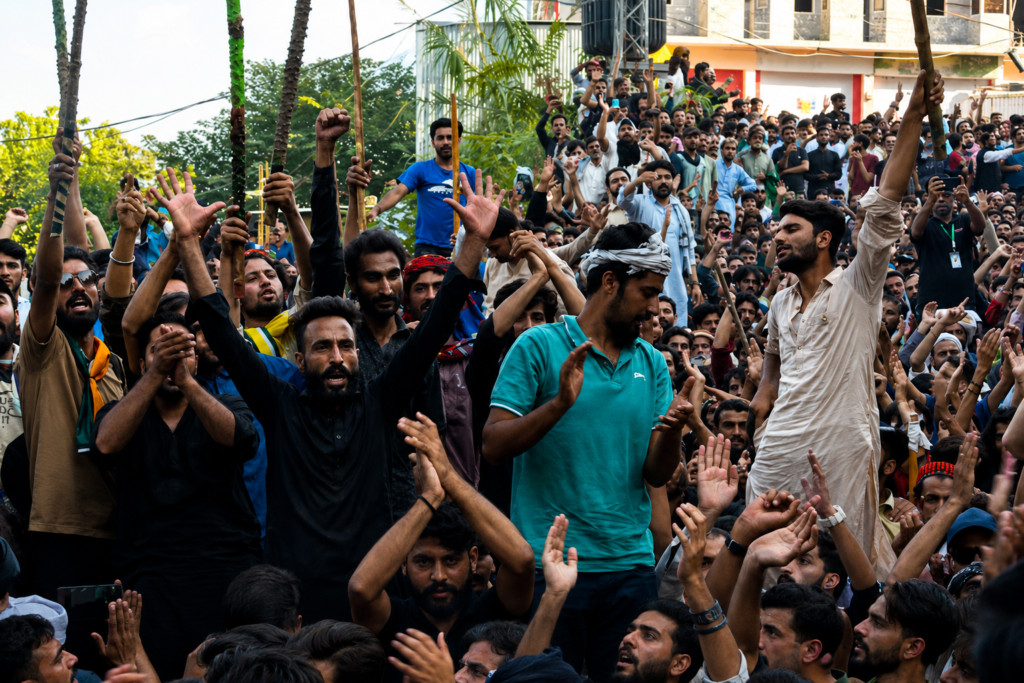
New Delhi: India has mounted one of its strongest diplomatic attacks on Pakistan in recent months, accusing Islamabad of decades-long “systemic exploitation,” denial of fundamental rights and administrative oppression in Pakistan-occupied Kashmir (PoK). The Ministry of External Affairs (MEA) has urged the international community to hold Pakistan “fully accountable” for what it described as “egregious abuses and misdeeds” against the people of the region as anti-government protests continue across PoK.
Addressing a weekly media briefing, MEA spokesperson Randhir Jaiswal said the unrest was “a direct consequence of Pakistan’s decades-long systemic exploitation, denial of fundamental rights and administrative oppression in areas under its illegal and forcible occupation.”
“We expect and hope that the international community will hold Pakistan fully accountable for these egregious abuses and misdeeds,” Jaiswal said, alleging that Pakistani authorities had responded to peaceful protests with force rather than addressing public grievances.
India’s remarks come amid growing demonstrations in several parts of Pakistan-administered Kashmir, with residents voicing concerns over political representation, rising living costs, unemployment and governance. New Delhi has sought to portray the unrest as evidence of Pakistan’s failure to govern the region, while Islamabad is expected to reject the allegations and defend its administration.
Why Protests Erupted
The latest unrest was triggered by Pakistan’s decision to reserve 12 seats in the PoK Legislative Assembly for refugees from Jammu and Kashmir residing elsewhere in Pakistan. Local political groups and residents argue that the move dilutes the political representation of people living in the region and further strengthens Islamabad’s influence over local governance.
However, the demonstrations have rapidly expanded beyond the Assembly seat controversy. Protesters accuse Pakistani authorities of decades of economic neglect, unemployment, soaring electricity tariffs, expensive wheat flour, corruption, poor infrastructure and shrinking political space. Their demands now include subsidised electricity and food, employment opportunities, greater political autonomy, transparent governance and the restoration of civil liberties.
The protests have spread across Muzaffarabad, Rawalakot, Mirpur and several other districts, making them one of the largest public mobilisations witnessed in Pakistan-administered Kashmir in recent years. Protest leaders say the movement is no longer confined to electoral issues but reflects widespread frustration over economic hardship and governance failures.
India Raises Allegations
The MEA accused Pakistan of responding to peaceful demonstrations with heavy-handed measures instead of dialogue. According to India, Pakistani security forces have resorted to police crackdowns, arbitrary arrests, internet shutdowns, restrictions on movement and excessive use of force against civilians.
New Delhi further alleged that authorities have curtailed access to essential supplies and attempted to suppress dissent through intimidation and violence. India described these actions as evidence of Pakistan’s continued denial of democratic rights in the territory.
Reports from the region indicate clashes between protesters and security personnel have resulted in casualties and injuries, although the exact figures remain independently unverified because of limited access for journalists and observers.
Meanwhile, the Awami Action Committee (AAC), one of the principal organisations leading the protests, has announced that it is ending negotiations with Pakistani authorities and will proceed with a planned long march to Muzaffarabad on July 15. The decision marks a significant escalation in the movement, with protest leaders declaring that dialogue has failed to address public concerns. The planned march is expected to test both the resolve of demonstrators and the response of Pakistani authorities.
Diplomatic Push
India has consistently maintained that the entire Union Territory of Jammu and Kashmir, including Pakistan-occupied Kashmir, is an integral and inalienable part of India. In its latest statement, however, New Delhi shifted the focus beyond its territorial claim to Pakistan’s governance record in the region.
According to the MEA, the protests are not isolated law-and-order incidents but the outcome of decades of political suppression, economic exploitation and administrative failures. India argued that Pakistan has systematically denied residents their democratic rights while failing to provide accountable governance or adequate public services.
By urging the international community to hold Pakistan accountable, India has sought to internationalise the human rights dimension of the unrest and counter Pakistan’s longstanding criticism of developments in Jammu and Kashmir. New Delhi’s remarks also reinforce its position that Pakistan remains in “illegal and forcible occupation” of the territory.
The diplomatic offensive comes at a time when bilateral relations between the two countries remain frozen, with little formal engagement and continuing disagreements over Kashmir.
Pakistan Under Pressure
Pakistan has historically rejected India’s allegations concerning PoK, maintaining that the region enjoys self-governance under its constitutional framework. Islamabad has consistently accused New Delhi of attempting to divert international attention from developments in Indian-administered Jammu and Kashmir and is expected to respond similarly to the latest criticism.
Even so, the sustained protests add to the challenges facing Pakistan, which continues to grapple with economic instability, high inflation and political uncertainty. The demonstrations have highlighted local grievances over governance and public welfare while drawing renewed international attention to conditions in Pakistan-administered Kashmir.
The developments also carry broader regional implications. Any prolonged unrest or escalation could further strain already fragile India-Pakistan relations and intensify diplomatic exchanges over Kashmir. With the Awami Action Committee preparing for its July 15 march and authorities expected to tighten security, the situation remains fluid.
What Lies Ahead
The unrest in Pakistan-occupied Kashmir has evolved into a broader movement reflecting political, economic and governance-related grievances. While the reservation of Assembly seats acted as the immediate trigger, the protests now encompass demands for affordable living costs, employment, accountable governance, democratic representation and greater autonomy.
India has used the developments to sharpen its diplomatic messaging, arguing that the protests expose Pakistan’s decades-long “systemic exploitation” of the region and calling for global accountability. Pakistan, meanwhile, is expected to dismiss those allegations while attempting to contain the demonstrations.
Whether the protests develop into a sustained political movement or are eventually brought under control, they have once again placed Pakistan-administered Kashmir at the centre of South Asia’s geopolitical discourse. As demonstrations continue and diplomatic rhetoric intensifies, the situation is likely to remain under close regional and international scrutiny in the coming weeks.


