

The systemic health of an economy is ultimately measured not by its stock market indices, but by its capacity to offer meaningful social mobility to its youngest citizens. When institutional pathways to employment collapse, the demographic dividend transitions from an asset into a profound crisis. This stark reality formed the core of the address delivered by the Leader of the Opposition in the Lok Sabha, Rahul Gandhi, during the “Chhatron Ki Goonj” (Students’ Echo) convention held at the Bannu School Ground in Dehradun, Uttarakhand.
Addressing an assembly of students and job aspirants, the opposition leader diagnosed the contemporary economic landscape through the framework of four closed doors. He argued that deliberate policy trajectories, corporate consolidation, and technological disruptions have systematically sealed off traditional avenues of livelihood creation.
This macroeconomic critique was punctuated by a devastating human tragedy, as the stage became a forum for Rajesh Mall, a grieving father from Dehradun. His 23-year-old daughter, Riya Kumari, died by suicide following the systemic compromise of the NEET-UG examination.
Four Closed Doors
The traditional engines that historically facilitated entry into the middle class have been compromised by a combination of domestic policy failures, global trade imbalances, and technological shifts.
The first avenue of mobility, industrial manufacturing, remains fundamentally stagnant. While official narratives champion domestic expansion, the manufacturing base has failed to achieve the scale necessary for mass employment, a vulnerability exacerbated by foreign commodities. Addressing this structural failure, Mr Gandhi noted:
“In India, four out of five doors are closed to you. Why are they closed? Because India’s manufacturing sector is stalled, while Chinese goods are sold across the country.”
The second avenue, independent entrepreneurship, faces a credit crisis driven by severe financial concentration. Access to capital is the lifeblood of small and medium enterprises, yet the current domestic banking architecture has increasingly restricted credit lines to a narrow cadre of premier business houses. For an ordinary youth attempting to secure a bank loan to initiate a small enterprise, the institutional barriers remain insurmountable. Highlighting this financial bottleneck, the opposition leader stated:
“The second door, entrepreneurship is also closed because bank funds in India have been captured by just 4-5 business houses… if any of you want to become an entrepreneur or seek a bank loan, you won’t get it.”
Simultaneously, the modern corporate dream, particularly within the information technology and business process outsourcing sectors, faces an existential threat from automation. The third door, white-collar corporate employment, has suffered a severe contraction due to the rapid integration of artificial intelligence, which is automating entry-level software development and back-office support roles. This shift has resulted in a decoupling of corporate revenue growth from job creation. Criticising this technological dislocation, Mr Gandhi remarked:
“The third door, corporate jobs, specifically in IT, has been dealt a massive blow by AI.”
Finally, the safety net of the public sector has been systematically diminished. The fourth door, secure government employment within public sector undertakings, has effectively closed due to privatisation, contractualization, and outsourced recruitment. By scaling back permanent vacancies, the state has withdrawn from its historical role as an employer of last resort. Explaining this shift, he remarked:
“The fourth door, the public sector, has effectively closed due to privatisation. For millions of young people, the only path remaining is that of a government job.”
The Rejection System
With the avenues of manufacturing, independent entrepreneurship, corporate technology, and public sector undertakings heavily restricted, millions of young citizens are funneled into a single, agonizingly narrow corridor: the competitive government examination system. This structural bottleneck has transformed the educational landscape from a mechanism of human resource cultivation into a hyper-competitive elimination process.
The mathematical scale of this crisis is unprecedented. Across the nation, the aggregate pool of individuals aspiring for secure employment stands at approximately 90 million, with nearly 60 million candidates actively sitting for various central and state-level competitive examinations. However, the total number of successful vacancies filled across these major examinations amounts to a mere 600,000.
This stark disparity translates to an empirical success rate of roughly 0.66 per cent, effectively turning competitive examinations into an apparatus designed to eliminate candidates rather than select them. Commenting on the brutal selection ratio, Mr Gandhi explained:
“6 crore people try to enter this specific door. 6 crore people attempt the exam, yet they face narrow hurdles… Out of 9 crore aspirants, only 6 lakh succeed. You only pursue this path if you were the one who stood first among those fifty students. The others, those who came second, third, or fourth, could not cross this threshold.”
Testing Mafia
The constriction of the labour market has facilitated the rise of a highly exploitative parallel economy centred around private coaching institutes and compromised testing infrastructures. Because the state has underfunded public universities, families frequently liquidate ancestral land or incur high-interest informal debts to finance years of preparation in crowded coaching hubs.
This financial vulnerability is further compounded by the complete collapse of institutional integrity within the testing apparatus, transforming paper leaks into a highly structured illicit industry.
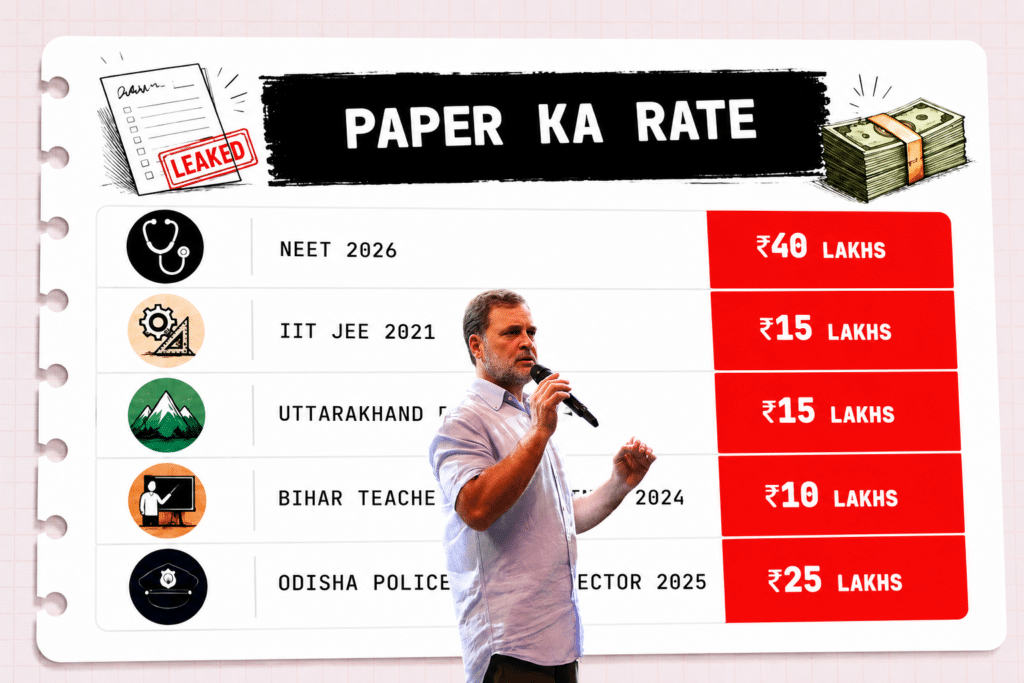
The recurring phenomenon of examination paper leaks, most notably exemplified by the NEET-UG and state selection controversies, reveals a deeply entrenched network of corruption where advanced digital channels are used to distribute compromised examination papers to wealthy buyers.
Over the past decade, an estimated 7.5 crore young students have had their academic labour and career trajectories compromised by 152 recorded paper leak cases, a systemic breakdown that has proceeded entirely without legal convictions. Condemning the lack of accountability and the criminal monetisation of public exams, the opposition leader stated:
“A ‘system’ has taken root here regarding UKSSSC exams, where positions like Patwari or Lekhpal are secured not through merit, but at rates fixed by criminals… The government enacted a strict anti-cheating law—yet the leaks continued. The law remained merely on paper, while exam papers continued to be sold in the market… Just think about it: a child prepared for years, filled out the form, paid the fee, travelled to a far-off centre. And their position was bought by someone else. This isn’t a leak—it’s theft.”
The Way Forward
The tragic culmination of this systemic failure was manifested in the story of Riya Kumari, whose father, Rajesh Mall, stood on the Dehradun stage to demand accountability after his daughter took her own life following the NEET paper leak. Her experience reflects a widespread generational trauma: the devastating realisation that no amount of individual merit or personal sacrifice can overcome a rigged institutional game.
The crisis outlined in Dehradun cannot be resolved through cosmetic administrative updates or periodic adjustments to employment statistics. It requires an immediate, structural overhaul of India’s macroeconomic and educational policies. The state must move away from a model of jobless growth and actively intervene to democratise the economic landscape.
This intervention must begin with a comprehensive legislative framework designed to restore the integrity of public examinations, providing absolute accountability, swift punitive measures against testing mafias, and financial restitution for candidates affected by sudden cancellations and leaks.
Emphasising that this movement transcends partisan politics to address an impending national crisis, Mr Gandhi concluded:
“This is not a political meet… This is your fight, and I’m with you. Come, let’s turn the ‘Echo of Students’ into a battle cry. We won’t let the future be auctioned off. We won’t let dreams be leaked.”


