

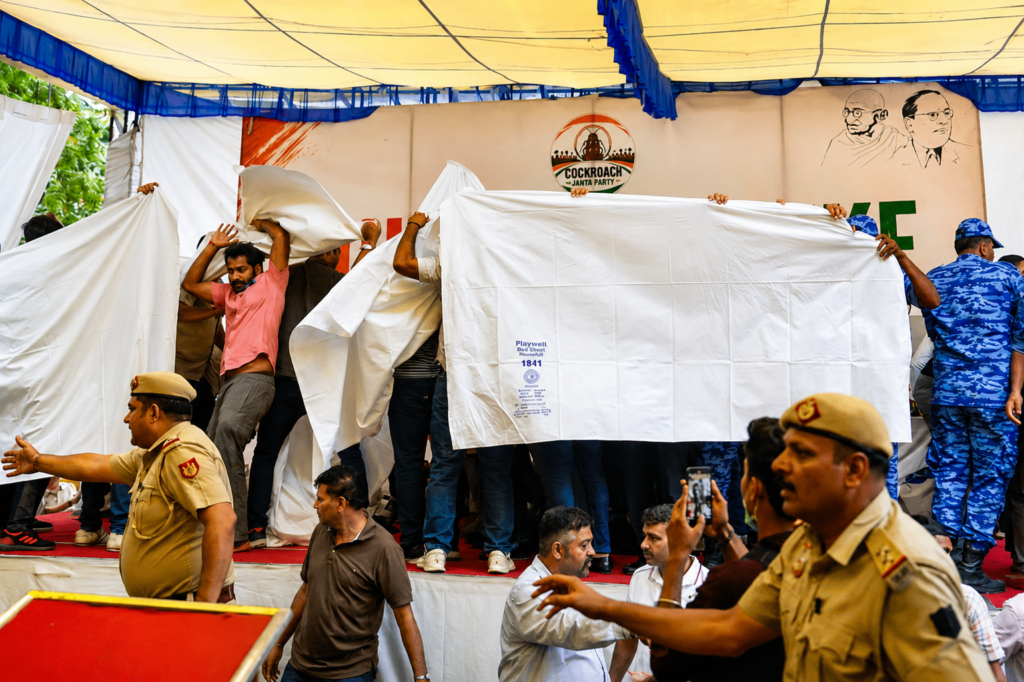
Democracy died a little more today under the early morning Delhi sky! That is how countless users across X and other social media platforms are describing the images that emerged from Jantar Mantar.
As day broke over Jantar Mantar on July 18, 2026, the heart of India’s capital witnessed an operation so clinical, so meticulously orchestrated, that it exposed what critics are describing as the desperation of a government unwilling to let a peaceful protest gather further momentum.
For 20 grueling days, climate activist Sonam Wangchuk sat on an indefinite hunger strike. He wasn’t armed. He wasn’t inciting violence. Alongside three student leaders from AISA, he was waging a quiet, Gandhian campaign against what the protesters described as the systemic breakdown of India’s education framework. Their demands centered on accountability for the alleged failures surrounding the NEET-UG examination and the reported deaths of students driven to despair.
By the twentieth day of his fast, Wangchuk had reportedly lost nearly 20 percent of his body weight. Physically weakened but mentally resolute, he remained committed to continuing the hunger strike and leading a planned march to Parliament on July 20.
But the State, his supporters argue, was unwilling to wait until July 20. It could not afford the optics of a fasting activist marching toward the nation’s Parliament at the head of a growing movement. So, before dawn had fully broken over Delhi, the authorities moved.
The Pre-Dawn Evacuation
The operation commenced at daybreak when a contingent of approximately 35 plainclothes Delhi Police personnel, backed by layers of the Central Reserve Police Force (CRPF) and the Rapid Action Force (RAF), cordoned off the protest perimeter. To manage public optics and prevent immediate crowd mobilization, security forces deployed large white sheets to obscure the physical removal of Wangchuk from his makeshift bed.
While the Delhi Police maintained that the evacuation was conducted under “strict medical advice” and aligned with recent High Court observations regarding the preservation of life, legal observers have questioned the execution. Critics argue the judicial directives authorized health monitoring rather than the involuntary dismantling of a peaceful agitation.
Wangchuk, who has reportedly lost roughly 20 percent of his body mass over the three-week fast, was demonstrating alongside student leaders from the All India Students’ Association (AISA). The agitation seeks systemic accountability over the recent NEET-UG examination discrepancies and the broader crisis within the national education framework.
Hospital Standoff
The center of gravity has since shifted to Safdarjung Hospital, where a administrative conflict is unfolding between state medical authorities and Wangchuk’s family.
Gitanjali Angmo, Wangchuk’s wife, issued an uncompromising public statement challenge to the hospital administration, alleging that the facility refused to provide the family with official copies of his medical diagnostics. Addressing reporters through the Press Trust of India (PTI), Angmo stated:
“He is at Safdarjung Hospital. I forbid them from administering anything without my consent. No treatment should start without my consent. I hold everybody accountable if anything happens.”
Medical sources indicate that while clinicians flagged Wangchuk’s potassium levels as critically low (2.9 mEq/L), the activist remains conscious and is actively refusing intravenous fluids, oral rehydration solutions, and voluntary medication. The impasse underscores a profound breakdown of trust between civil society actors and state-administered institutions.
Dipke Takes Over
If the objective of the law enforcement operation was to neutralize the momentum of the July 20 movement, the immediate aftermath suggests the strategy has backfired.
Following Wangchuk’s removal, Abhijeet Dipke, founder of the Cockroach Janta Party (CJP), immediately assumed the vacancy at the protest site, declaring an indefinite hunger strike alongside the remaining AISA activists. The student leaders, whose health metrics show weight losses ranging between 7.5 and 10.5 kg formed human chains to prevent municipal authorities from clearing the protest infrastructure.
The situation escalated further in the afternoon when an unidentified individual bypassed the security perimeter and hurled blue ink directly at Dipke during a press address.
The assault failed to disrupt the proceedings. Defusing the provocation, Dipke integrated the incident into the broader narrative of institutional resistance, stating to the gathering:
By invoking the constitutional and egalitarian symbolism of “Jai Bhim,” Dipke effectively neutralized the attempt at intimidation, re-establishing the protest’s ideological footing and stabilizing the crowd before local law enforcement intervened to detain the assailant.
Growing Questions Over State Response
The events at Jantar Mantar today have sparked a wider debate over the government’s approach to peaceful protests and democratic dissent. Critics have questioned whether the deployment of Delhi Police, the CRPF, and the Rapid Action Force against fasting activists was proportionate, arguing that the scale of the operation reflected an increasingly restrictive response to non-violent demonstrations.
The controversy is no longer just about a hunger strike, it is about how a democracy chooses to respond when its citizens dissent peacefully. Reports of surveillance of student leaders, preventive detentions, and possible restrictions on the planned July 20 “Chalo Sansad” march have further intensified concerns among civil rights advocates, who warn that such measures could discourage citizens from exercising their constitutional right to peaceful assembly.
The government, however, maintains that its actions were guided by medical advice, legal obligations, and the need to preserve public order, emphasizing that Wangchuk’s deteriorating health required immediate intervention. Whether viewed as a necessary exercise of state authority or an excessive crackdown on peaceful protest, the events of July 18 have transformed Jantar Mantar into a defining symbol in the ongoing debate over civil liberties, democratic rights, and the limits of state power in contemporary India.
Current Status
As of tonight, Jantar Mantar remains under strict security lockdown, with access roads heavily barricaded. Despite the removal of its primary figurehead, the organizational committee has renewed its nationwide call for decentralized demonstrations on July 20.
The forceful institutionalization of Sonam Wangchuk and the subsequent assault on Abhijeet Dipke have transformed a localized fast into a high-stakes political confrontation over the constitutional right to peaceful dissent in the capital.


