

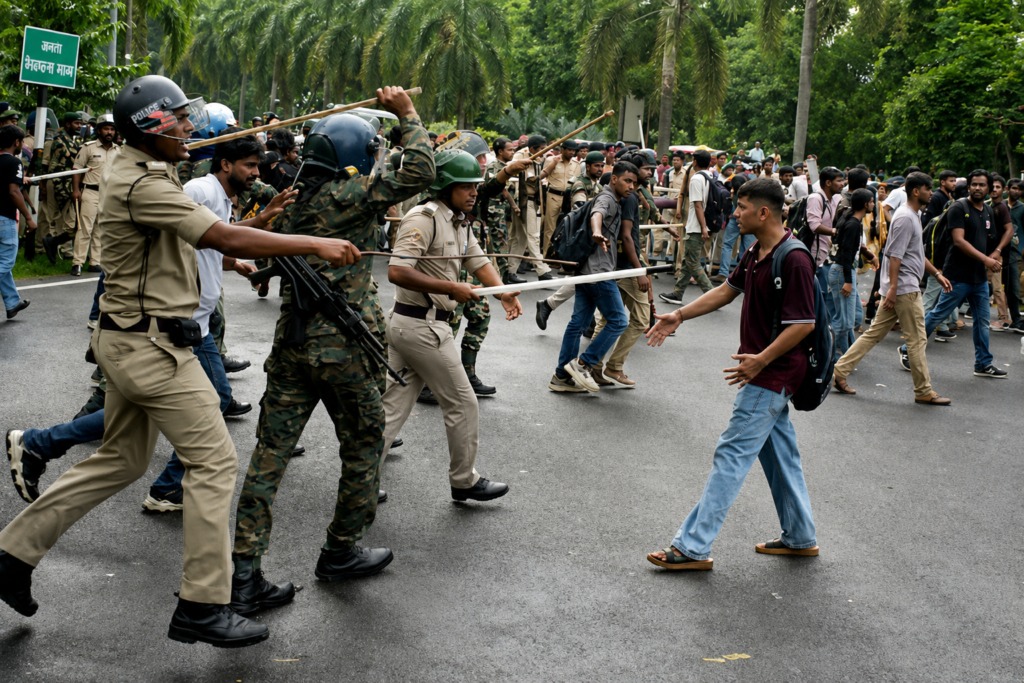
The Indian government has directed telecom companies to disable mobile data services in central parts of New Delhi, in and around the site where thousands of students and youth have gathered to protest against alleged examination paper leaks. The order, confirmed by multiple sources familiar with the matter, has once again put the spotlight on the government’s use of internet shutdowns during periods of civil unrest.
According to sources, telecom operators complied with the directive on Thursday evening, leading to a near total loss of mobile internet connectivity across several parts of central Delhi. The shutdown affected areas surrounding Jantar Mantar, where the protest, organised under the banner of the Cockroach Janta Party, has continued for days.
What triggered the shutdown
As the protest at Jantar Mantar grew in scale over the past few days, the government moved to disable mobile data services in and around the demonstration site, a step authorities have taken in the past whenever large public gatherings have raised concerns about law and order.
Sources familiar with the matter told that telecom operators, including Reliance Jio, Bharti Airtel and Vodafone Idea, received directions from the government and complied with the order on Thursday evening. Protesters at the site alleged that mobile internet had already become patchy as early as 10 am, well before the disruption spread across central Delhi later in the day.
Many residents in the affected areas received text messages from their telecom providers informing them of the suspension. One such message sent to subscribers read, “As per the government instructions, the internet services have been temporarily stopped in your area because of which you are not able to use these services. You will be able to use the internet services once we get directions from the government.”
Notably, voice calling services remained largely functional through the shutdown, with only mobile data connectivity affected. This is a pattern that has been followed in previous shutdowns in the city as well, where authorities have opted to restrict data specifically rather than cutting off communication entirely.
Impact on businesses and commuters
The mobile data shutdown has had a visible ripple effect beyond the protest site itself. Vendors, shopkeepers and restaurants in the affected areas complained that they were unable to accept digital payments, a significant disruption in a city where UPI and mobile wallet transactions have become the default mode of payment for everyday commerce. With voice calling largely unaffected but data services suspended, many small businesses reported being forced to turn away customers or rely on cash transactions for the first time in years.
Adding to the disruption, authorities also shut down sixteen metro rail stations in and around the central parts of Delhi where protesters have camped, inconveniencing thousands of daily commuters who rely on the metro for their office and college commute. Separately, the New Delhi Traders Association asked all offices and businesses in the Connaught Place area, the city’s bustling commercial hub, to close early, citing an advisory from municipal authorities over the security situation.
For the common man in Delhi, the disruption went well beyond the protest zone itself. Office goers struggled to book cabs, track deliveries, or make online payments at shops and eateries that no longer accepted cash by default. Delivery and ride hailing apps also reported difficulties operating in the affected zones, leaving several riders and delivery partners stranded without navigation or order updates. For a city where digital transactions have become routine, even a few hours of data blackout was enough to bring everyday errands to a halt.
Officials from the government and the Department of Telecommunications did not immediately respond to requests for comment. Major telecom players, including Reliance Jio, Bharti Airtel and Vodafone Idea, also did not immediately comment on the directive.
How such orders are issued
Internet shutdowns of this kind are typically ordered under the Temporary Suspension of Telecom Services Rules, 2017, which allow the government to suspend services in the interest of public safety or to avert a public emergency. In earlier instances, such orders have been issued by local law and order authorities such as the Delhi Police or the Ministry of Home Affairs, rather than directly by the Department of Telecommunications, which only facilitates the technical suspension once directed. Telecom companies are legally bound to comply once such a directive is issued, regardless of the commercial or public inconvenience it causes.
A recurring pattern
This is not the first time mobile internet services have been suspended in the national capital during protests. Similar shutdowns were recorded in December 2019 during protests against the Citizenship Amendment Act, and again in January 2021 during the farmers’ agitation near Delhi’s border points. According to a report by the KeepItOn coalition, India recorded 65 internet shutdowns in 2025 alone and has accounted for 920 of the 2,102 internet disruptions documented worldwide since 2016, making it one of the most frequent users of such measures globally.
Digital rights groups have repeatedly raised concerns over the lack of transparency around these orders. The Internet Freedom Foundation has pointed out that no public copy of the shutdown order has been released by the Ministry of Home Affairs, the Department of Telecommunications, the Delhi government or the Delhi Police, making it difficult to verify whether the shutdown was authorised by a competent authority in line with the Supreme Court’s ruling in the Anuradha Bhasin case, which requires all internet suspension orders to be published along with reasons and made subject to judicial review.
What happens next
As the protest at Jantar Mantar continues, questions around the legality and transparency of the shutdown remain unresolved, with no official order made public so far. Until the government publishes the directive and clarifies the grounds on which it was issued, residents, vendors and commuters in central Delhi are likely to keep facing the same disruption every time mobile data services are switched off in the area.


