

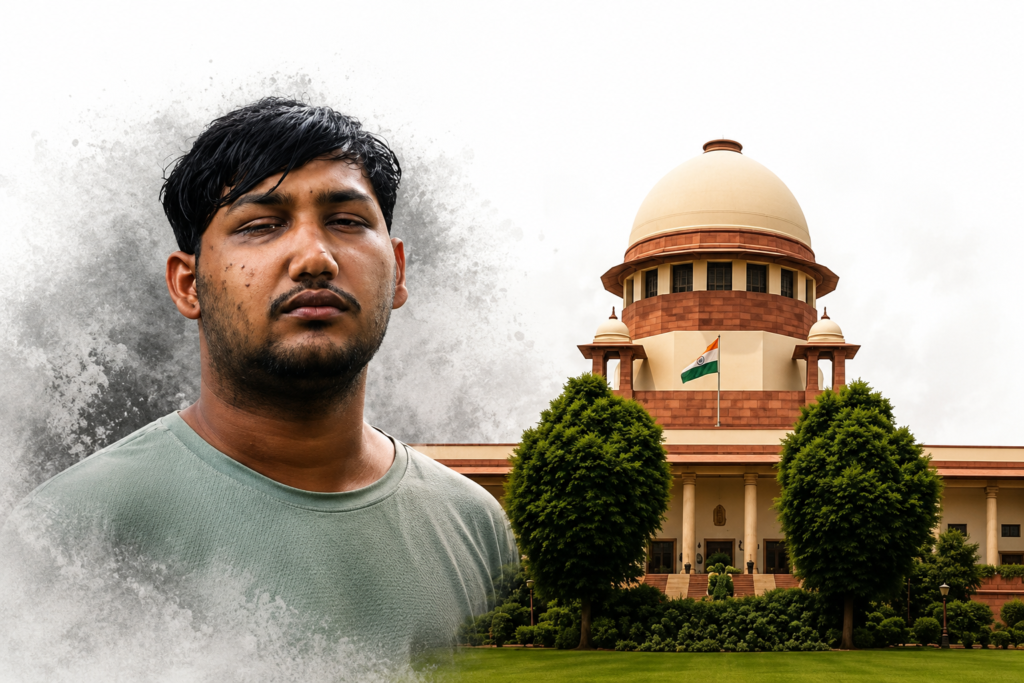
The Supreme Court of India on Thursday took up a sensitive plea seeking a nationwide ban on pellet guns used by police forces to disperse crowds. The matter arose from the violence that broke out during student protests against the NEET paper leak at Delhi’s Jantar Mantar on July 20, when demonstrators gathered under the banner of the Cockroach Janta Party’s “Sansad Chalo” march and clashed with security personnel deployed by the Delhi Police and the Rapid Action Force.
Several students later alleged they were struck by metallic pellets, while police maintained that some of their own personnel had come under attack from within the crowd. The episode quickly escalated into one of the most closely watched confrontations between student protesters and law enforcement in recent years, drawing scrutiny in both Parliament and the courts. While the court declined to pass a blanket ban at this stage, it directed the Delhi government to ensure proper medical treatment for those who suffered pellet injuries and asked the Centre to preserve crucial evidence linked to the incident.
What The Petition Sought
The plea was filed under Article 32 of the Constitution by former Central Information Commissioner and retired IPS officer Yashovardhan Azad, along with two others, Prasant Kumar Singh and Sheikh Irshad Mansoori, who claim they sustained pellet injuries during the “Sansad Chalo” protest called by the Cockroach Janta Party. The petitioners sought a nationwide ban on the use of wholly or partly metallic pellet ammunition fired from pump-action or projectile-action guns for dispersing civilian gatherings.
The plea argued that such weapons fail the constitutional tests of necessity, proportionality and reasonableness when used against unarmed protesters. It also sought compensation, complete medical treatment, care and rehabilitation for everyone injured in the July 20 incident.
This is not the first time the Supreme Court has been asked to regulate protests at Jantar Mantar. In an earlier ruling, the court held that a blanket ban on demonstrations at the site could not be sustained, and instead directed the Delhi Police to frame guidelines on participant numbers and safe distances from sensitive government buildings. The present plea builds on that legacy by questioning whether the weapons used to enforce such regulations are themselves constitutional.
Why The Court Called The Prayer Vague
A bench comprising Chief Justice of India Surya Kant, Justice Joymalya Bagchi and Justice V Mohana observed that the demand for an outright ban could not be examined in isolation, since the petitioners had not challenged the underlying police rules that currently permit the use of pellet guns in exceptional situations.
Justice Bagchi pointed to the advisory issued by the Bureau of Police Research and Development, which allows police to use pellet guns under specific circumstances. He remarked that unless those regulations are directly challenged, a prayer seeking a complete ban remains incomplete in law.
“Police rules allow the use in exceptional circumstances unless you challenge the rules themselves,” Justice Bagchi observed during the hearing.
The bench also raised a practical concern about protests that begin peacefully but later turn violent, or are infiltrated by miscreants with ulterior motives, asking how a blanket prohibition could work in such situations.
This line of questioning echoes an earlier observation by CJI Surya Kant, made while the wider batch of petitions over the NEET protest violence was first mentioned before the court, stressing that peaceful protest cannot be curtailed simply because a demonstration is underway.
“Right to peaceful, lawful protest absolutely guaranteed under Constitution. So long as it is peaceful agitation, merely because there is agitation, there can’t be excess,” the CJI had remarked, adding that uniform protocols were needed across states rather than city specific rules.
Arguments From The Petitioners’ Side
Senior advocate Vrinda Grover, appearing for the petitioners, argued before the bench that the pellets recovered from the injured were metallic in nature, distinct from the rubber or plastic variants generally considered less harmful. She contended that the gathering at Jantar Mantar was largely made up of students and did not present the kind of threat that would justify such force.
“There can be rubber, plastic and metallic pellets. These were metallic and recovered from the bodies. Nature of the crowd will determine use of this as well. Was it a violent mob? No. These metallic pellets were fired,” Grover submitted.
She also told the court that the police rules permitting pellet gun use were not easily accessible in the public domain, making it difficult for citizens to challenge them directly, and urged the bench to direct their disclosure.
Directions Issued By The Court
Even as it questioned the scope of the plea, the bench passed several significant directions. The Delhi government was asked to ensure the best possible medical treatment for Prasant Kumar Singh, Sheikh Irshad Mansoori and others who suffered pellet injuries during the protest. The Centre, represented by Solicitor General Tushar Mehta, was directed to preserve the ammunition log of the Rapid Action Force deployed at Jantar Mantar on the day of the protest.
The Delhi Police was further directed to place on record its standard operating procedure governing the use of pellet guns during crowd control operations. The court indicated it was willing to examine whether the force used on July 20 was proportionate to the situation on the ground, even without ruling on the larger question of a nationwide ban.
Police Safety Also Flagged By The Bench
The hearing on the broader NEET protest violence has also seen the court raise concerns about the safety of police personnel deployed during such demonstrations. In an earlier sitting, the bench observed that many state police units lack adequate protective equipment such as helmets and riot gear while managing large crowds.
“Protective gear is more important than offensive gear,” the bench had remarked, indicating it may ask states to explain why such safeguards are not routinely provided to personnel handling demonstrations. Justice Bagchi added that harm suffered by any individual, whether protester or police officer, deserves equal concern, after counsel for policemen’s families told the court that some officers had also been attacked during the clashes.
The Issue Has Also Reached Parliament
The pellet gun controversy has spilled well beyond the courtroom and into Parliament, reflecting how politically charged the NEET protest crackdown has become. In the Rajya Sabha, Leader of Opposition Mallikarjun Kharge accused the government of undermining democracy and public safety, telling the House that ordinary citizens no longer felt secure raising their voice.
Responding to the criticism, Union Minister JP Nadda defended the conduct of the police, drawing on his own past as a student activist to argue that confrontation with authorities is not unusual for those involved in campus politics.
“I have been a student activist, and I was arrested several times in the classroom during the Emergency under Congress rule,” Nadda said, suggesting that any student drawn into activism should expect to face such situations.
Nadda had earlier held talks with a delegation from the Cockroach Janta Party after protesters marched towards Parliament, assuring them the government would engage with their demand for the resignation of the then Education Minister. His later remarks defending the police have drawn criticism from the opposition, which points to the contrast with his earlier conciliatory outreach.
What Happens Next
The Supreme Court has not closed the door on examining the legality of pellet gun use in India. By asking the Centre to preserve ammunition records and the Delhi Police to disclose its operating procedures, the bench has set the stage for closer scrutiny of how such weapons are deployed against civilian gatherings.
The larger case over the NEET paper leak protests continues to be monitored by the same bench, which has already ordered the release of detained minors without criminal antecedents, barred coercive action against protesters, and proposed a high-powered committee to independently probe the alleged police excesses reported from several states.
For now, the immediate relief lies in medical care for the injured, while the constitutional question of whether metallic pellet guns can ever be used against unarmed citizens remains open for future hearings.


