

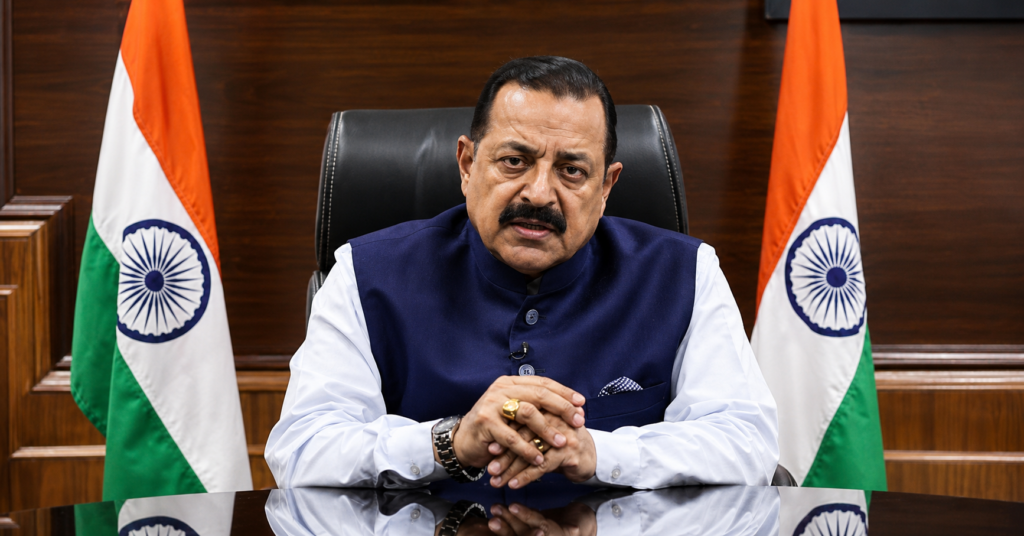
Union Minister Jitendra Singh introduced the Public Examinations (Prevention of Unfair Means) Amendment Bill, 2026 in the Rajya Sabha on Thursday, a day after it was cleared by the Lok Sabha, walking into a session marked by sustained sloganeering and sharp exchanges between the Treasury and Opposition benches. The bill, meant to tighten India’s legal framework against examination paper leaks and organised cheating networks, was expected to dominate a discussion scheduled to run for roughly seven hours in the Upper House.
Instead, it ended up sharing the floor with a separate and far more heated controversy over police action against student protesters in Delhi, as opposition members used nearly every opportunity to redirect the debate toward questions the government appeared reluctant to answer directly. What was meant to be a relatively straightforward legislative exercise, tightening penalties and speeding up trials under an existing law, instead turned into one more flashpoint in an increasingly combative Monsoon Session, with the substance of the bill often struggling to hold the room’s attention against the noise around it.
From Lok Sabha to Rajya Sabha
The legislation reached the Upper House after clearing the Lok Sabha following nearly ten hours of discussion a day earlier, a debate that itself was repeatedly interrupted. Singh referenced this history as he introduced the bill in the Rajya Sabha, noting that discussion had continued in the Lower House “notwithstanding frequent interruptions and notwithstanding the fact that the entire reply was made in the din.”
Proceedings in the Rajya Sabha were expected to run for approximately seven hours, beginning around 2 pm, with Congress President and Leader of the Opposition Mallikarjun Kharge leading the response for his party alongside senior Congress leader Mukul Wasnik. Presiding officer C P Radhakrishnan repeatedly urged members to let ministers speak without interruption as opposition MPs shouted slogans from their benches soon after Singh took the floor.
Uproar Overshadows the Bill
While the bill was ostensibly the business of the day, much of the session’s energy was consumed by an unrelated but politically charged dispute. Opposition members used the debate to press the government over the police response to a student protest held on July 20 during a Sansad Chalo march from Jantar Mantar, with allegations that officers used pellet guns and, in some accounts, more serious force against demonstrators.
Congress MP Pramod Tiwari directed his questions squarely at the government’s front bench, arguing that the minister piloting the bill was not the right person to answer for the conduct of the police that day. “Jitendra Singh cannot answer for the lathi charge, the disrespect shown to women, or the firing of AK-47s; only Amit Shah can answer that,” Tiwari said, demanding that the Union Home Minister appear in the House directly to respond.
Kharge opened his own address with a Hindi couplet, “Gunahgar haste rahe, masoom sisakte rahe,” meaning that the guilty kept laughing while the innocent kept sobbing. He argued that provisions modelled on fast track courts would change little in practice, and that the real test of the government’s intent lay in how examinations were actually conducted going forward rather than in the severity of punishments written into law. Part of his remarks, which touched on the Manusmriti, were later expunged from the official record after Union Minister J P Nadda objected that the comments risked stirring unrest.
The disruptions echoed scenes from the Lok Sabha a day earlier, where the bill’s passage was similarly overshadowed by opposition anger over Leader of the Opposition Rahul Gandhi’s remarks against Amit Shah and allegations that the government had failed to account for the protest crackdown.
What Singh Told the House
Introducing the amendments, Singh described the legislation as a reaffirmation of the “government’s commitment to protecting the interests of students and youth.” He told the House that the amendments reflected a willingness to “learn from experience” gained since the original 2024 anti-paper leak law came into force, and shared figures to back the government’s record, stating that fifty two FIRs had been registered under that law and that examination linked student suicides had declined during the period.
Singh also used the moment to trace a longer institutional history, telling the Rajya Sabha that the idea of a dedicated national examination body was first proposed in 1992 under a Congress government, and that a committee set up during the UPA years in 2010 had strongly recommended the same step, without it being acted upon at the time. Turning to the opposition benches, he said, “I am sure they will appreciate and be grateful and thank Prime Minister Modi that the unfinished task and unfinished agenda left by UPA are being completed and brought by the NDA.” The line drew loud protests from Congress members even as Singh continued his remarks, and has since been widely shared as one of the more pointed exchanges of the session.
Inside the Amendment Bill
The amendment strengthens the original Public Examinations (Prevention of Unfair Means) Act, 2024 by providing for expedited investigations, fast track trials and enhanced penalties for those found involved in organised examination fraud or paper leak syndicates. The government has positioned the changes as a response to practical difficulties observed while implementing the original law, rather than as an admission that the earlier act had failed.
Singh reminded members that the 2024 law itself had moved through Parliament quickly once introduced, having been tabled in January 2024, enacted the following month and then implemented and formally notified by June of that year. He held this pace up as evidence of the government’s seriousness on the issue, contrasting it with the decades that passed between the first proposal for a national testing body in 1992 and the eventual creation of the National Testing Agency years later.
Why This Debate Matters
For the millions of students and job seekers who sit for competitive examinations conducted by bodies such as the Union Public Service Commission, the Staff Selection Commission, the Railway Recruitment Board, the Institute of Banking Personnel Selection and the National Testing Agency, the outcome of this debate carries direct consequences. Repeated paper leak controversies, including the NEET irregularities that dominated headlines in previous years, have left many candidates and their families anxious about the reliability of the testing process itself.
The government maintains that the amended law will close gaps exposed since 2024 and act as a stronger deterrent against organised cheating networks. The opposition, meanwhile, has continued to argue that legal penalties alone cannot fix a system it believes suffers from deeper structural problems, and has used the current session to link the examination debate to its broader criticism of how the government has handled recent student unrest.
With the bill now before the Rajya Sabha, its passage appeared likely given the government’s numbers in the House, though the session made clear that the debate around it would remain entangled with wider political disputes rather than being confined strictly to questions of examination policy.


