

A Delhi court has sentenced former AAP councillor Tahir Hussain and four other men to life imprisonment for the murder of Intelligence Bureau staffer Ankit Sharma, one of the most closely watched killings to emerge from the communal riots that swept through northeast Delhi in February 2020. The sentencing, delivered by the Karkardooma court on Friday, draws a line under a prosecution that has run for more than six years, moving through multiple rounds of arrests, a lengthy trial and a separate hearing on punishment before reaching its conclusion.
Prosecutors had pressed for the death penalty, arguing that the killing was carried out with a brutality that placed it among the rarest of rare cases under Indian law. The court disagreed. While it condemned the crime in some of the strongest language used in its judgment, it ruled that the convicted men were not beyond the possibility of reform, and settled instead on life imprisonment.
For Ankit Sharma’s family, the verdict closes one chapter of a long and difficult legal fight. For Mr Hussain, once a sitting municipal councillor and now a convicted murderer, it opens the door to an appeal that is expected to take the case to the Delhi High Court.
The verdict
Additional Sessions Judge Praveen Singh sentenced Mr Hussain, Nazim, Kasim, Javed and Anas on Friday for murder, rioting and related offences. Six of the eleven people originally accused in the case had already been acquitted at an earlier stage of the proceedings, after the court found the evidence against them insufficient to sustain a conviction. Friday’s hearing was confined to the question of punishment for the five men already found guilty, and was attended by senior police officers, lawyers for both sides and members of Ankit Sharma’s family.
The judge described the killing as a heinous and barbaric act that had shaken the conscience of society, but stopped short of calling it a rarest of rare case, the threshold Indian courts apply before imposing a death sentence. Mr Sharma was pulled into a mob during the riots and attacked with sharp and blunt weapons, the court found. His body bore 51 injuries, seven of which alone were enough to cause death, a detail the judge referred to repeatedly while explaining why the crime deserved the harshest available punishment short of execution.
“The savagery did not end there. Instead, the body was dragged like an animal as if the hatred had still not been satiated. The body was then thrown into the nallah,” the court said in its order, referring to the drain in Chand Bagh where Mr Sharma’s body was later found. The passage was among the most quoted lines from the judgment in the hours after it was delivered, cited repeatedly by reporters and lawyers as an illustration of how starkly the court viewed the circumstances of the killing, even as it declined to impose a death sentence.
What happened in 2020
Ankit Sharma, a 26 year old Intelligence Bureau security assistant, went missing on 25 February 2020 as communal violence spread through parts of northeast Delhi, a wave of unrest that began after clashes between groups supporting and opposing a new citizenship law. His father, Ravinder Kumar, told police his son had been dragged into a building owned by Mr Hussain and attacked by a mob after stepping out to buy groceries that evening. Residents in the area also alleged at the time that stones and petrol bombs had been thrown from the roof of the same building, claims that would later feature prominently in the police investigation and chargesheet.
Mr Sharma’s body was recovered two days later from a drain near Chand Bagh Pulia, not far from where his family lived. A post mortem found he had died from haemorrhage caused by multiple stab wounds, and doctors at GTB Hospital declared him brought dead. Mr Hussain, then a sitting municipal councillor with the East Delhi Municipal Corporation, was arrested along with several others in the days that followed, in what became one of the highest profile arrests to emerge from the riots.
The Aam Aadmi Party suspended him from the party shortly afterwards, pending the outcome of the investigation, distancing itself from a councillor who had, until then, held a position within its ranks in East Delhi. The riots themselves claimed dozens of lives across the capital and left the city on edge for weeks, prompting a wider debate over the police response and the political tensions that preceded the violence.
The conspiracy claim that did not hold
Police had alleged a wider conspiracy behind the killing, describing Mr Sharma as a familiar face in the area who was deliberately targeted by a mob that Mr Hussain had allegedly led and instigated over two days, 24 and 25 February. Investigators said they recovered a blood stained knife used in the attack, along with blood stained clothing belonging to one of the accused and a second knife believed to have been used during the assault, evidence that formed the backbone of the prosecution’s case at trial.
Ten people, including Mr Hussain, were named in the chargesheet, which invoked offences ranging from murder and kidnapping to promoting religious enmity and criminal conspiracy. Investigators argued at the time that the violence in Chand Bagh had not been spontaneous, but had followed a pattern of planning that included the alleged stockpiling of weapons and the deliberate disabling of surveillance equipment in the area.
The trial court, however, found the conspiracy charge unproven. It noted that damaged and diverted CCTV cameras in the area suggested a conspiracy might have been afoot, but said prosecutors had failed to show when, where or how such a plan was formed, or who among the accused had taken part in devising it. Mr Hussain and the other convicts were acquitted on that count, even as the court went on to hold them responsible for the killing itself on other grounds.
Six years in court
Charges were formally framed against Mr Hussain and ten co-accused in March 2023, under sections of the Indian Penal Code covering murder, rioting, kidnapping, conspiracy and promoting enmity between groups. The court heard from 91 witnesses over the course of the trial.
On 13 July 2026, Judge Singh delivered a 320 page judgment convicting five of the accused and acquitting the remaining six for lack of sufficient evidence. The court held that Mr Hussain had been part of a heavily armed mob that assembled with animus against Hindus to commit rioting, arson and looting, and that Mr Sharma was subjected to a savage and relentless assault after being surrounded and dragged toward Chand Bagh Pulia.
Mr Hussain was convicted of murder, kidnapping, rioting, rioting while armed, and promoting enmity between groups, along with disobeying a lawful order, all read alongside the provision on unlawful assembly, which made him vicariously liable even without evidence of a specific act on his part.
The case for and against death
At a separate sentencing hearing, Special Public Prosecutor Madhukar Pandey argued for the death penalty, calling the killing a cold blooded and brutal murder and noting that nobody in the mob had attempted to get Mr Sharma to hospital after the attack.
Defence counsel Rajiv Mohan argued that capital punishment could only be imposed in the rarest of rare cases, after weighing aggravating and mitigating factors together, not on the basis of injuries alone. He pointed out that six of the eleven original accused had been acquitted, and that the judgment had not attributed any specific act to Mr Hussain beyond his presence in the crowd. Mr Hussain’s conduct in custody, the defence added, had been satisfactory throughout.
The court ultimately accepted the defence’s broader argument, concluding that prosecutors had not shown the convicts were beyond reform.
The family’s response
Ankit Sharma’s brother, Ankur Sharma, said the verdict had brought a measure of relief after years of waiting, telling reporters that the family had never lost faith in the judicial process even when the case seemed to stretch on without end. “After almost six years of fighting this case, our family finally feels that we have received a sense of justice,” he said, calling it a long and painful journey. The family said it would continue to press for the case to be treated as rarest of rare before a higher court, arguing that the scale of the violence inflicted on Mr Sharma warranted nothing less than the death penalty.
Delhi’s law minister, Kapil Mishra, said he was disappointed the death penalty had not been imposed, describing the killing as deserving the harshest punishment available and voicing hope that the Delhi High Court would revisit the sentence on appeal. His remarks reflected a broader strain of political reaction to the verdict, with several leaders weighing in on both the severity of the crime and the adequacy of the punishment handed down.
Hussain vows to appeal
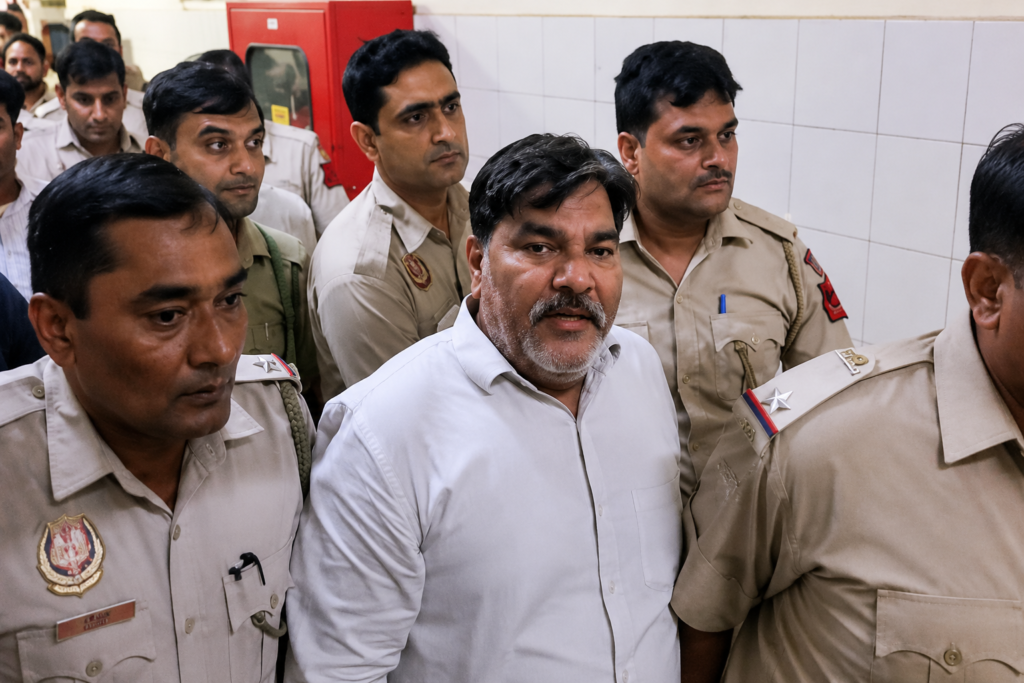
Speaking to reporters as he was escorted from the Karkardooma court, Mr Hussain said he would challenge the verdict, maintaining a defiant tone even as he was led away by police personnel. “Insaaf High Court se milega. The High Court will give justice; it is not too late,” he said, signalling that he intends to contest both his conviction and the life sentence handed down against him.
What comes next
The case is now expected to move to the Delhi High Court, where an appeal is likely from both sides. Mr Hussain and his co-convicts are expected to contest the conviction itself, while prosecutors may seek to have the sentence enhanced to death.
Indian appellate courts have historically been reluctant to overturn a trial court’s judgment on sentencing unless there is a clear error in how aggravating and mitigating factors were weighed, meaning any request to enhance the punishment is likely to face a high bar. The question of vicarious liability under the unlawful assembly provision, which underpinned Mr Hussain’s conviction, could also draw scrutiny on appeal.
A case that came to define the riots
The killing of Ankit Sharma has become one of the defining cases to emerge from the 2020 Delhi riots, among the worst instances of communal violence the capital has seen in decades. It has repeatedly surfaced in political debate over the years, invoked by leaders across the spectrum whenever questions of law and order, communal tension or the pace of India’s judicial process are raised, and the verdict is likely to keep it there for some time yet.
For the Sharma family, the sentencing closes one chapter of a long legal fight, even as another begins in the Delhi High Court. Whatever the outcome of the appeal, the case will remain a reference point in how Delhi’s institutions, from its police to its courts, are judged to have responded to one of the darkest episodes in the city’s recent history.


