

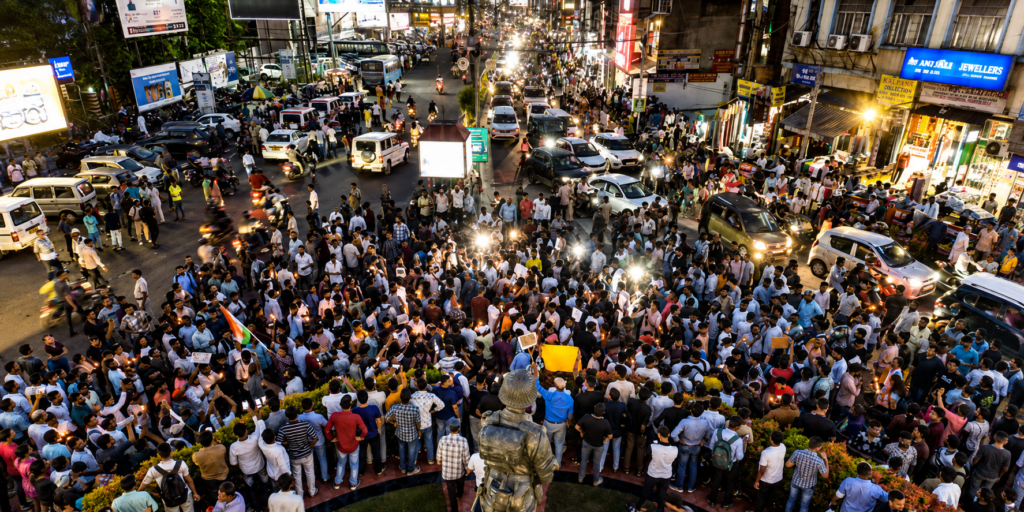
A wave of student anger has taken over Ranchi, the capital of Jharkhand, where thousands of young job aspirants have gathered to demand accountability from the state’s recruitment bodies. At the centre of this movement is student leader Devendra Nath Mahto, now on an indefinite hunger strike, refusing food to force the government’s hand on what protesters call systemic corruption in competitive exams.
The demonstration, which began as a sit-in on July 25, has grown into one of the largest youth-led movements Jharkhand has seen in years, with students converging on the Jaipal Singh Munda Stadium against alleged irregularities in the Jharkhand Public Service Commission, or JPSC, and the Jharkhand Staff Selection Commission, or JSSC.
The Spark: A Viral Answer Sheet
The trigger was small but explosive. About a month before the sit-in began, a copy of a successful candidate’s OMR sheet from the JPSC preliminary exam went viral, with claims the candidate had qualified despite attempting only 48 of 100 questions. The image became proof of what students had long suspected. Within days, murmurs of doubt turned into organised protest, first at Bapu Vatika in Morabadi, then at the larger stadium.
How the Protest Began
What started as a modest gathering soon spiralled into a full-blown agitation. By July 29, the sit-in had become a fixture in the city, drawing new participants daily, with slogans echoing through the site as demonstrators demanded a central investigation. A protester who joined in the early days captured the mood plainly. “That is why we students have united and are protesting; this is our third day here,” she said, adding that the Satyagraha would continue “until the government addresses our demands, demands that are in the students’ best interest.”
A Pattern That Predates This Protest
This movement is not an isolated flare-up but the latest chapter in a long-running crisis. The JSSC Combined Graduate Level exam held in 2023 was cancelled after leak allegations, with results withheld for over a year during a CID probe and re-examination.
The JPSC itself has not been spared, having formally charged fifty people in an earlier scandal, including a former chairman and the examination controller. Earlier this year, more than 150 students were detained over suspected leaked papers for the Excise Constable exam, though police later said the material did not match the actual paper. By the time this year’s row erupted, nine JPSC recruitment processes had already been postponed indefinitely, each chipping away at students’ faith that a job here can be won on merit alone.
Devendra Nath Mahto’s Journey to the Hunger Strike
Devendra Nath Mahto is not new to activism. A native of a village near Ranchi who studied in Bundu before attending Dr Shyama Prasad Mukherjee University, Mahto has led student movements since 2015 over paper leaks, scholarships and reservation policies, and now serves as vice president of the Jharkhand Loktantrik Krantikari Morcha’s student wing.
After weeks of sit-in demonstrations failed to move the government, Mahto escalated his protest on the night of August 2, beginning an indefinite hunger strike he called his last available option.
“The fast was the last option as the protest did not move the government,” Mahto said.
His decision has drawn comparisons to environmentalist Sonam Wangchuk, whose own hunger strike earlier this year during nationwide exam protests has led some to call Mahto the Sonam Wangchuk of Jharkhand. By the fourth day, five more students had joined his fast.
What the Students Are Demanding
The protesters’ demands include a CBI and ED probe into alleged irregularities in the JPSC and JSSC exams, cancellation of the 14th JPSC preliminary exam, disclosure of OMR sheets, answer scripts and cut-off marks, blacklisting of implicated agencies, reforms within the recruitment bodies, and a fifth “not attempted” option on OMR sheets for added accountability.
Behind these formal demands lies something more personal. One protester from Giridih district said, “The careers of thousands of students and aspirants are at stake due to corruption in both agencies. Most of us come from farmers’ families. We only want fair opportunities based on merit.” Another was blunter: “Responsibility must be fixed. If something like this is happening in your state, in your society, and under your government, then you must take responsibility. You should accept accountability for this, either bring reforms or step down from your position.”
Protesters have taken pains to distance the movement from party politics, even as political parties have tried to align with the cause. “Our fight isn’t with the Chief Minister. Our fight isn’t with any party. Our fight is with the rotten system that has taken over,” one demonstrator said, insisting the platform would not become a tool for any political outfit.
The Political Crossfire
The opposition BJP has intensified its demand for Soren’s resignation, citing repeated paper leaks as evidence of institutional breakdown. Its youth wing staged demonstrations outside collectorates in East Singhbhum, West Singhbhum and Chatra, and national spokesperson Pradeep Bhandari warned that “every passing day number of students on the streets are increasing.” Former chief minister Raghubar Das called it a deeper governance failure, and the protest has also attracted the Cockroach Janata Party, known for unconventional activism, drawing comparisons to earlier protests at Delhi’s Jantar Mantar.
The Government’s Response
For much of the agitation’s early weeks, the state government stayed silent, deepening frustration at the site. That changed on August 4, when Soren addressed the matter publicly for the first time.
“This is a sensitive government that believes in delivering justice. Whenever we take up an issue, we remain committed to resolving it. Our young people will certainly get justice within the ambit of the Constitution and the law,” Soren said.
Ruling party leader Manoj Pandey backed the state’s own investigative agencies to lead the probe rather than the CBI. “Strict action must be taken, and we agree with that. Whoever be it an individual, official, or employee is involved in such irregularities will face the strictest possible action. Whoever did this will not be spared. I assure you with full confidence,” Pandey said. The state CID has already arrested eleven people in the JPSC paper leak case, though students say the scale of alleged irregularities warrants a wider, independent probe.
Why This Movement Resonates Beyond Jharkhand
This protest is not purely a local dispute over one exam. For young Indians with limited private-sector options, a government job remains one of the few reliable paths to security, and the competitive exam is the gatekeeper. Students who describe coming from farming families and pouring years into preparation are describing a bargain that feels broken, and each fresh allegation chips away at it, for those directly affected and for the wider cohort watching from the sidelines.
Where Things Stand Now
As the protest enters its second week and Mahto’s fast continues, the standoff shows no sign of resolving quickly. Civil society groups and political parties have amplified calls for a fair investigation, and public figures, including Bollywood actor Sonakshi Sinha, have voiced solidarity online. With Mahto’s health reportedly deteriorating and no resolution in sight, the stadium remains the epicentre of a movement representing a generation of job aspirants, one whose outcome could shape trust in Jharkhand’s recruitment system for years to come.


