


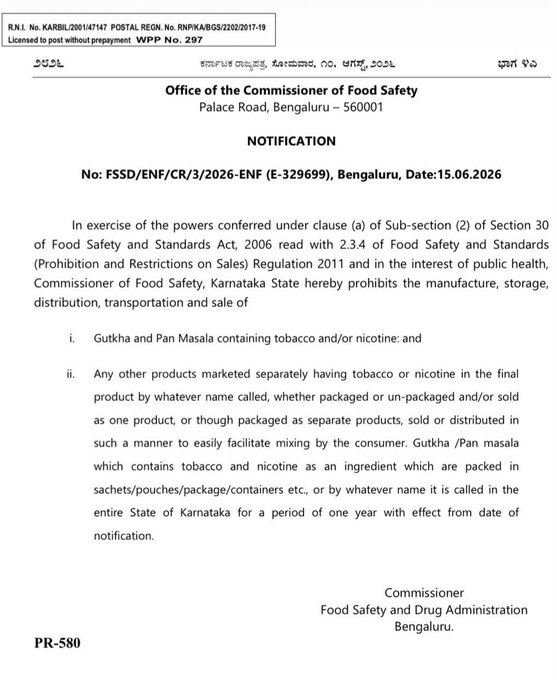
The Karnataka government has imposed a one year ban on the manufacture, storage, distribution, transportation and sale of gutkha and pan masala containing tobacco or nicotine across the state. The order was issued by the Office of the Commissioner of Food Safety and came into force on August 10, 2026. It will remain in effect for twelve months from the date of issuance.
The notification cites public health as the basis for the prohibition. It was issued under clause (a) of sub section (2) of Section 30 of the Food Safety and Standards Act, 2006, read with Regulation 2.3.4 of the Food Safety and Standards Prohibition and Restrictions on Sales Regulations, 2011. This provision allows a state Commissioner of Food Safety to prohibit the manufacture, storage, distribution or sale of any food article across the state for up to one year, in the interest of public health.
Scope of the prohibition
The order applies to gutkha and pan masala containing tobacco or nicotine, regardless of the packaging used, including sachets, pouches, containers and any other packaging format. It also covers products sold under alternative brand names if they contain tobacco or nicotine.
A specific clause in the notification addresses products sold as separate components intended to be combined by the buyer, such as plain pan masala sold alongside tobacco or nicotine sachets. Both components fall within the ban when they are marketed or packaged in a manner that allows the buyer to mix them into a final product containing tobacco or nicotine.
The restriction covers every stage of the supply chain within Karnataka. This includes manufacturing units, storage warehouses, transport operators, wholesale distributors and retail sellers.
Legal basis and past enforcement
Karnataka first banned gutkha in 2013, after the Supreme Court directed states to enforce the Food Safety and Standards Regulations against tobacco laced food products. The 2013 order, issued under the same Section 30 provision, prohibited gutkha and pan masala containing tobacco and nicotine as ingredients across the state.
That ban did not eliminate the products from the market. Manufacturers began selling pan masala and raw tobacco or nicotine as separate packets, which consumers could combine themselves. This practice allowed sellers to argue that neither packet, sold individually, contained both tobacco and pan masala together, placing them outside the literal wording of the earlier order. The August 2026 notification directly addresses this by extending the prohibition to products sold separately for mixing.
Bans issued under Section 30 have to be renewed periodically because the provision caps each notification at a maximum of one year. States including West Bengal, Gujarat, Bihar and Andhra Pradesh have issued similar year long, repeatedly renewed bans on gutkha and pan masala since 2011, when the Food Safety and Standards Authority of India first clarified that tobacco and nicotine cannot be used as ingredients in food products.
Penalties for violation
Violations of a prohibitory order issued under Section 30 of the Food Safety and Standards Act are dealt with under Chapter 10 of the Act, which covers offences and penalties. Manufacturing, storing, selling or distributing an article of food that is unsafe carries a penalty of imprisonment for up to six months and a fine of up to one lakh rupees where the contravention does not result in injury. The penalty rises to imprisonment for up to one year and a fine of up to three lakh rupees where the contravention results in non grievous injury, and up to six years imprisonment with a fine of up to five lakh rupees where it results in grievous injury.
Under Section 64 of the Act, a person convicted a second time for the same offence is liable to twice the punishment that could have been imposed on first conviction, along with a daily fine for continuing offences and cancellation of their food business licence.
Department statement
The Department of Food Safety and Drugs Administration confirmed that enforcement operations began immediately after the notification took effect. Food Safety Officers have been deployed to inspect manufacturing sites, storage facilities and retail outlets across the state.
In its official release, the department stated:
“The Department of Food Safety and Drugs Administration appeals to the public to inform the concerned authorities if they come across the manufacture, sale or distribution of prohibited tobacco and nicotine products and to extend their cooperation in building a healthy and addiction-free Karnataka.”
Health data behind the decision
Smokeless tobacco products, including gutkha and pan masala containing tobacco or nicotine, are established risk factors for oral cancer, oral submucous fibrosis and gum disease. Government data cited in previous state level bans has put annual new oral cancer cases in India at over 80,000, with more than 90 percent of oral cancer cases in the country linked to tobacco use in some form.
Chewing tobacco products have also been associated with cardiovascular effects and gastrointestinal harm, in addition to oral disease. Non food grade additives found in some gutkha formulations have been flagged by health researchers as an added risk beyond tobacco itself.
Political response in 2013
When Karnataka first imposed the ban in 2013, it drew objections from legislators representing areca nut growing constituencies in the Malnad region, who argued that the state should have consulted growers before the order was issued. The then Chief Minister defended the decision as compliance with the Supreme Court’s directive, stating that the government had no discretion in the matter and would face contempt of court proceedings if it did not act. The current 2026 notification has not been accompanied by a similar public political dispute at the time of its issuance.
Current status
The ban remains in force until August 2027 unless renewed or modified before then. Enforcement is being carried out by Food Safety Officers under the Department of Food Safety and Drugs Administration, with inspections targeting manufacturing units, warehouses, transport routes and retail points of sale across Karnataka.


