

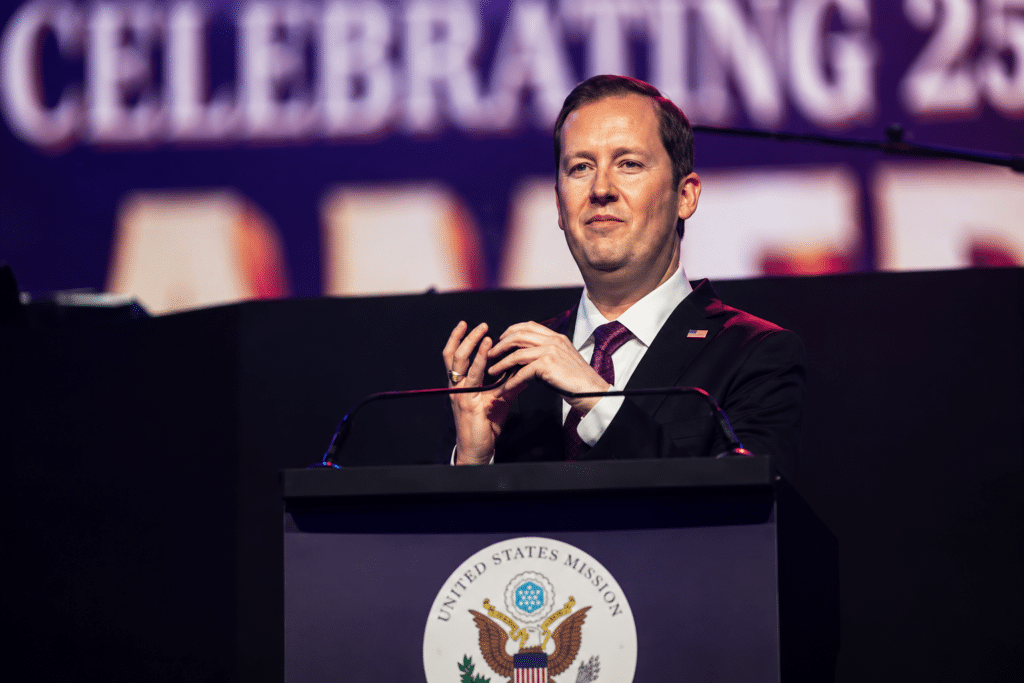
The India-US commercial relationship stands at a decisive juncture. On Tuesday, US Ambassador to India Sergio Gor used the national stage of the Indo-American Chamber of Commerce (IACC) to deliver a candid message to policymakers and business leaders in both countries: the two democracies cannot reach their full economic potential until they resolve the friction points that continue to slow trade, taxation and technology cooperation. The address comes at a time when both governments are eager to project momentum in the relationship, even as unresolved tariff disputes and regulatory uncertainty continue to shape how investors on both sides weigh their next move. For a partnership that officials on both sides routinely describe as one of the most consequential of the century, Gor’s remarks served as a reminder that goodwill alone will not be enough to sustain the pace of growth both countries are chasing.
Speaking at the IACC National Convention 2026 in Mumbai, themed “Redefining the India-US Comprehensive Strategic Partnership,” Gor’s remarks landed at a moment when bilateral trade has already crossed record levels, even as tariff disputes, export control disagreements and regulatory unpredictability continue to test the relationship.
Gor’s Call for Predictable Taxation
Gor’s central message centered on three pillars he believes must be strengthened for businesses on both sides to invest with confidence: taxation, technology and intellectual property.
He told the gathering that stable, predictable tax and regulatory systems are essential for companies to operate without second-guessing policy shifts. He also pressed for more open, trust-based conversations between Washington and New Delhi on export controls and the flow of critical technologies, alongside stronger intellectual property safeguards that would let innovators build, invest and expand without fear of losing their edge.
“We must address friction points together as true partners,” Gor said, framing the relationship not as a transactional one but as a genuine strategic alliance that needs continuous maintenance.
He was equally direct about what is at stake if these frictions go unresolved. According to the ambassador, unpredictability in policy and regulation is precisely what holds back deeper capital flows between the two economies, even as both governments publicly commit to expanding cooperation.
Trade Numbers Show Explosive Growth
Behind the diplomatic language lies a striking statistic. Gor highlighted that India-US trade in goods and services has expanded from around 20 billion dollars two decades ago to more than 240 billion dollars today, a twelvefold increase that reflects the deepening economic interdependence between the world’s oldest and largest democracies.
That growth trajectory is now being pointed toward an even more ambitious target. Both governments have set their sights on reaching 500 billion dollars in bilateral trade by 2030, a goal that would require sustained momentum across manufacturing, services, technology and defense sectors over the next four years.
Gor credited the scale of this growth to what he called a partnership built on deep and unbreakable trust between the two nations, one that he argued has room to expand further if structural barriers are addressed rather than papered over.
Technology Cooperation Takes Center Stage
Beyond trade volumes, the ambassador used his address to spotlight the technology partnership taking shape between Washington and New Delhi. He referenced the trust initiative launched by President Donald Trump and Prime Minister Narendra Modi early in Trump’s second term, an effort designed to accelerate joint work in artificial intelligence, quantum computing, semiconductors, defense and critical minerals.
Gor pointed to the personal chemistry between the two leaders as a driving force behind this push, describing an investment in the relationship that dates back to the start of the current administration.
He also cited New Delhi’s hosting of the Global AI Summit during his early months as ambassador as proof that India has cemented its place as a serious player in the global technology ecosystem, one that Washington increasingly views as a partner rather than merely a market.
The embassy’s own track record featured prominently in his remarks as well. Gor noted that the US mission in India topped every other American embassy worldwide in attracting investment, having helped channel more than 20 billion dollars into the country.
Maharashtra Eyes Bigger Share of US Investment
The Mumbai convention was not just a platform for federal-level diplomacy. On the sidelines, Gor held a separate meeting with Maharashtra Chief Minister Devendra Fadnavis, a conversation that quickly turned to how the state could capture a larger share of American capital.
Fadnavis described the discussion as wide-ranging, covering sectors where the United States holds a competitive edge, including technology, higher education, data centers and semiconductors. He said the conversation focused on channeling investment in these fields specifically into Maharashtra.
“It was a very productive discussion, and we intend to take this initiative forward,” Fadnavis said following the meeting, signaling that the state government plans concrete follow-up rather than treating the exchange as a ceremonial courtesy call.
Maharashtra’s pitch is backed by scale. Fadnavis pointed out that if the state were an independent nation, its economy would rank as the 20th largest in the world, a statistic he used to underline why global investors, particularly American ones, should view the state as a serious economic hub rather than a peripheral market.
What This Means for Businesses
For companies operating across both markets, the diplomatic language used in Mumbai translates into practical concerns. Predictable taxation means fewer sudden compliance shifts. Trust-based engagement on export controls means smoother technology transfer approvals. Stronger intellectual property protection means lower risk for firms investing in research and product development in India.
These are not new complaints from American businesses, but Gor’s decision to raise them publicly at a major bilateral forum suggests Washington wants visible, measurable progress rather than incremental promises. The ambassador’s remarks arrive against the backdrop of earlier tariff tensions between the two countries, tensions that Gor himself had once described as narrowing rather than widening.
Taken together, Tuesday’s events in Mumbai, spanning a chamber of commerce address, a state-level investment meeting and a fresh set of trade statistics, paint a picture of a relationship growing in scale even as its underlying friction points remain unresolved. Whether that friction is genuinely reduced, or simply managed through diplomatic messaging, is likely to shape how quickly the 500 billion dollar trade target becomes reality rather than aspiration.


