

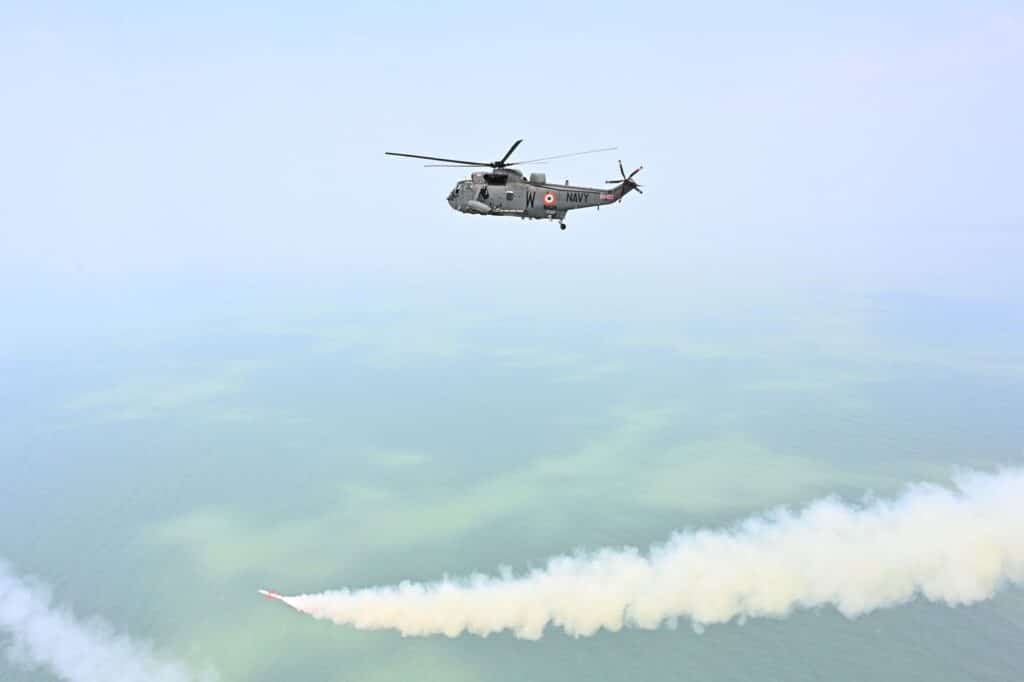
India has taken a significant step in strengthening its maritime strike capability with the successful maiden salvo launch of the Naval Anti-Ship Missile Short Range system.
The trial, conducted jointly by the Defence Research and Development Organisation and the Indian Navy off the Odisha coast, demonstrated for the first time the ability to fire two indigenous anti-ship missiles in quick succession from a naval helicopter. Defence officials said the test validated coordinated multi-missile engagement, precision targeting, and seamless integration with rotary-wing platforms.
The development comes at a time of rising strategic competition across the Indo-Pacific, where maritime dominance and rapid response capability are increasingly central to national security planning.
Test validation
The maiden salvo launch involved the near-simultaneous firing of two NASM-SR missiles from a naval helicopter, marking a first for an indigenous air-launched anti-ship system in India. The missiles were released within seconds of each other to replicate real operational scenarios in which multiple targets must be engaged in a compressed timeframe.
According to defence officials, both missiles followed their designated trajectories and successfully struck their intended targets, meeting all mission objectives. The trial was monitored using a combination of radar systems, telemetry, and electro-optical tracking instruments, which confirmed the missiles’ stability, coordination, and accuracy throughout the mission.
A key outcome of the test was the confirmation of precision strike capability at the waterline of the target. This is considered a critical vulnerability point in naval vessels, where impact can cause maximum structural damage and significantly increase the likelihood of disabling or sinking a ship. The validation of this capability reflects the system’s readiness for realistic combat conditions.
Missile capability
The NASM-SR is a lightweight, subsonic, air-launched anti-ship missile designed for deployment from naval helicopters. With a range of around 55 kilometres, it is optimised for short-range engagements in both coastal and open-sea environments.
The missile operates on a sea-skimming flight profile, flying at very low altitudes to minimise detection by enemy radar systems. This enhances survivability in contested environments where adversaries deploy layered air defence systems.
It features fire-and-forget functionality, allowing operators to disengage immediately after launch, thereby improving response time and operational efficiency. In addition, the missile incorporates Man-in-Loop guidance, enabling operators to receive real-time imagery and adjust targeting mid-flight, which is particularly important in congested maritime zones.
The system also supports lock-on-after-launch capability, allowing it to acquire and track targets after being fired. This adds flexibility and ensures effectiveness against moving or partially obscured targets in dynamic combat situations.
Technology stack
The NASM-SR integrates a range of advanced technologies developed within India’s defence research ecosystem. It is equipped with a Fibre Optic Gyroscope based inertial navigation system, which ensures precise guidance during the mid-course phase of flight.
A radio altimeter enables the missile to maintain a stable low-altitude trajectory during its sea-skimming phase. The inclusion of a high-bandwidth two-way data link allows continuous communication between the missile and the launch platform, supporting real-time updates and targeting adjustments.
The propulsion system combines a solid booster with a long-burn sustainer, providing consistent thrust and stable flight performance. A jet vane control system enhances manoeuvrability, allowing the missile to adapt to changing target conditions.
The development programme involved collaboration among multiple laboratories under the Defence Research and Development Organisation, along with contributions from Indian industry partners under a development-cum-production model. This approach supports India’s broader objective of building a self-reliant defence manufacturing base.
Strategic impact
The successful salvo launch represents a significant enhancement of India’s maritime deterrence capability. Modern naval vessels are equipped with layered defence systems designed to intercept incoming threats, making single missile engagements less effective in high-threat environments.
By demonstrating coordinated multi-missile engagement, the NASM-SR enables saturation attack capability, increasing the probability of penetrating enemy defences. This provides a tactical advantage against high-value targets such as destroyers and frigates.
The integration of the missile with helicopter platforms further expands operational flexibility. Helicopters can engage targets beyond the horizon, reducing the exposure of larger naval assets and enabling faster response across wide maritime areas.
This capability is particularly relevant in the Indo-Pacific region, where strategic competition and naval deployments are intensifying. The system also contributes to the modernisation of India’s naval arsenal by providing an indigenous alternative to legacy anti-ship missiles, supporting long-term strategic autonomy.
Official response
India’s Defence Minister Rajnath Singh congratulated the teams involved in the successful test and described it as a major milestone for the country’s defence preparedness.
“The successful development and testing of this system will greatly enhance the operational capability of the Armed Forces,” he said, acknowledging the contribution of scientists, engineers, and naval personnel.
Officials also emphasised that the achievement reflects sustained progress in indigenous defence research and development, with the NASM-SR programme undergoing multiple stages of testing since 2022 before reaching this milestone.
There has been no direct response from international leaders on this specific development. However, earlier remarks by Donald Trump on India’s strategic role in global security underscore the broader geopolitical context. In a previous statement on defence ties, he said, “India is a very strong nation, and we have a great relationship when it comes to security and defence.”
The missile system is expected to undergo further user trials before full operational induction, with additional testing planned under varied combat conditions to ensure readiness.


