

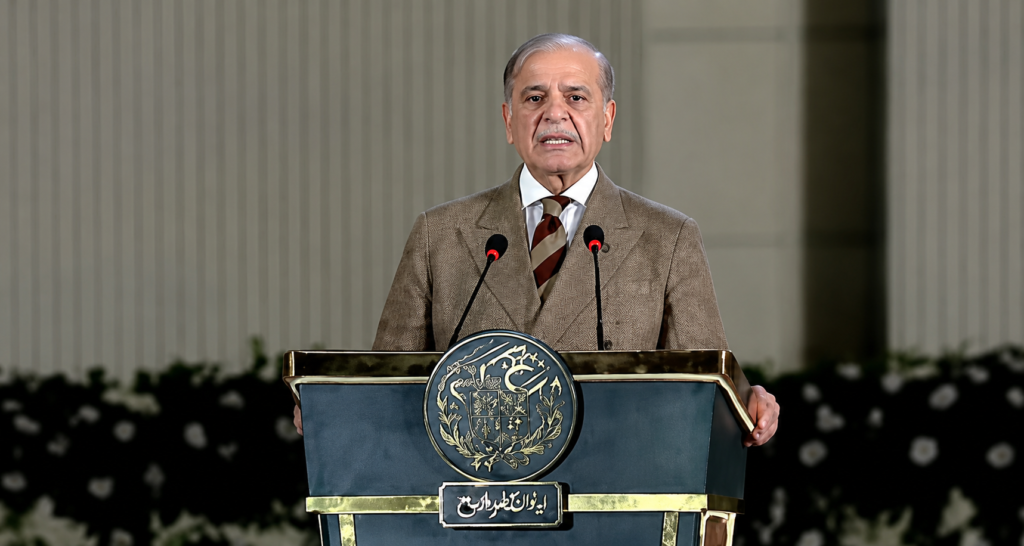
Pakistan Prime Minister Shehbaz Sharif has warned India of a direct response over the suspended Indus Waters Treaty, declaring that every single drop of his country’s water is a red line. The statement, delivered on the eve of Pakistan’s Independence Day, marks Sharif’s most pointed warning yet on the treaty, which India placed in abeyance following the April 2025 Pahalgam terror attack.
The comments have drawn a sharp counter from Jammu and Kashmir Chief Minister Omar Abdullah, who said the treaty has long worked against the region and should remain suspended. In India, the timing of Sharif’s warning has also come under scrutiny, with many noting that it arrives more than sixteen months after the treaty was first put on hold.
Sharif Declares Water A Red Line
Sharif made the remarks on Thursday, August 13, while addressing the inauguration of the Yadgar-e-Fatah, or Victory Monument, in Islamabad, a structure built to commemorate what Pakistan calls its victory in the May 2025 conflict with India, referred to domestically as Marka-e-Haq.
“Every single drop of Pakistan’s water is a red line,” Sharif said, according to Pakistani state media. He added, “If India does not come to its senses and does not remain on the right track, it will be responded to directly.”
Sharif said Pakistan’s pursuit of peace should not be mistaken for weakness and that any threat to the country’s sovereignty or national security would draw a forceful reply. He referred again to the four day military confrontation between the two countries in May 2025, claiming Pakistan had demonstrated its capacity to defend itself and warning that any repeat escalation would face an even stronger response from Islamabad. He also credited United States President Donald Trump with helping bring about the ceasefire that ended that conflict, a claim India has repeatedly rejected, maintaining that the ceasefire was reached through direct communication between the two militaries.
Why India Suspended The Treaty
India announced the treaty would be held in abeyance shortly after the April 22, 2025 attack in Pahalgam, in which terrorists killed twenty six people, most of them tourists. New Delhi has said the attack was linked to Pakistan based militant groups and cited it as the trigger for a set of punitive diplomatic and strategic measures, including the suspension of the water treaty.
India’s position has since been reiterated at international forums. Speaking at the United Nations in March 2026, India’s Permanent Representative P. Harish said the treaty would remain suspended until Pakistan ends its support for terrorism, calling the neighbouring country a global epicentre of terror. Harish said India had signed the 1960 agreement in good faith but that Pakistan had repeatedly undermined it through wars and cross border attacks. He also said New Delhi’s attempts to discuss modifications to the treaty in light of technological and environmental changes had been rejected by Islamabad in the past.
What The Indus Waters Treaty Covers
The Indus Waters Treaty was signed in September 1960 by India and Pakistan, with the World Bank serving as guarantor. It governs the sharing of six rivers in the Indus basin. Under its terms, India was given control over the three eastern rivers, the Ravi, Beas and Sutlej, while Pakistan received rights over the three western rivers, the Indus, Jhelum and Chenab. India is permitted limited, non consumptive use of the western rivers for purposes such as run of the river hydropower generation and restricted irrigation.
The agreement survived multiple wars and decades of hostility between the two nuclear armed neighbours before its suspension last year, making the current standoff one of the most serious tests of the pact since it was signed.
Pakistan’s Dependence On The Indus System
The Indus river system is central to Pakistan’s economy and food supply. It provides roughly eighty percent of the water used across the country’s sixteen million hectares of agricultural land and accounts for about ninety three percent of Pakistan’s total water use. The system supports an estimated 237 million people and contributes close to a quarter of the country’s gross domestic product through crops including wheat, rice and cotton.
Sharif has raised the issue at international platforms beyond Pakistan. In May 2026, addressing a three day International Conference on Glaciers’ Preservation in Dushanbe, Tajikistan, attended by delegates from eighty United Nations member states, he called India’s decision to suspend the treaty unilateral and illegal, saying millions of lives could not be held hostage to what he described as narrow political gains.
Omar Abdullah Says Kashmir Bore The Cost
Reacting to Sharif’s latest warning, Jammu and Kashmir Chief Minister Omar Abdullah told reporters in Srinagar on Friday that the treaty should remain suspended, arguing that the region had suffered under its terms for decades.
“Our lifeblood has been drained, these are our rivers, and we had the primary right to them,” Abdullah said. “Pakistan claims to be a great sympathiser of the Kashmiris, but when it comes to the issue of water, that sympathy vanishes. Where was this sympathy when we were stripped of the right to utilise our own rivers? We have been bearing the brunt of this Indus Waters Treaty ever since.”
Abdullah has repeated this position on multiple occasions since the suspension took effect, previously stating that he had opposed the treaty from the outset and calling for follow up infrastructure, including the long stalled Tulbul Navigation Barrage on the Jhelum, to allow the region to use its river resources for irrigation, electricity and navigation.
Reaction Over Timing In India
Sharif’s warning has been met with scepticism among sections of the Indian commentariat, who have pointed out that the treaty has already been suspended for well over a year, during which Pakistan made no comparable statement of this intensity. Commentators have also linked the timing of the remarks to domestic pressures facing Sharif’s government, citing ongoing militant violence in Khyber Pakhtunkhwa, unrest and human rights concerns in Balochistan and Pakistan occupied Jammu and Kashmir, and the continued imprisonment of former prime minister Imran Khan.
India has not issued a fresh official response to Sharif’s Thursday remarks. New Delhi’s established position, repeated most recently by its UN envoy in March 2026, remains that the treaty will stay in abeyance until Pakistan takes verifiable action against terrorism emanating from its territory.


