

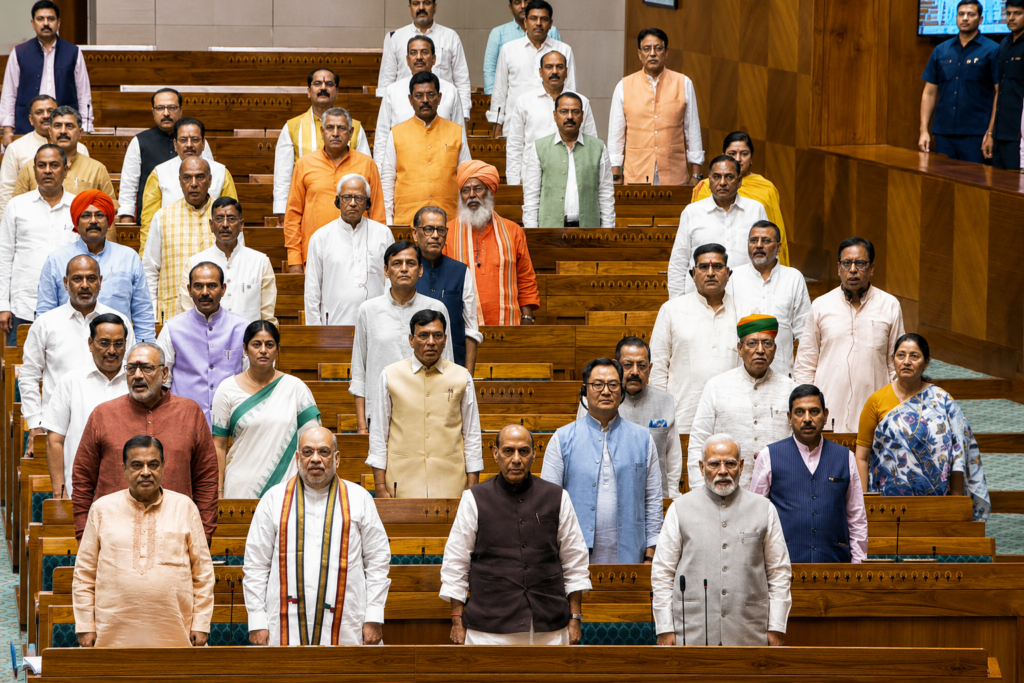
India’s Monsoon Session 2026 concluded on Thursday, August 13, with both the Lok Sabha and Rajya Sabha adjourned sine die, bringing to a close a session marked by repeated disruptions, political confrontation and a sharp gap between legislative output and parliamentary productivity.
Parliamentary Affairs Minister Kiren Rijiju described the session as successful in terms of legislative business, saying 12 Bills were passed. The Opposition, however, argued that Parliament had failed to provide adequate space for debate and accountability on several major public issues.
The productivity figures underline the divide. According to figures cited by Rijiju, the Lok Sabha recorded productivity of 19 percent, while the Rajya Sabha recorded 39 percent. The figures highlight the central paradox of the session: Parliament was able to clear a significant legislative agenda despite spending much of its scheduled time amid disruption.
A Stormy Close
The session ran from July 20 to August 13, with proceedings repeatedly disrupted as Opposition members raised issues ranging from the NEET controversy to alleged police action against protesting students.
The Opposition also pressed the Government over allegations concerning donations collected for the Ram Temple in Ayodhya and sought responses from senior ministers, including Home Minister Amit Shah.
Lok Sabha Speaker Om Birla repeatedly appealed to members to return to their seats and participate in parliamentary debate rather than protest in the well of the House. Despite such appeals, several sittings were affected by demonstrations, adjournments and the loss of scheduled business.
Question Hour, one of Parliament’s principal mechanisms for holding the executive accountable, was among the casualties of the disruptions.
The result was a session in which significant legislation moved through Parliament, but much of the scheduled time for debate, questioning and scrutiny was lost.
NEET Protests Take Centre Stage
The NEET controversy became one of the defining political issues of the session.
Opposition parties raised concerns over the integrity of the examination system and the handling of allegations surrounding irregularities in the National Eligibility cum Entrance Test. Student protests also became a major point of contention, with Opposition MPs questioning the Government over the alleged use of force against demonstrators.
The Opposition sought a detailed discussion and demanded answers from the Government, including from Amit Shah over issues relating to policing and public order.
Claims of police excess against students remained allegations raised by Opposition parties and student groups. They should not be treated as established facts unless supported by an independent investigation or authoritative finding.
The Government, meanwhile, maintained that it was willing to engage with the issues through parliamentary mechanisms and accused the Opposition of repeatedly disrupting proceedings instead of participating in debate.
The dispute illustrated a recurring problem in Indian parliamentary politics: when the Government and Opposition disagree over the format or timing of a discussion, the disagreement can itself become a reason for Parliament to stop functioning.
Ram Temple Donation Row
A second major flashpoint involved Opposition allegations concerning donations collected for the Ram Temple in Ayodhya.
Opposition leaders used the issue to demand greater accountability and sought answers from the Government. On July 31, Leader of the Opposition Rahul Gandhi, Congress president Mallikarjun Kharge, Priyanka Gandhi Vadra and Purnia MP Pappu Yadav staged a protest inside Parliament, using a donation box as part of their demonstration.
The allegations concerned the handling of funds and donations associated with the temple. However, these claims should be understood as political allegations unless independently established through an authoritative inquiry or judicial finding.
The Government and those associated with the temple administration have rejected allegations of wrongdoing made in connection with the temple and related transactions.
The controversy nevertheless became another source of confrontation between the treasury benches and the Opposition, adding to the disruptions already surrounding the NEET issue.
Bills Cleared Despite Disruptions
Despite the political turbulence, the Government continued to push its legislative agenda.
There is an important distinction in the figures. Rijiju said that 12 Bills were passed during the session, while PRS Legislative Research recorded 12 Bills introduced and 11 passed by both Houses. The figures refer to different stages of the legislative process and should therefore not automatically be treated as contradictory.
Among the most significant measures was the Public Examinations (Prevention of Unfair Means) Amendment Bill, 2026. Its importance was heightened by the NEET controversy, which made examination integrity one of the central political issues of the session. The legislation seeks to strengthen safeguards against unfair practices in public examinations.
The Supreme Court (Number of Judges) Amendment Bill, 2026, was another significant piece of legislation. It increases the sanctioned strength of judges in the Supreme Court from 34 to 38. The measure is intended to expand the court’s capacity to deal with its substantial workload and continuing case backlog.
The Kerala (Alteration of Name) Bill, 2026, attracted political attention for a different reason. It provides for changing the official name of the state from Kerala to Keralam. The proposed name reflects the Malayalam usage of the state’s name and has linguistic and cultural significance.
The Tribunals Reforms Bill, 2026, dealt with India’s tribunal system and its regulatory framework. Tribunals play an important role in resolving specialised disputes and are also intended to reduce pressure on conventional courts.
The Taxation and Other Laws (Amendment) Bill, 2026, amended provisions relating to taxation and associated legal matters. Such legislation can have implications for taxpayers, businesses and government revenues, making detailed parliamentary examination particularly relevant.
The Bankers’ Books Evidence Bill, 2026, concerned the legal treatment and use of banking records as evidence. Its significance lies partly in the changing nature of financial records and the growing importance of electronic banking documentation.
The Mines and Minerals (Development and Regulation) Amendment Bill, 2026, also formed part of the Government’s legislative agenda. Changes to the mining framework have implications for mineral exploration, investment, state revenues and India’s broader resource economy.
Measures concerning micro, small and medium enterprises were also taken up during the session. The MSME sector remains important to India’s economy because of its contribution to employment, entrepreneurship, manufacturing and supply chains.
Taken together, the legislation considered during the Monsoon Session covered a wide range of subjects, from examination integrity and judicial capacity to taxation, banking, mining, tribunals, state nomenclature and small businesses.
But the legislative record raises another question: how much time did Parliament actually spend examining these measures?
Debate Becomes the Question
The answer is central to the controversy surrounding the session.
PRS data showed a significant disparity in the amount of time devoted to different Bills. The Public Examinations (Prevention of Unfair Means) Amendment Bill received substantially more discussion than most of the other legislation.
Several other Bills received limited floor debate, with some measures being passed amid Opposition protests.
Rijiju also highlighted the limited extent of discussion, arguing that the Government’s legislative record should be assessed alongside the disruptions that affected proceedings.
Opposition parties offered a different interpretation. They argued that important legislation was being pushed through without adequate scrutiny and that disruptions were, in part, a consequence of the Government’s refusal to accommodate the discussions they were seeking.
Both arguments point to the same underlying issue.
Legislative output is not the same as parliamentary deliberation.
A Bill can be formally passed through Parliament, but the democratic value of that process depends partly on whether MPs have had sufficient opportunity to examine its provisions, question ministers, propose amendments and raise concerns on behalf of their constituents.
What Sine Die Means
The adjournment sine die on August 13 marked the end of the Houses’ scheduled sittings for the Monsoon Session.
When a House is adjourned sine die, it is adjourned without fixing a date for its next sitting. This should not be confused with prorogation, which formally brings a parliamentary session to an end through the President, or dissolution, which ends the life of the Lok Sabha itself.
In practical terms, however, the August 13 adjournment brought the Monsoon Session’s parliamentary proceedings to a close.
The next stage is formal prorogation, which is a separate constitutional procedure.
A Test Beyond Numbers
The Monsoon Session 2026 presents two very different ways of measuring parliamentary performance.
Judged by legislative output, the Government has a substantial record to point to. Multiple Bills were passed covering areas ranging from examination reforms and judicial capacity to taxation, mining, banking and the MSME sector.
Judged by parliamentary productivity and deliberation, however, the picture is considerably less favourable.
The Lok Sabha’s reported productivity of 19 percent and the Rajya Sabha’s 39 percent underline how much scheduled parliamentary time was lost.
The issue goes beyond a simple Government versus Opposition dispute. Parliament performs several functions at the same time. It makes laws, scrutinises legislation, questions the executive, debates matters of public importance and gives the Opposition an institutional platform to challenge the Government.
A session can therefore produce a substantial number of Bills while still raising serious questions about the quality of parliamentary scrutiny.
That is the central lesson of the Monsoon Session 2026.
The Government can point to legislation completed despite repeated disruptions. The Opposition can point to low productivity, lost Question Hour and limited debate. Both facts can exist simultaneously.
Ultimately, the session’s lasting significance may depend not only on the number of Bills that reached the statute book, but on whether Parliament was able to perform its wider democratic function of discussion, scrutiny and accountability.


