

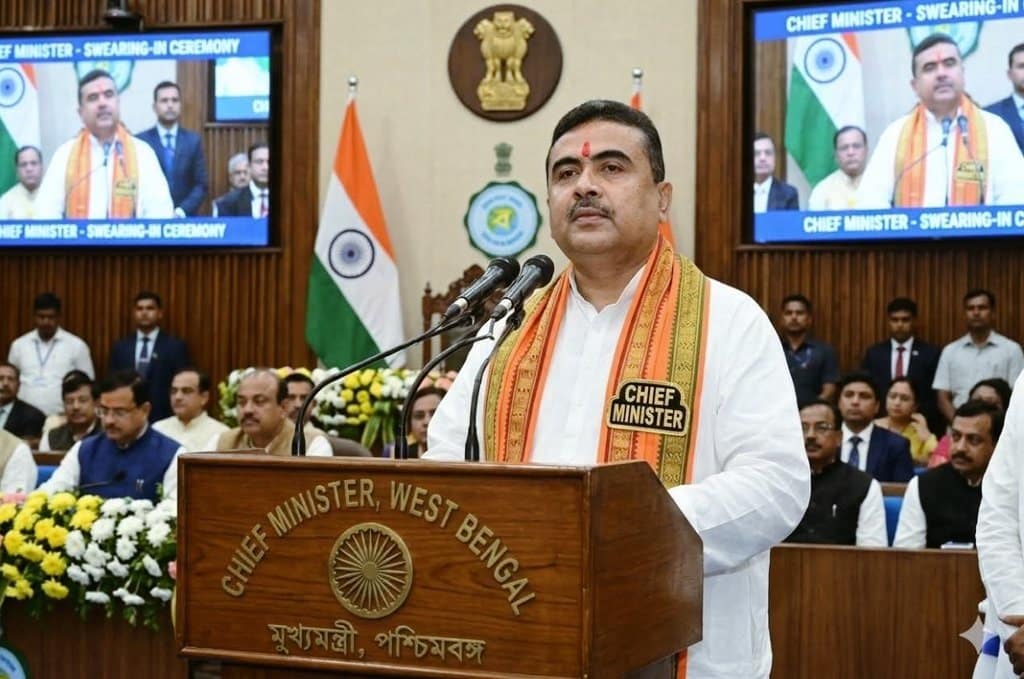
The Bharatiya Janata Party (BJP) has named Suvendu Adhikari as the next Chief Minister of West Bengal after securing a landmark victory in the 2026 Assembly elections, ending years of Trinamool Congress rule and opening a new political chapter in the state. The decision was announced after Mr Adhikari was elected leader of the BJP legislature party at a key meeting attended by senior party leadership. His elevation marks the first time the BJP will govern West Bengal, a state that has long remained one of India’s most politically distinctive regions.
The result is being viewed as one of the most significant electoral shifts in recent Indian politics. West Bengal, once dominated by the Left Front and later by Mamata Banerjee’s Trinamool Congress, has now delivered a decisive mandate to the BJP. With government formation under way and preparations for the swearing-in ceremony in progress, attention is rapidly shifting from campaign triumph to the challenges of governance, administration and political stability.
A Historic Political Shift in Bengal
West Bengal has often stood apart from national political trends. The state was ruled by the Left Front for more than three decades before Mamata Banerjee led the Trinamool Congress to power in 2011. Since then, Trinamool remained the dominant force, while the BJP steadily expanded its organisational presence and voter base.
That balance changed dramatically in the 2026 Assembly elections. The BJP’s victory is being described as a watershed moment, bringing the party to power in a state once considered difficult terrain for its national expansion.
Political observers attribute the result to a combination of anti-incumbency sentiment, aggressive booth-level organisation, a campaign centred on governance and employment, and the BJP’s ability to broaden its support across districts.
Union Home Minister Amit Shah described the mandate as “a victory for development, democracy and the people of Bengal who wanted change.” He later added, “The people of Bengal have written a new chapter.”
For the Trinamool Congress, the defeat marks its most serious setback since first coming to power fifteen years ago.
Why Suvendu Adhikari Was Chosen
Suvendu Adhikari emerged as the clear frontrunner for the chief minister’s post soon after the election result, owing to his political influence, campaign visibility and organisational strength.
A former senior Trinamool Congress leader and once a close associate of Mamata Banerjee, Mr Adhikari joined the BJP in 2020 in a move that significantly reshaped Bengal politics. His arrival gave the BJP an experienced regional face with deep roots in state politics.
His stature rose sharply after defeating Ms Banerjee in the high-profile Nandigram contest in 2021. In the 2026 campaign, he remained one of the BJP’s principal leaders, leading rallies across the state and attacking the outgoing government on corruption, governance and law-and-order issues.
Speaking after being elected legislature party leader, Mr Adhikari said “This victory belongs to the people of West Bengal. We will form a government committed to development, transparency and justice for every citizen.”
He also pledged to honour the party’s promises, saying “We will work towards fulfilling every commitment made to the people.”
Party leaders said his legislative experience, grassroots appeal and ability to unite cadres were key reasons behind the decision.
Immediate Challenges Facing the New Government
Despite the scale of the victory, the incoming administration faces immediate challenges.
The first is administrative transition. The BJP has never governed West Bengal before, meaning it must now move quickly from opposition politics to managing a complex state administration. Cabinet formation, departmental allocations and coordination with the bureaucracy will be among the first tests.
The second challenge is restoring political calm after a fiercely contested election. Reports of post-poll tensions in parts of the state have highlighted the need for a smooth and stable transfer of power.
Mr Adhikari said the new government would act firmly on law and order, stating “No citizen should live in fear because of political identity. The rule of law will prevail.”
Economic expectations will also be high. Employment generation, industrial investment, infrastructure and public services featured prominently during the campaign, and voters are likely to expect swift action.
In addition, political observers say social reconciliation will be important in a deeply polarised environment, where governance will require balancing momentum with stability.
National Significance of the Bengal Result
The BJP’s victory in Bengal carries importance far beyond the state.
For Prime Minister Narendra Modi’s party, winning West Bengal represents a major strategic breakthrough in eastern India and strengthens the BJP’s claim that it can challenge entrenched regional parties across the country.
Amit Shah said after the result that “This mandate will accelerate development and good governance in Bengal.”
For opposition parties, the result is likely to trigger renewed debate over leadership, alliance-building and electoral strategy. West Bengal had long been viewed as a key resistance centre against the BJP, making the outcome politically significant at the national level.
For Mamata Banerjee personally, the defeat is the most serious reversal of her political career after more than a decade as one of India’s most prominent opposition leaders.
Analysts believe the result may also encourage the BJP to intensify efforts in other states where regional parties remain dominant.
New Government Ahead
Mr Adhikari is expected to meet the Governor to formally stake claim to form the government, after which he is likely to be sworn in as Chief Minister. Preparations are reportedly under way for a major ceremony in Kolkata, with senior BJP leaders expected to attend.
Attention will then shift to the composition of the new cabinet, early policy signals and the tone set by the incoming administration during its first weeks in office.
Mr Adhikari has pledged a development-focused government, saying “Our priority will be jobs, investment, security and clean governance. We are accountable to the people who trusted us.”
The BJP has achieved what once seemed improbable — capturing power in West Bengal and installing its own chief minister. Whether that electoral breakthrough can now be converted into stable governance and long-term political consolidation will define Bengal’s next political chapter.


