

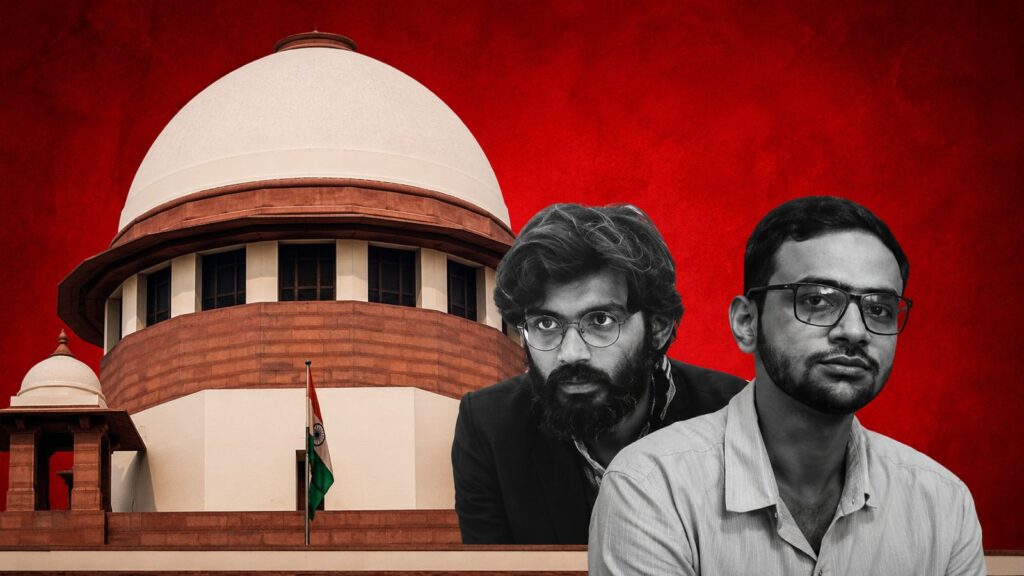
The Supreme Court’s rare and strongly worded criticism of its own earlier judgment denying bail to activist Umar Khalid and researcher Sharjeel Imam has reopened a major constitutional debate over the use of anti-terror laws, prolonged incarceration and the balance between national security and personal liberty in India.
The development has triggered intense political and legal reactions because the apex court did not merely revisit a procedural issue — it openly questioned the reasoning adopted by another coordinate bench of the Supreme Court in January 2026 while refusing bail to the two accused in the Delhi riots larger conspiracy case.
The latest observations came during proceedings in a separate UAPA-linked narco-terror matter, where the court strongly reaffirmed that constitutional protections cannot be diluted merely because stringent anti-terror legislation has been invoked. The bench underlined that delays in trial proceedings cannot justify endless incarceration and warned against interpretations of law that weaken Article 21 protections guaranteeing personal liberty.
The case has now evolved into far more than a routine bail dispute. Legal experts believe the Supreme Court’s remarks could significantly influence how courts across India interpret bail provisions under the Unlawful Activities (Prevention) Act in future cases involving prolonged detention without trial.
The controversy also quickly entered the political arena after BJP leader Nalin Kohli defended the legal process while accusing opposition voices of selectively politicising the issue. At the same time, civil liberties groups described the Supreme Court’s observations as one of the strongest recent reaffirmations of constitutional liberty in UAPA jurisprudence.
Supreme Court Observations
The controversy intensified after a Supreme Court bench comprising Justices B V Nagarathna and Ujjal Bhuyan expressed serious reservations about the January 2026 ruling that denied bail to Umar Khalid and Sharjeel Imam.
The bench was hearing the bail plea of a Jammu and Kashmir resident accused in a UAPA-linked narco-terror case when it revisited constitutional principles governing bail under anti-terror legislation. During the hearing, the judges referred extensively to the landmark 2021 judgment in Union of India vs KA Najeeb, which held that constitutional courts possess the authority to grant bail in UAPA cases where prolonged incarceration and extraordinary delays in trial violate Article 21 of the Constitution.
Justice Ujjal Bhuyan strongly stressed that constitutional protections cannot be weakened through procedural rigidity. The bench observed that smaller benches cannot dilute binding precedents laid down by larger benches through narrower interpretations of law.
In one of the hearing’s most significant remarks, the court reaffirmed the principle that “bail is the rule and jail is the exception.” The bench made it clear that this principle remains central to Indian criminal jurisprudence even in cases prosecuted under UAPA.
The judges also questioned conditions imposed in the January ruling which prevented Khalid and Imam from filing fresh bail pleas for one year or until the examination of protected witnesses. According to the bench, such restrictions raised constitutional concerns because they effectively limited judicial remedies despite continuing delays in trial proceedings.
Legal experts have interpreted the observations as a clear signal that the Supreme Court may now be reassessing how UAPA bail provisions are being applied across the country.
Delhi Riots Case
The Umar Khalid case has remained one of India’s most politically sensitive criminal investigations since his arrest in September 2020 in connection with the Delhi riots larger conspiracy case.
The communal violence that erupted in northeast Delhi in February 2020 during protests against the Citizenship Amendment Act left more than 50 people dead and hundreds injured. Delhi Police alleged that anti-CAA protests formed part of a broader conspiracy that eventually escalated into organised violence.
Investigators accused Khalid and Sharjeel Imam of participating in a wider network that allegedly coordinated protests, mobilisation efforts and speeches intended to provoke unrest. Prosecutors argued that the conspiracy extended beyond spontaneous street violence and involved planned attempts to destabilise public order.
Both Khalid and Imam have consistently denied wrongdoing and maintained that they are being prosecuted for political dissent rather than criminal activity.
The January 2026 Supreme Court ruling denied bail to both men while granting relief to five co-accused individuals. At the time, the court stated that allegations against Khalid and Imam placed them on a “qualitatively different footing” because investigators had linked them to the alleged larger conspiracy behind the riots.
That reasoning became controversial because critics argued that despite years of incarceration, the trial itself had progressed slowly and was unlikely to conclude in the near future. Civil liberties groups increasingly questioned whether prolonged detention under UAPA was becoming punitive before guilt had been established in court.
Over time, the case evolved into a wider symbol of the debate surrounding dissent, protest rights and the use of stringent anti-terror legislation in India.
BJP’s Response
The Supreme Court’s latest observations immediately triggered political reactions, particularly from the BJP, which has consistently defended the Delhi riots investigation as a matter involving serious national security concerns.
BJP leader Nalin Kohli strongly rejected attempts to portray the matter solely as a civil liberties issue and argued that public debate should not ignore the seriousness of allegations made against the accused.
“This is a legal process,” Kohli said while responding to questions regarding the Supreme Court’s remarks.
He noted that the court was examining whether legal procedures enacted by Parliament had been properly followed while deciding bail in cases involving anti-terror legislation.
“The Supreme Court observed that the three-judge bench had held that if there is a very long delay in the trial, bail should be granted,” Kohli stated.
However, he also accused opposition parties and activists of selectively politicising the issue.
“The bigger issue is how politics is being played over this matter. Those engaging in politics should also answer who these people are against whom allegations have been made, whether related to narco-terrorism, riots, violence, or links to terrorism,” he added.
The BJP has consistently argued that reducing the Delhi riots conspiracy investigation to a debate over free speech overlooks the gravity of accusations contained in police chargesheets. Party leaders maintain that UAPA exists because conventional criminal laws may not sufficiently address organised violence or terror-linked conspiracies.
Opposition leaders and rights activists, however, have repeatedly accused the government of increasingly using stringent laws against activists, students and protest organisers.
UAPA Debate
The Supreme Court’s observations have once again placed the constitutional debate surrounding the Unlawful Activities (Prevention) Act at the centre of national discussion.
Section 43D(5) of UAPA imposes severe restrictions on bail by preventing courts from granting relief if accusations appear “prima facie true.” Critics argue that the provision often results in prolonged incarceration because trials in conspiracy cases move extremely slowly and involve extensive evidence and witnesses.
As a result, accused individuals can spend years in prison before courts fully examine the merits of the prosecution’s case during trial proceedings.
The Supreme Court’s reaffirmation of the KA Najeeb precedent is therefore being viewed as highly significant. That judgment had already recognised that constitutional courts retain the authority to intervene where delays in trial become excessive and infringe upon fundamental rights guaranteed under Article 21.
Legal experts believe the latest observations indicate growing judicial concern that procedural delays should not effectively transform preventive detention into indefinite imprisonment.
Importantly, the court has not questioned the legitimacy of anti-terror investigations themselves. Instead, the focus remains on ensuring that constitutional safeguards continue to operate even in cases involving serious allegations concerning national security.
Several pending UAPA cases across India are now expected to rely heavily on the Supreme Court’s latest observations while seeking bail on grounds of delayed trial and prolonged incarceration.
Wider Implications
Although the Supreme Court has not yet overturned the earlier denial of bail to Umar Khalid and Sharjeel Imam, its unusually direct criticism of the January ruling has already altered the legal and political landscape surrounding UAPA jurisprudence in India.
Constitutional scholars believe the observations could influence how courts balance national security concerns with individual liberty in future anti-terror prosecutions.
For supporters of the government, the Delhi riots conspiracy investigation remains fundamentally about accountability for large-scale communal violence and allegations of organised unrest.
For critics, the case increasingly symbolises broader concerns regarding civil liberties, due process and the expanding use of preventive detention laws against dissenting voices.
The Supreme Court’s intervention has ensured that the debate now extends far beyond one individual bail plea. It has evolved into a larger constitutional confrontation over how India’s democracy interprets liberty, security and justice during politically sensitive criminal investigations.
As proceedings continue, the eventual outcome may shape not only the future of Umar Khalid and Sharjeel Imam, but also the broader direction of UAPA bail jurisprudence in India for years to come.


